shloboe boe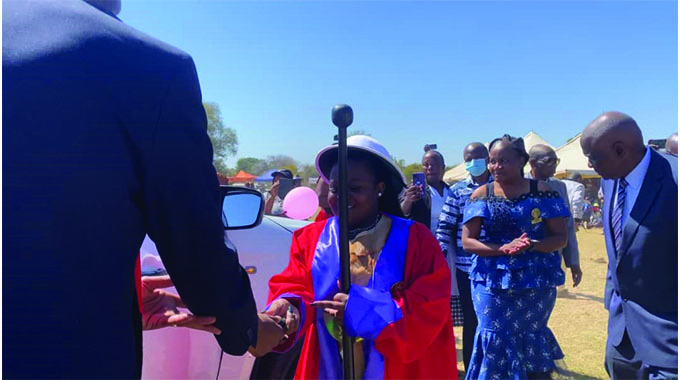
Fairness Moyana in Hwange
THE installation of 31-year-old Ms Silibaziso Mlotshwa as substantive Chief Mvuthu has been hailed as a landmark moment for women’s empowerment and gender equality in Zimbabwe, making her the first female substantive chief in Matabeleland North Province.
Her ascendancy last Friday ended an 11-year succession dispute that followed the death of her father in 2012, during which some relatives resisted her leadership on the grounds of gender.
Invoking Section 56 of the Constitution, which guarantees equality before the law, Ms Mlotshwa successfully challenged the opposition in court, paving the way for her coronation.
Speaking on the sidelines of her installation ceremony, Zimbabwe Gender Commission (ZGC) chairperson, Mrs Margaret Mukahanana-Sangarwe said the appointment was a defining moment for women in leadership.
“This is a milestone inspired by Section 56 of the Constitution. The President always says, ‘leave no one behind,’ and women should not be left behind in leadership. We are very happy about this inauguration because it fulfils the Constitution’s call for equality between men and women,” she said.
Mrs Mukahanana-Sangarwe said she was optimistic that the installation of Chief Mvuthu would inspire the elevation of more women in future.
“She is not only a role model for women but also the youth. There are still very few women in leadership positions, and this is an important example,” she said.
National Chiefs’ Council president, Chief Mtshane Khumalo, echoed the sentiments, describing the development as ground-breaking for the province.
“She is the first female substantive chief in Matabeleland North. This is in line with the Constitution’s spirit of gender equality,” he said.
Matabeleland North is also home to the country’s first female regent under the Mabhikwa chieftainship in Lupane District. Nationally, there are six other female chiefs, among them Chiefs Chimukidzo of Mudzi, Charehwa of Mutoko, Mabhena, Mathe, Sigola and Hikwa of Matabeleland South.
The recognition of Chief Mvuthu not only fulfils the Constitution but also aligns with Zimbabwe’s commitments under international frameworks such as the United Nations Sustainable Development Goal 5 (gender equality) and the African Union’s Agenda 2063, which call for the elimination of gender disparities in all spheres of life.
Traditionally, Zimbabwe’s chieftainships have been male-dominated institutions, with women largely excluded from succession lines despite playing significant roles in community leadership and dispute resolution.

Section 283 of the Constitution recognises the role of traditional leaders but requires that their appointment be consistent with constitutional principles, including gender equality.
Ms Mlotshwa’s installation not only settles a long-standing family wrangle but also sets a legal and cultural precedent for the recognition of women in traditional leadership structures across the country.
Bulawayo lawyer Mr Thulani Ndlovu of Ndlovu Legal Practice, who represented the new chief, said the case shows women are not powerless against unlawful administrative decisions.
“For too long, succession disputes have been influenced by politics and closed-door deals.
The High Court reminded us that chieftainship is a public office governed by the Constitution and law,” he said.
By confirming the lawful installation of Chief Silibaziso Mlotshwa, Mr Ndlovu said the ruling set a precedent, under the 2013 Constitution, for a woman to assume traditional leadership through a transparent process.
“This signals cultural continuity and progress, affirming that women and youth have a place in shaping the nation’s future.
“…The success of the mandamus application showed that accountability and fairness can be demanded in traditional leadership matters.
“For Hwange, the decision restored a lawful process and strengthened trust in justice. Nationally, it reassures communities that the law can shield their interests.”
Mr Ndlovu said the case also highlights the value of persistence and constitutionalism in litigation.
“Over ten years, more than seven applications were filed across all superior courts.
Ultimately, this was more than a succession dispute, it was about affirming constitutionalism, promoting gender equality, and ensuring traditional authority evolves with democratic principles,” he said.


 Online Reporter