admin
admin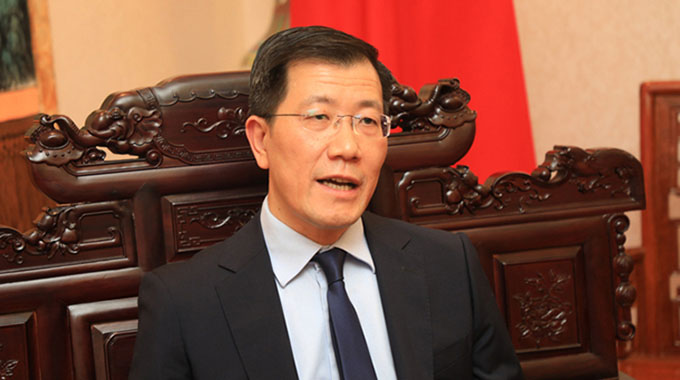
Fungi Kwaramba Political Editor
Zimbabwe’s all weather friend China has supported this country more than any other in the fight against Covid-19. Our Political Editor Fungi Kwaramba (FK) spoke with His Excellency Chinese Ambassador to Zimbabwe Guo Shaochun (GS) who shared his views about the two countries’ relationship. Below are excerpts of the interview.
********
FK: How much has China channeled to Zimbabwe in fighting Covid-19?
GS: China believes aid to Zimbabwe should be pragmatic and visible; it should not be a numbers game. China has been working hard to help reinforce Zimbabwe’s capacity to fight the pandemic. Based on an incomplete count, donations coming in from China have amounted to more than 1 million masks, 51 000 testing kits, and 140 000 pieces of other types of PPEs. In May, Zimbabwe became the first south African nation to receive a Chinese medical expert team.
In the two-week programme, the team checked on the preparedness of hospitals and communities, interacted with their Zimbabwean colleagues, and consolidated their observations and experience into a tailor-made strategy for Zimbabwe. There have been five on-line workshops for sharing of knowledge between Chinese and Zimbabwean health professionals.
The Chinese business community here has been donating food hampers and medical supplies to the needy; most importantly they spruced up the Wilkins Hospital before the pandemic took hold in the country.
In the past couple of months, at the opening ceremony of the 73rd World Health Assembly and the Extraordinary China-Africa Summit on Solidarity Against Covid-19, Chinese President Xi Jinping made a number of pledges to support Africa’s fight against the pandemic, such as pairing up Chinese and African hospitals. We have begun consultations with the Zimbabwean authorities to implement the initiatives. With infections rising fast these days, we are prepared to do more and stick with Zimbabwe for the eventual triumph.
FK: Covid-19 was first reported in China, how did you respond to the pandemic and any lessons for Zimbabwe?
GS: China is among the first countries hit by Covid-19 and the first country to report the novel coronavirus outbreak to the WHO. But this does NOT lead to the conclusion that the virus originated in Wuhan. China’s success in fighting the pandemic can be attributed to a number of factors. First, political commitment. President Xi himself underlined the overriding importance of protecting life in meetings he personally chaired to form and update the government’s response.
He also inspected on-site the work in hot spot cities, such as Wuhan and Beijing, to inspire confidence and courage.
Second, prompt and decisive actions. The central government was quick to put together an inter-ministerial taskforce headed by Premier Li Keqiang immediately after the outbreak. Similar taskforces were then created at various levels of government to coordinate the national response.
Free testing, quarantine, and treatment were soon provided. Mobile hospitals were built within days. Megacities were put under strict lockdowns.
Third, public awareness. Boosting awareness is a critical plank of the Chinese response. Making full use of traditional and new media, especially social apps, health authorities release a steady stream of information on the dangers and precautions to take.
Accepting quarantine, wearing masks, washing hands, and room ventilation are all effective means. Time is of the essence in case identification, reporting, quarantine, and treatment.
Fourth, society-wide mobilisation. Health professionals and medical supplies were flown to the hot spots from all parts of China. All residential communities carried out surveillance.
Countless community volunteers helped to take the temperature and deliver daily supplies to families under quarantine.
I commend the strong leadership of President ED Mnangagwa and the robust actions taken by the inter-ministerial task force. It is very heart-warming that Zimbabwean businesses, educational institutions, charity organisations, and generous individuals have also chipped in. I’m confident as long as we pull together, act decisively, and continuously raise our awareness, we will prevail.
FK: Who are the donors of donations that are coming from China to Zimbabwe, ?
GS: The donations are coming in from all over China, from Professor Peng Liyuan, wife of President Xi, from the Communist Party of China, from the central government, provincial governments, military, businesses, and individual citizens. The Chinese communities in Zimbabwe did quite a lot as well. In addition to the Wilkins Hospital project, they have provided food and medical supplies multiple times for the most vulnerable people.
This outpouring of support shows China and Zimbabwe are inextricably linked together; ours is a truly rock-solid friendship.
FK: Tell us about the relationship between the CCP and ZANU PF.
GS: China conducts diplomacy with other states; and the CCP, as the ruling party, conducts diplomacy with foreign political parties. In party diplomacy, we follow the principles of independence, equality, mutual respect, and non-interference in each other’s internal affairs. In this spirit, we carry out exchange and cooperation with all legal political parties and political organisations in the host country, for the purpose of promoting the unity and stability of the host country and encouraging all stakeholders to contribute towards a better life for the people.
The CCP and ZANU PF developed a deep friendship in the trying days of Zimbabwe’s liberation struggle. For more than half a century, mutual trust and support has been the hallmark of this relationship. It is a very important part of China-Zimbabwe relations. The two parties work closely with each other to tackle the challenges we face. We fight Covid-19 with one heart and one mind; we started a workshop in 2013 to exchange experience in governance.
We have also been engaging each other in a number of fora to explore ways to strengthen our respective parties and countries, including China-Africa Political Parties Theoretic Seminar and China-Africa Young Leaders Forum.
FK: There were some reports that China was repatriating its citizens from Zimbabwe because of an increase in the number of Covid-19 cases, can you shed light on that issue?
GS: The Chinese government is deeply committed to protecting its citizens. Last month over 200 Chinese nationals in Zimbabwe with various vulnerabilities took a charter flight home.
These are either students who must head back to continue their studies, individuals with serious underlying conditions, minors, old age persons, or pregnant women. We are grateful to the support of the Zimbabwean Government in repatriating the stranded Chinese nationals and stand ready to assist the return of Zimbabweans from China.
As we protect the weak among us, we are also glad to see that the overwhelming majority of Chinese nationals in Zimbabwe choose to stay, to fight side by side with their Zimbabwean brothers. To them, Zimbabwe is their second home.
China remains Zimbabwe’s biggest trading partner, how has Covid-19 impacted on the projects and when can we expect full resumption of operations in areas like Hwange.
As the Covid-19 pandemic upended the global economy, world trade fell sharply. According to the estimates by the World Trade Organisation, world trade volume will shrink by 18,5 percent year-on-year in the second quarter. This decline is historically large. Frankly speaking, trade between China and Zimbabwe is also expected to register a decline in the first half of 2020. However, we are making every effort to avoid the worst-case scenario. For example, China Tianze Tobacco Company is prepared to purchase over 60 million kg packed Zim tobacco leaf valued at $500 million this year. Because of their hard work, to date 80 percent of that goal has been achieved.
As for the Chinese-aided projects and government concessional loan projects, including the New Parliament Building project, Hwange Thermal Power Station expansion project, RG Mugabe International Airport project, the Pharmaceutical Warehouse project, 500 boreholes drilling project, etc., the Chinese contractors are also doing their best to mitigate the impact of the pandemic. More Chinese engineers and technicians will arrive in Zimbabwe to expedite the constructions in the next few months. Meanwhile, we will work closely with relevant Zimbabwean authorities and be very strict with the PRC tests and self-quarantine for these personnel to ensure the safety of Zimbabwean people.
FK: Tell us about the significance of these projects to Zimbabwe and its Vision 2030?
GS: The above mentioned projects are extremely important for economic and social development of Zimbabwe. Let’s take Hwange Thermal Power Station project as an example. Once completed, this project will add 600 megawatts to the national grid, expanding current generating capacity by 50 percent.
In Zimbabwe, getting electricity is the one of the biggest hurdles for attracting foreign investment and industrial development. By the World Bank ease of doing business index, Zimbabwe only ranks 167th out of 190 in this field.
Without adequate supply of energy, it is hardly possible to increase industry capacity utilisation and create an environment conducive to long-term and job-creating economic growth. So all these projects are like stepping stones to achieving the Vision 2030.
FK: We have read reports of conflicts between some Chinese and Zimbabwe, to what extent is this prevalent?
GS: There was a very unfortunate incident at a private Chinese company in Gweru in June. We firmly support Zimbabwe’s law enforcement agencies to transparently and openly investigate and handle the case in accordance with the laws of Zimbabwe.
Illegal actions and law-breaking individuals should not be shielded.
I would like to reiterate that this is an isolated incident. It does not capture the larger picture of our excellent partnerships. Neither does this individual represent the larger Chinese community in Zimbabwe. The majority of Chinese businesses abide by Zimbabwean laws and regulations, create much-needed jobs for this country, take good care of their local staff members, and give back to the local community with a loving heart.
They have long enjoyed amicable ties with Zimbabwean people. Many Chinese have been living in Zimbabwe for generations and see this beautiful country as their second home.
Just to cite one example. Some Chinese businessmen and women set up the Loving Mothers Group. Caring about Zimbabwean children like those of their own, they built a new orphanage in Hatcliffe and continuously support the school with funding and daily necessities. Their charity work greatly improved the living and studying conditions of the children and is widely welcomed by the local community.
Examples like this are many. The Chinese Embassy also consistently asks Chinese businesses and individuals in Zimbabwe to follow Zimbabwe’s laws and regulations, be sensitive to cultural differences, respect the local cultural norms and customs, and conduct themselves with honesty and integrity. Our calls are well-heeded.
I am confident the long-standing friendship between the Chinese community and wider Zimbabwean society will continue to grow and flourish.
TO BE CONTINUED


 Online Reporter