admin
admin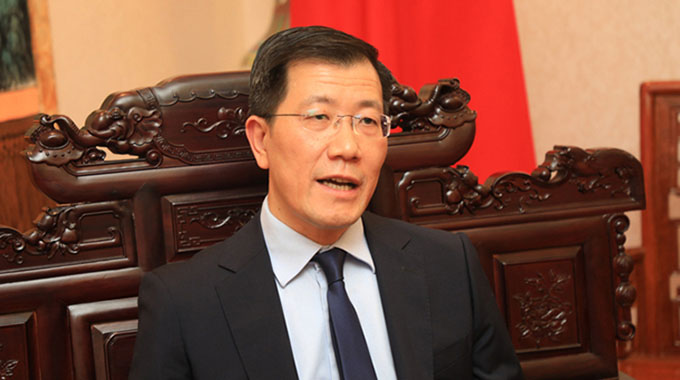
Presentation by China’s Ambassador to Zimbabwe, His Excellency Guo Shaochun during a Zimpapers editors’ workshop
It’s an honour to join you for this workshop. I’m sure the discussion today will be very rewarding.
Zimbabwe already has a remarkable degree of administrative decentralisation. There is strong political will from the very top, from the State leader; there is a legal and institutional framework governing devolution; our workshop today also shows there is strong public interest in devolution. I would like to commend the achievements made so far by the Zimbabwean Government in decentralisation for the well-being of its population across the country.
We also acknowledge that like other countries, Zimbabwe still faces some challenges in devolution, such as clarity on the roles and responsibilities of the three tiers of Government, adequate resourcing of the sub-national authorities, and efficiency in policy execution.
China has gone a long way in trying to address some similar challenges. I hope my remarks today will offer you some food for thought.
I am going to focus on three questions.
How did China delegate powers to the lower levels of governments? How did China manage the issue of funding? And how did China make sure devolution delivers its desired result?
First, the powers. Like the Zimbabwean Government, China took a gradualist approach in devolution, starting from the Special Economic Zones in Shenzhen, Zhuhai, Shantou and Xiamen, and expanded step by step to more coastal cities, new development areas, and then across the country.
The Special Economic Zones were given the powers to formulate their own development plans, give access to foreign investments, conduct industry and commerce registration and land allotment, and decide on fixed asset investment, foreign trade and foreign exchange, pricing, and resources allocation. To draw a clear boundary on the roles of responsibilities of different levels of governments, the government created four lists — the list of powers, of responsibilities, a negative list, and a list of service provision. This information is available to all in tables and forms to receive public scrutiny.
In recent years, with the development of technology, big data and cloud computing are also used to monitor government activities. The devolution process is not a one-way traffic, but an interaction between the central and other levels of governments. Provincial and local authorities may negotiate what powers are delegated, in light of their local conditions.
Meanwhile, the central government is careful about retaining some important powers. For example, when Guangdong Province became home to special economic zones, it gained the power to approve foreign investment projects. But if a proposed light industry project exceeds 30 million RMB, or a heavy industry project goes above 50 million, Guangdong Province would still need permission from the central government. This makes the central government the gatekeeper for major economic activities to avoid overheating and redundant capacity and ensure equitable growth across regions.
Second is funding. Understanding the critical importance for funding to follow functions, China delegated significant fiscal powers to the sub-national levels in the early stage of its reform. Before the early 1990s, the central government did not have its own tax collection agencies. Taxes were collected by local governments and then partly transferred to the central government by a set ratio. Over time, this arrangement began to produce problems. The central government did not have enough fiscal resources for macro control.
In 1994, China established a tax-assignment system. Taxes were divided into three distinct categories: central, local, and shared. Central taxes would go into the central coffer, and local taxes into local budgets. As for the shared taxes, they were divided between the central and provincial governments, according to some established formulas. For instance, 75 percent of VAT revenue belonged to the central government and the remaining 25 percent to the provincial ones. Since then, the revenue-sharing arrangement has been undergoing constant improvements.
Today the central and provincial governments share income tax by a ratio of 60:40 and VAT by 50:50. Environmental tax belongs completely to local governments to encourage on-the-ground actions. A more sophisticate fiscal transfer system has also been put in place. Last year, the central government transferred 67.9 percent of its disposable revenue to local governments, and 36.5 percent of local government spending was funded by the central fiscal transfer. In total government revenue, the central government accounted for 46.9 percent.
Third question, how does central government make sure the local governments deliver on value? The Communist Party of China and the central government have well-established systems for evaluating the performance of officials at different levels. In addition to integrity, leadership skills, and diligence, it also looks at indicators for economic and social development. These indicators are constantly updated to align with the overall national development strategy.
In the early days of reform, GDP growth, fiscal revenue, and foreign investment were among the most important. Today, with China focused on promoting quality growth, officials are also evaluated in terms of how they fight poverty and pollution, how effective they are in mitigating financial risks, how they improve social services, support innovation and the rule of law, and how they promote peace and social justice, to name a few.
This system ensures that the powers delegated to lower levels are truly used to implement the policy direction given by the central government. It also encourages competition at the local level.
In short, devolution in China is not a simple distribution of power and interests, but a more scientific and balanced allocation of power and responsibility, so that national strategic decisions can be more effectively implemented at all levels of government. In the meantime, successful local practice can help improve decision-making at the national level, or even directly develop into national policies.
The fundamental purpose of delegation of power is to better serve the development of the country and the well-being of the people.
I would also like to take this opportunity to brief you on a new development pattern proposed in China a few months ago. The country is now working to establish a dual circulation for the economy. Under this approach, the domestic market will be the mainstay and the internal and external markets will boost each other.
It is essentially a re-balancing from an export- and investment-driven economy toward more focus on domestic demand. Here, the sub-national governments have a lot that they can do. Many have introduced policies to encourage new models of consumption, improve the quantity and quality of consumer goods and services supply, build the necessary infrastructure, create a favourable environment, and help businesses address challenges.
On all three questions I addressed above, public scrutiny is important. It can bring about greater government responsiveness and accountability. After all, the ultimate goal of all government policies is to make life better for the ordinary people. In this sense, the robust media agencies in Zimbabwe, especially Zimpapers has a big role to play. With your unparalleled reach in the country, you can give a voice to the voiceless, to build dialogue between citizens and the State.
In the meantime, you also have the important job to guide the public by giving them true information. Today, some social media is full of fake news, unfounded allegations, and conspiracy theories. For example, the unfounded allegations about Chinese government taking Zimbabwean resources have been circulating in some circles. This is unfair to Chinese government, which is committed to supporting the development of Zimbabwe.
Our consistent position is that the Chinese government is not interested in taking resources from Zimbabwe. In fact, if anyone takes a serious look at all official agreements between the two counties, he will find none of them is about mining. In the mining of precious metals, such as gold, diamond and platinum, he will not find a single state-owned enterprise from China. Another fact is that the Chinese government is not part of the business dealings of private Chinese companies in Zimbabwe, and the Embassy is not in a position to oversee their business operation.
On many occasions, we have suggested that the Zimbabwean government set up a compliance monitoring mechanism in all mining companies working in the country, to oversee whether the enterprises operate legally, whether they comply with Zimbabwe’s environmental protection and labour policies, and whether they trade mineral products in legal channels.
With such a mechanism, all the mining enterprises are required to share with the public information about its investment cost, output and profit sharing arrangements. We hope that such real information can be reported more effectively, so that the possible problems can be solved in a more accurate way.
I am confident you will continue to report the public concerns with excellence and integrity. I have no doubt Zimbabwe will make more progress in devolution and national development in its own way.
Thank you.



 Online Reporter