admin
admin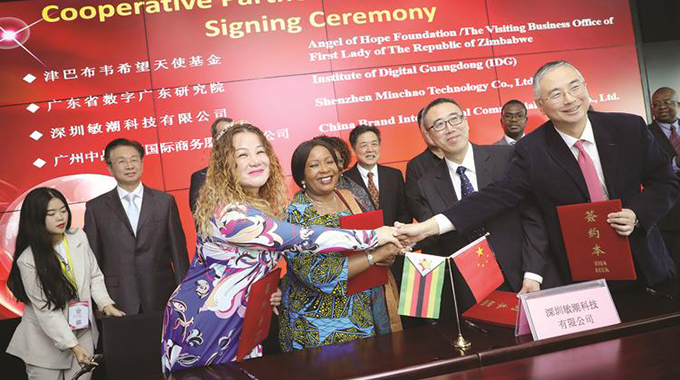
Tendai Rupapa in GUANGZHOU, China
The Zimbabwe delegation here, yesterday came face-to-face with state-of-the-art technology that could speed the pace of development and foster growth in an economy.
Courtesy of First Lady Auxillia Mnangagwa, through her organisation Angel of Hope Foundation that extended an invitation to various Government ministries and businesspeople who are part of the delegation, Zimbabwe is poised to reap immense benefits from the trip.
The trip is the first of its kind in Zimbabwe, where the First Lady has led a high-powered delegation to seek ways of reviving the economy.
Amai Mnangagwa has a passion to see the country thrive, hence her involvement in national prayers and moves to roll out empowerment programmes for women and other vulnerable groups.
Only two weeks ago, she was in Ghana with a delegation of women active in the tourism sector, to sharpen their marketing skills and expose them to competitors from across the world.
Yesterday, the delegation toured the Institute of Digital Guangdong where it met officials from the institution which works in collaboration with Huawei Technologies and Minchao Technologies Group.
All the three firms were well represented.
The delegation also toured the exhibition hall of Guangzhou Economic and Technological Development and were taken through the operations of the state-of-the-art equipment.
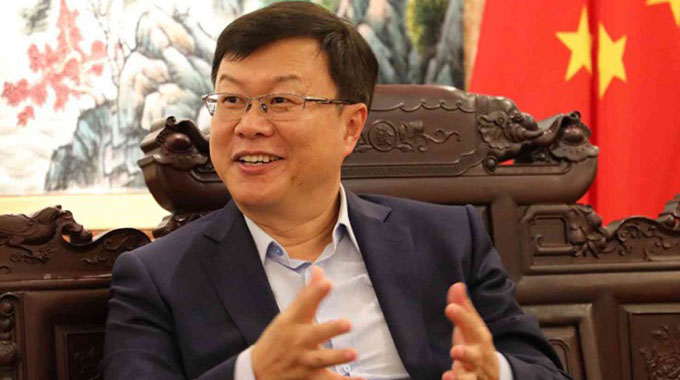
In an interview on the sidelines of the meeting, Dr Raymond Sun, the vice president/researcher at Peking University in the Chinese capital of Beijing under the Institute of Digital Guangdong, paid tribute to Amai Mnangagwa’s industriousness.
“Zimbabwe and China we are very close good friends, hence we really want to do something for the Zimbabwean people.
“We are humbled by the First Lady of Zimbabwe’s visit and we have been following her works which she is conducting through her charity foundation, Angel of Hope, and we must say she has the vulnerable members of the society at heart, especially women and children.”
He expressed the institute’s willingness to share knowledge with Zimbabwe’s various sectors in areas that include logistics management, satellite application and geo-information systems.
Dr Sun was touched by the First Lady’s concern about the education of poor children in Zimbabwe, and expressed eagerness to do something to complement her works and vision.
“Talking about smart education, we want to promote remote areas in Zimbabwe and issue high-end education, quality education.
“In the cities, they have good schools and good teachers, something that is hard to find in remote areas.
“In remote areas, the children do not have such resources, therefore, we need to partner Angel of Hope Foundation and help these children.
“Looking at smart medical care system, we can use this system to assist Zimbabwe in the health sector, particularly in remote areas and small towns so that they enjoy good health resources like those in big towns. It is all about Internet connectivity in the remote areas and sharing resources.
“We want to offer one-stop smart city solutions,” he said.
Mrs Madeline Magwenzi, the Midlands provincial head in the Ministry of Lands, Agriculture, Water and Rural Resettlement, described the tour as an eye-opener.
She said Zimbabwe could partner the Chinese on smart irrigation and smart water management.
“In our country, irrigation is the in-thing because due to climate change, seasons have shifted, there is less water and many community irrigation schemes are dry.
“We have a lot of irrigation schemes in the country, hence we can make use of smart irrigation and smart energy.
“When there are solar-powered boreholes and solar-powered energy sources, it means they are more sustainable.
“If we can partner with China, we will benefit immensely. Most of the schemes use electricity to draw water or a canal system which is not efficient; but solar-powered boreholes would be efficient,” she said.
Mrs Magwenzi said Zimbabwe had commodity groups with value chains, but there were no accurate statistics to inform policymakers on performance, hence the need for a geographical information system for location, accuracy and specificity.
“This would greatly improve the efficiency in the Ministry of Lands, Agriculture, Water and Rural Resettlement. Big Data would also be handy in the ministry for records, policy informing, decision-making and performance scaling up as a country.
“The Emergency Response Unit in Agriculture (Ministry) is vital for early warning across the country and calamities for food security, especially in agriculture. Land resources were prudent in their presentation and of importance to the country because we are issuing land according to land use management.”
She said she felt humbled by Amai Mnangagwa’s vision to end food insecurity in Zimbabwe.
“As a ministry, we have been eye-opened here in China and this was made possible by the First Lady who made us part of her entourage to China.
“We are grateful and I promise to go back home and make a difference for the betterment of our ministry and country at large,” said Mrs Magwenzi.
Zimbabwe Tourism Authority executive director (special projects) Mr Reason Machigere echoed similar sentiments.
“Institute of Digital Guangdong works in collaboration with the Peking University and digital companies like Huawei Technologies and Shenzhen Minchao Technology.
“What we have learnt is that they have the capacity to develop and impart innovations which will be helpful to us as a country if we are to embrace them.
“Digital economy will in turn help in the transformation of livelihoods of people across different sectors. From a tourism perspective, we are in the process of developing an integrated tourism management information system which has various modules, including development of virtual tours. We want that to be in the digital world.
“Through innovation and also harnessing online technology, we should be able to put the country on the digital platform so that we are known fully in different parts of markets. With increased digital presence, there will be increased digital awareness and we will see more tourists coming to Zimbabwe.”
From a wildlife management point of view, Mr Machigere said: “They have technology on remote sensing and geographical information systems which will enable us to track the animals or even track the poachers. If we are to embrace these technologies, it would enable us to manage our wildlife for tourism purposes. We appreciate that they have the capacity to train us on e-tourism and as a ministry we are looking forward to working with them.”
Family health director in the Ministry of Health and Child Care Dr Bernard Madzima said: “They were talking about improving efficiencies through use of technology. For example, back home in the health sector, we use paper-based clinic cards, but if we have electronic health records, one just needs something like a bank card.
“If that person gets sick while not in their home area, they will just go to any nearby clinic and present that electronic-controlled card and all their previous medical history comes out.
“We need to have our records in electronic format and that makes it efficient.
“They also gave an example of a rural-based doctor confronted with a complication, instead of referring the patient to a major hospital, he or she will quickly send a video to a specialist seeking guidance and together they will go through the process via the video. They can easily go through the stages together, thereby reducing referrals, saving lives and time.
“This technology issue as presented by our Chinese friends is very critical. The technology can also be used in medical schools. For example, a specialist guest lecturer can conduct lectures in various universities at the same time using digital devices, just at the click of a button. This is smart health care or tele-medicine, something that the ministry has always wanted to do, but failing due to lack of resources.
“We are happy that they are willing to train our people and provide resources.”
After the meeting, Amai Mnangagwa, representing her organisation and the Institute of Digital Guangdong, signed a letter of intent to partner.
The First Lady said Zimbabwe was going through its transition period and what she and her delegation had learnt here would be used in rebuilding the country.
“This kind of technology is something we really want as a country. The training programmes would be of great benefit to our country because China is advanced technologically. We are going to take what we learnt and saw here seriously.
“When I go back, I will inform the President all about my trip and how you all want to assist in certain sectors so that he engages the relevant people in the ministries for the transformation and betterment of our country,” she said.
Amai Mnangagwa added that technology augured well with Zimbabwe’s universities and she would be grateful if the students could be introduced to such technology.
“Also because Zimbabwe is agro-based, the smart irrigation as highlighted here will be of great importance to the Ministry of Lands, Agriculture, Water and Rural Resettlement in alleviating poverty in the country.”
Huawei was represented by chief digital transformation officer Mr Edwin Diender, while Minchao Technologies Group CEO Mr Frank Shi represented his firm.
Amai Mnangagwa is in China at the invitation of the ChinaBrand Group of Companies owned by Mrs Juliana Yutao-Jiang.
After following her philanthropic works and empowerment programmes, the Chinese company decided to engage her.
The Zimbabwe delegation is holding meetings with Chinese potential investors.


 Online Reporter