Online Reporter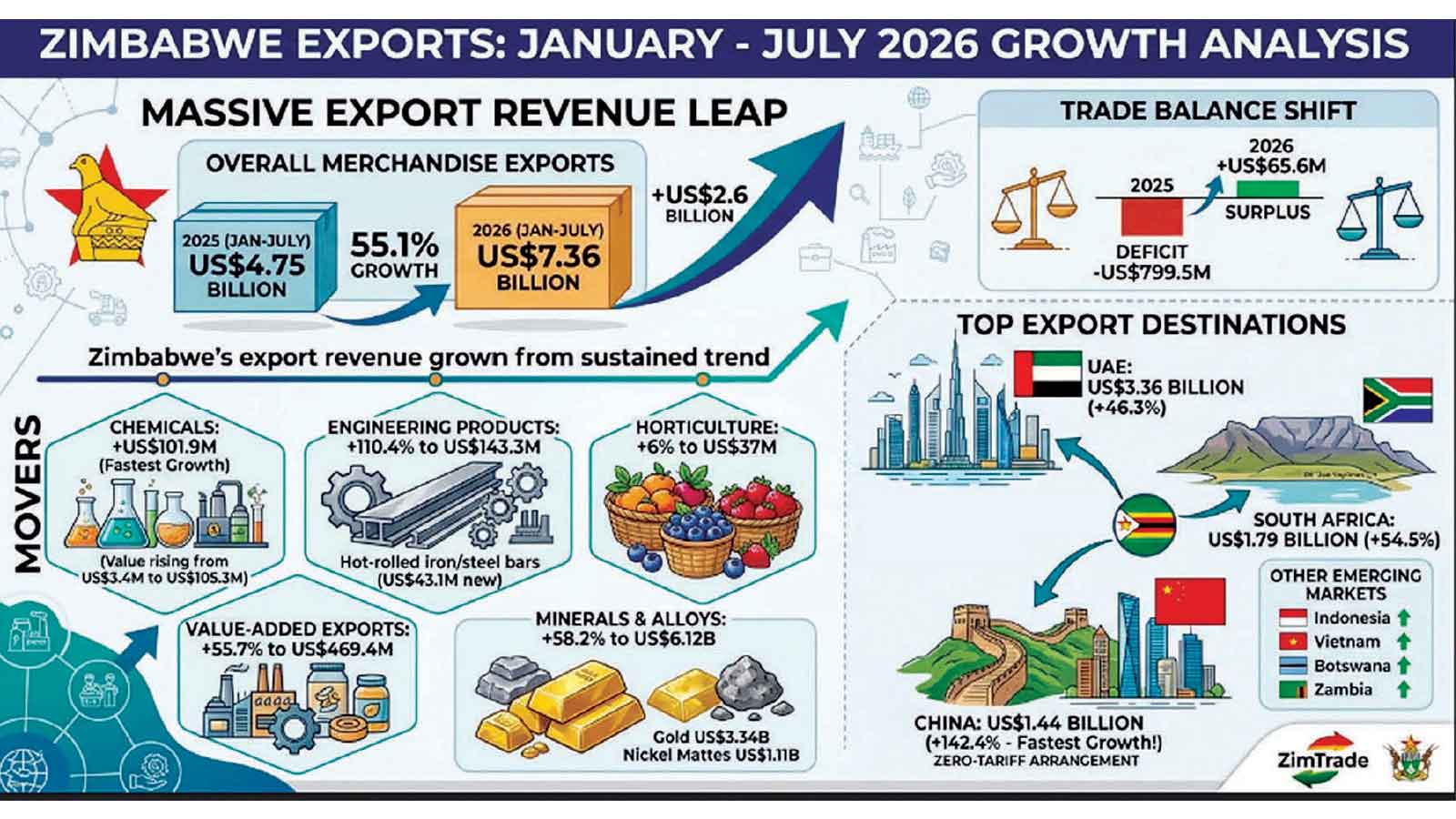
Trade Focus
Allan Majuru
Zimbabwe’s export revenues recorded a major leap during the first seven months of 2026, with merchandise exports rising by 55,1 percent to US$7,36 billion from US$4,75 billion during the same period in 2025.
THE increase of more than US$2,6 billion is significant, particularly because export growth outpaced the 31,6 percent rise in imports.
This shifted the trade position from a deficit of US$799,5 million between January and July 2025 to a surplus of US$65,6 million during the period under review.
The result places the country on a stronger footing for the last months of the year.
This growth is consistent with the policy direction championed by President Mnangagwa, particularly the emphasis on engagement and re-engagement, economic diplomacy, industrialisation, value addition and the expansion of Zimbabwe’s presence in international markets.
The Second Republic has placed export growth within the broader national development agenda, where stronger productive capacity and improved commercial relations are expected to support economic transformation.
The figures show progress.
Of particular importance is the performance of value-added exports, which increased by 55,7 percent to US$469,4 million from US$301,5 million.
Sustained export growth must now come from products that retain more value in the domestic economy through processing and manufacturing.
Import growth also provides useful context.
Machinery, parts and equipment imports rose by 46 percent to US$1,24 billion, while chemicals, fertilisers and agricultural inputs increased by 61,9 percent to US$912,9 million.
Electrical, information and communications technology (ICT) and renewable-energy equipment imports increased by 71,5 percent to US$505,1 million.
A significant part of import growth is, therefore, associated with machinery, mining inputs, energy and productive equipment, which can support future production and export capacity.
Movers
Chemicals recorded the fastest percentage growth, rising to US$105,3 million from only US$3,4 million.
Sulphates and alums accounted for US$99,6 million of the total, compared with US$500 000 in the previous year.
The increase is substantial, although concentration in one product makes shipment continuity important.
Engineering products continued to stand out among the fastest-growing value-added categories.
Exports more than doubled, increasing by 110,4 percent to US$143,3 million.
Hot-rolled iron and steel bars generated US$43,1 million where there were no comparable exports in the previous year, forged bars rose by 339,1 percent to US$43,6 million, while semi-finished iron and steel products increased by 11.8 percent to US$33,2 million.
The figures point to continued scaling in domestic steel production and an expanding ability to supply industrial products to regional and international markets.
Horticulture exports returned to growth during the period under review, increasing by 6 percent to US$37 million from US$34,9 million.
The improvement was driven mainly by high-value fresh fruit, with the category that includes blueberries nearly doubling to US$8,5 million.
The rebound is encouraging given the sector’s potential to generate higher returns from premium fresh-produce markets and to support wider participation by farmers and rural communities.
Cotton exports increased by 14,6 percent to US$4,3 million during the January-July 2026 period.
Although the sector accounted for only 0,1 percent of total exports, the improvement points to some recovery in external demand.
The current export value remains below the sector’s earlier potential, which leaves scope for stronger production, improved productivity and greater value addition across the cotton-to-clothing value chain.
Pharmaceutical exports also recorded positive growth, increasing by 34,3 percent to US$4 million from just over US$3 million during the same period last year. The sector remains a relatively small contributor to total exports, but the increase is notable because pharmaceuticals represent a higher-value manufacturing line with potential to support diversification of Zimbabwe’s export basket.
Continued improvements in production capacity, quality assurance and market access will help the sector build on the gains recorded during the period under review.
Minerals and alloys remained the dominant export sector, increasing by 58,2 percent to US$6,12 billion from US$3,87 billion.
Gold rose by 46,7 percent to US$3,34 billion, nickel mattes increased by 60,6 percent to US$1,11 billion, while other mineral substances more than tripled to US$681,8 million.
The sector made the largest contribution to export growth.
At the same time, the concentration of earnings in a narrow range of mineral products places strong emphasis on the importance of maintaining momentum in value-added sectors.
Tobacco also remained a major source of export earnings.
Unmanufactured tobacco increased by 37,2 percent to US$712,4 million. Manufactured tobacco rose by 25,3 percent to US$86,8 million, with other manufactured tobacco products increasing by 55,6 percent to US$58 million.
Growth in the higher-value line is important because it demonstrates the additional earnings that can be generated when primary agricultural commodities are processed further before reaching international markets.
Shakers
The performance was not uniform across all sectors.
Hides, leather and leather products fell by 52,5 percent to US$9 million, largely because of weaker raw hide exports, although further-prepared leather almost doubled from a low base.
Agricultural inputs and implements declined by 26,7 percent, packaging and stationery fell by 20,2 percent, while household electricals and furniture, livestock products and arts and crafts also recorded declines.
The United Arab Emirates remained Zimbabwe’s largest export destination, with exports increasing by 46,3 percent to US$3,36 billion, accounting for 45,7 percent of the national total.
South Africa remained second, recording growth of 54,5 percent to US$1,79 billion.
China posted the fastest growth among the three leading markets, with exports rising by 142,4 percent to US$1,44 billion. Its share increased from 12,5 percent to 19,6 percent, with the trade outlook linking the increase to the newly introduced zero-tariff arrangement and stronger trade.
The China performance is significant within the wider engagement and re-engagement agenda.
Other markets also recorded encouraging growth.
Indonesia increased by 83,6 percent to US$71,4 million, Vietnam nearly doubled to US$31,8 million, Botswana rose by 56,6 percent to US$35,5 million and Zambia increased by 28 percent to US$103,3 million.
These gains show some widening of demand beyond the three leading destinations.
Allan Majuru is the ZimTrade chief executive officer.