Online Reporter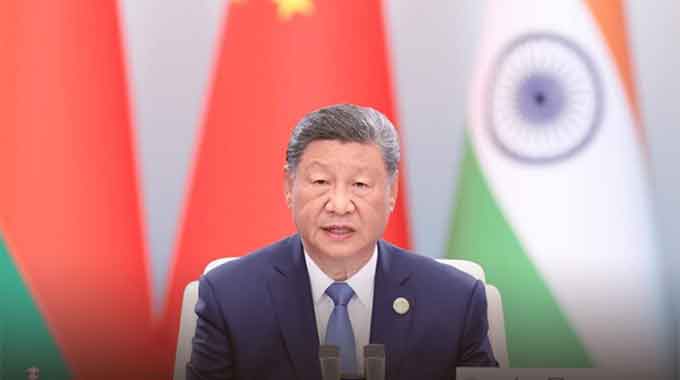
Lawrence Freeman
IT should be more than obvious by now that “the rules-based international order” created by the West has failed.
Its demise, which has been accelerating in recent years, sounded its death knell at the recent Davos conference.
This year, 2026, will continue to be turbulent and fraught with the peril of more wars. As the death agony of the international order, which has been controlling relations between nations through its military and economic might, unfolds, civilization is given the opportunity to create a new system founded on the principles of economic development.
“The rules-based order” was established under the control of the political-financial elites of the West that dominated the rest of the world for decades. It may appear to some that it was the actions of US President Donald Trump, that caused its demise. However, that would be inaccurate. President Trump may have accelerated the final stage of the collapse of the rules-based order, but it was always doomed to fail because of its underlying diseased ideology.
Rules-based order was doomed
The fatal flaw of “the rules-based order” is its axiomatic belief that people and nations are merely manipulated players in a zero-sum game of victims and victors. Contrary to this false belief, our universe is governed by the human species, uniquely endowed with creativity. We were not created to be ruled by the mighty and the powerful, but by the power of reason. We are human beings, not animals to be culled and controlled. We are not fixed in our behaviour, nor is the universe in which we exist. The physical world is not a zero-sum game board of winners and losers, but a developing and expanding universe that is continuously transformed through human creative intervention.
With the inevitable demise of “the rules-based order,” what will come next? This is not an academic question to be leisurely pondered. No, this is a call to arms for all of us to act in creating a new “international order” which corresponds to our unique human quality of creativity.
Unlike the oligarchical formation of “the rules-based order” after World War II, when a large number of nations were still under colonial rule, the new international system must represent the interests of the Global South, the majority of the world’s population.
China’s contribution
Chinese President Xi Jinping unveiled the Global Governance Initiative (GGI) in his address to the Shanghai Cooperation Organisation on September 1 2025. He called for a more just and equitable global governance system, echoing the efforts by the developing nations in the 1970s to establish a “New International Economic Order.”
Significantly, President Xi introduced a new concept not previously explicitly discussed by world leaders: that the goal of this new governance should be to advance toward a community with a shared future for humanity. This is true because all human beings are universally alike in our most fundamental inborn quality: creative mentation.
This concept represents a fundamental leap in the understanding that all nations have a common self-interest that should guide domestic and foreign policy. As a physical economist, I understand that policy should mean improving the physical standard of living and nurturing the creativity of the population of every nation.
President Xi also said that China is committed to the well-being of all humanity, rejects dividing the world into opposing blocs, and essentially discards outdated notions such as Western centrism.
China’s commitment
China’s Global Development Initiative (GDI) states unequivocally in the opening sentence of its concept paper: Development is the eternal pursuit of human society. The GDI also emphasises the eradication of poverty, sustainable development of agriculture and food security, and most importantly, improving industrial production capacity and manufacturing. Economic development is a core pillar of China’s concept of global governance.
There is no clearer demonstration of China’s commitment to the development of all nations than the success of the Belt and Road Initiative (BRI), introduced by President Xi in the fall of 2013.
In 2025, the BRI achieved new records of economic activity totalling US$213,5billion, according to a report by the Green Finance and Development Centre at Fudan University.
It had US$128.4 billion in construction contracts, an increase of 81 percent over 2024, and recorded US$85,2 billion in investments, an increase of 62 percent. Oil and gas engagements reached US$71,5 billion.
Africa was the top region of economic activity for BRI engagement at US$ 61, 2 billion dollars, an increase of some 283 percent, with Nigeria at US$ 24, 6 billion dollars in construction contracts. Since its inception in 2013, the BRI has had cumulative economic activity of 1, 399 trillion US dollars in 150 countries around the world, according to the report.
It is indisputable that China, through advancing fundamental principles of economic development, has alleviated the suffering of millions of people in the Global South, where BRI trading partners are concentrated.
All Western nations combined have not achieved this level of success in such a short period of time.
Many accept the outlook that we live in a world governed by strength, force and power, according to Stephen Miller, President Trump’s special advisor. That is categorically false. Homo sapiens developed over thousands of years by creative reason, not by force, or survival of the fittest.
Humanity desperately needs, nay, demands a new paradigm for global governance, which prioritizes economic development, free from wars, regime change and dictates. Let the GGI provide the framework for such an enlightened discussion. – RT.com
Lawrence Freeman is a US political-economic analyst for Africa, who has been involved in economic development policies for Africa for 35 years.