Chronicle Editor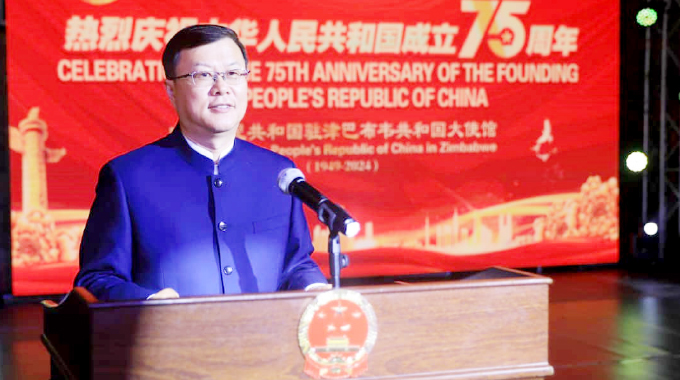
Farai Chinyani, Correspondent
Chinese people have achieved historic feats on the path to Chinese modernisation, transforming China from an impoverished and war-torn country into a thriving one.
These were the words of Chinese Ambassador to Zimbabwe, Mr Zhou Ding last week as he reflected on his country’s 75th anniversary of Independence — the Chinese National Day — celebrated on October 1 each year.
China’s independence journey from imperialism and colonialism is well storied, not just for its highlights of supreme sacrifices and heroism in defeating powerful enemies, which became a template for other countries in the Global South, including Zimbabwe; but also for its laying of a solid foundation for China’s modernisation.
This liberation-to-modernisation model is something that many countries in the world are now actively following, with China as a willing partner and friend. For many countries, including those that executed a liberation fight, there is a distinct privilege that, looking up to China which beat a successful path, they can now only emulate the successes and avoid pitfalls that China found itself encountering on the way.
For, in the past 75 years of Chinese independence, the Asian giant faced numerous challenges in early years, which are acknowledged, but overcame them through a painstaking process of learning and continuous reform, particularly in the past 50 or so years.
Following the Chinese example does not, today, imply encountering immense difficulties that the country had to go through: China itself is willing to share its lessons with the world, particularly developing countries. With key lessons from the past, China is now focused on charting a further path in the form of modernisation, itself a unique proposition because China’s home-grown model is different from that of former colonial powers who thrived on plunder of other nations to achieve development.
Without the “advantages” of imperialism and mighty destructive force, China which is now the world’s second largest economy, had to look inside, and its resources and ingenuity to achieve what even former colonial and imperial powers cannot achieve today. China has stated that it has no imperial ambitions, and that it will never deploy military or economic might to subdue other countries; rather, it will use its leadership to establish “a global community with a shared future for mankind”.
The results? China has lifted nearly 100 million people out of poverty, with remarkable social policies that have seen it set up the world’s largest educational system, social security system and medical care system. In education, for example, China has the largest state-run education in the world with nearly 300 million students, 19 million teachers and over 500 000 schools. It has nine years of compulsory, basic education and churns over 10 million college graduates. Some statistics say China enjoys literacy rate of over 96 percent, a remarkable achievement from days before 1949, when illiteracy ranked 80 percent of the population. Today, China spends US$890 billion in education, per reports in July, making it the world’s largest spender in education.
Economically, as of this year, China is the largest trading country in goods, and dubbed the world’s largest factory because of its massive production of the majority of goods that the world requires and thus stands as “a stabiliser and source of strength” in the global economy.
Apart from producing goods that serve the traditional market, China is pursuing innovation-driven growth in new areas such as new energy vehicle production and sales that now account for over 60 percent of the world, 70 percent of the world’s photovoltaic (solar) equipment and 60 percent of wind power equipment.
In light of new challenges such as climate change, China’s leadership is now seen in global green transition and sustainable development. China is making the steepest cuts in the world to carbon emissions, making tremendous contributions to global climate change response. Gone are the days when China was decried for its emissions which polluted its skies, land and sea because of burning of fossil fuels and industrial activity. It is now a global leader in cutting emissions, greening the environment and keeping the water and oceans clean. Under President Xi Jinping, China’s environmentally-conscious drive is pursued under the philosophy of “clear skies, lush mountains and lucid waters”, which is not just a slogan but a practical sustainable development direction, which currently has no parallels, even in the developed world, which is why the discourse of blaming China for pollution has suddenly fallen down, with China on course for meeting carbon reduction targets faster than any other country.
President Xi has said air quality is crucial to the people’s sense of happiness. Even more crucially, he has stated, and proved, that man can exist side by side with nature, something that is evident to any visitor to China as massive infrastructures, including in towns, are serenaded by trees; itself a symbolism of life. The idea to plant more trees dates back to former leader Deng Xiaoping who encouraged the practice of afforestation. Today, the novel idea of “Beautiful China” is a reality, and represents a solid achievement.
In another remarkable feat, China now ranks first in terms of e-commerce and mobile payment transactions in the world. According to the newly released Global Innovation Index (GII), China ranks the first among upper middle-income economy, and remains the only middle-income economy in the GII top 30. With its economic rise and social successes, China has sought to impart lessons and collaborations with other countries mostly in the Global South — including Zimbabwe — so as to upscale their conditions; hence China has become a partner in extending aid and co-operation in the fields of economic development and trade; education, health and culture through various initiatives at bilateral and multilateral levels.
China today enjoys peace and tranquillity at home; and has taken the task further to the international arena. Ambassador Zhou noted that China has “always” acted as the defender, builder and contributor of the international order. He explained: “China unswervingly defends the UN-centred international system, and the basic norms of international relations underpinned by the purposes and principles of the UN Charter.
“Over the past decade, Chinese President Xi Jinping has put forward the Belt and Road Initiative, the Global Development Initiative, the Global Security Initiative, and the Global Civilisation Initiative respectively, which contribute Chinese solution to improving global governance, responding to global challenges.
“China supports true multilateralism that is based on international law, in accordance with the principle of equity and justice, in pursuit of win-win co-operation. China advocates an equal and orderly multi-polar world and a universally-beneficial and inclusive economic globalisation.”
This has even more resonance with African countries and recently the two sides met for the 2024 Forum on China-Africa Co-operation (Focac) Summit, which had remarkable outcomes in a number of areas that will see the widening of co-operation in the next few years across various co-operation facets.
‘Trustworthy partner’
What does this mean for Zimbabwe?
China was the first country to establish diplomatic relations with Zimbabwe when the southern African country attained independence from Britain in 1980. This, following China’s decisive military, moral and technical assistance during the brutal 16-year war of liberation.
Following that, the two sides have co-operated in a number of areas economically, socially and politically; and this has been dubbed “all-weather friendship”, which both sides continuously praise because of mutual benefits and amity between the two sides.
Each year, a number of successes are recorded in diverse fields. China is Zimbabwe’s largest source of investment and a top trading partner. China is helping Zimbabwe build infrastructure in areas such as transport, energy and telecommunications; and has also helped in social sectors such as health and food security. The Asian country is assisting Zimbabwe in rural development and poverty reduction, and has committed its agricultural experts in modernising agriculture, and equip locals with agricultural skills. Further, China has ongoing human resources capacity development programmes that empower Zimbabwean youth, women, and vulnerable groups, as well as experts and Government officials through training programmes conducted in China
Ambassador Zhou declared that, “China will always be a trustworthy partner on Zimbabwe’s path to modernization and Vision 2030.”
But there is more. All of the above cooperation areas can be expanded exponentially so that Zimbabwe and China can enjoy an even more fruitful co-operation that can positively impact people’s lives and benefit the people of the two sides as well as deepen friendship.
This could be seen as the original mission of China’s global liberation agenda.
Most of Global South countries are now independent politically, but still struggle economically and socially. This is where China, once again, comes in.
China’s modernisation model provides insights on how developing countries like Zimbabwe can achieve success. It also provides a framework for co-operation with, and assistance from, China.
For the sake of clarity and completeness — and in all fairness — China is not perfect itself but also a student on a continuous journey of learning, continuous improvement and self-evaluation.
In an article titled, “China’s Path to a Brighter Future”, one Yi Xin asserted that a hallmark of China’s development approach is its long-term vision, government’s strategic planning, setting and achieving long term objectives. Yi explained that Chinese culture places great importance on fulfilling promises and completing tasks.
Further, stated Yi, China is proactive and transformative in addressing internal issues which has seen, for example, the country transitioning from a growth model focused on speed and scale to one that emphasises high quality development; signifying a deeper commitment to sustainability and balance.
In terms of the reform process, Yi notes that, it is “one of continuous exploration” and China is committed to self-improvement, innovation and high quality development. Other attributes of China’s modernisation include commitment to fighting corruption and ensuring that power is exercised on behalf of the people.
More critically for outside stakeholders, China has realised that it cannot go it alone.
“China envisions international relations based on mutual benefit,” Yi says. “The concept of a community with a shared future for mankind encapsulates this philosophy.”
*The writer is a scholar on China-Africa affairs, and associate researcher at Ruzivo Media and Resource Centre, a local think tank.


 Online Reporter