Online Reporter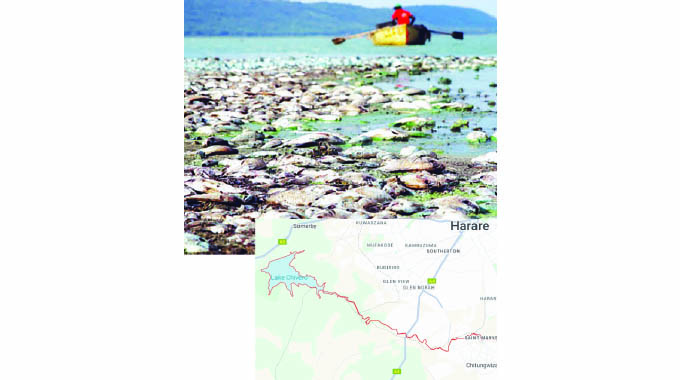
Fidelis Munyoro
Chief Court Reporter
THE High Court has ruled that the City of Harare and the Zimbabwe National Water Authority are out of the Lake Chivero pollution case, as opponents, after finding their notices of opposition invalid, and ordered the matter to proceed as unopposed.
Handing down judgment last week, Justice Priscilla Munangati-Manongwa upheld preliminary objections raised by Kuimba Shiri (Private) Limited and the Trustees, Zimbabwe Wildlife Africa Trust, and struck out the opposition papers filed by the City of Harare and ZINWA.
The judge ordered costs against the respondents.
“All the points in limine are hereby upheld,” the judge said. “The first (City of Harare) and third (Zinwa) respondents’ notice of oppositions are invalid. The matter shall thereafter proceed as unopposed.”
The application, filed on June 19, 2025, seeks a declaratory order that the City of Harare’s discharge of effluent and pollutants into the Manyame catchment area and Lake Chivero contravenes the Ramsar Convention, the Constitution, and environmental and water statutes.
It also seeks orders compelling the Environmental Management Agency, ZINWA, and the Zimbabwe Parks and Wildlife Management Authority to investigate damage, publish quarterly progress reports, and produce a mitigation and rehabilitation programme for Lake Chivero.
Kuimba Shiri also claims compensatory damages of US$86 240 for loss of profits in the 2024–2025 financial year.
Kuimba Shiri, through its director, told the court it operates a bird park and ecotourism resort on the shores of Lake Chivero, established in 1994, with income from a restaurant, bar, accommodation, camping, boat-based wildlife tours, and white rhino viewing.
It placed financial statements before the court showing a net profit of US$107 297 for the year ended December 31, 2024, then a net loss of US$21 057 for the first two months of 2025, which it attributed to pollution and the lake’s closure.
The trust filed papers aligning itself with Kuimba Shiri’s case.
In its founding papers, Kuimba Shiri alleged EMA had accused the City of Harare of discharging more than 250 million litres of untreated sewage into Lake Chivero daily and said EMA issued seven environmental protection orders between 2021 and 2025.
It also relied on what it said was an admission by the Acting Town Clerk before a Commission of Inquiry in February 2025 that the city was “contributing quite significantly to the basin through sewage”, and cited the city’s Wastewater Masterplan for figures that more than 60 percent of a 5 000 km sewer network had exceeded its design lifespan, treatment plants were operating at about 30 percent efficiency, and about 120 megalitres per day of untreated effluent was bypassing treatment.
Kuimba Shiri further alleged a cyanobacterial bloom in December 2024 contaminated the lake and led to wildlife deaths, including four rhinos, as well as zebras, wildebeests, fish eagles, and more than 1 000 fish, and said the Zimbabwe Parks and Wildlife Management Authority confirmed the incident and closed the lake to the public, which it said drove the loss of income.
Before the court could reach those claims, it dealt with objections to the validity of the opposition filed by the City of Harare and ZINWA.
On the City of Harare, the applicants argued that the council resolution authorising litigation was defective and not authenticated under the Urban Councils Act.
Justice Munangati-Manongwa agreed, citing section 317 and stating the attached resolution had no signatures by the mayor, chairman, councillors, or town clerk, and showed no authentication or attestation required by law.
“It should be noted, therefore, that the resolution that the first respondent attached contains no signatures of the mayor, councillors, chairman or town clerk, and there is no evidence of authentication or attestation in the manner the statute mandates,” the judge said.
“The document prima facie fails to satisfy the statutory requisites and cannot be said to properly confer authority on the deponent attesting to it.”
The judge also found a date problem with the city’s paperwork, pointing to the gap between the resolution date, 27 February 2025, and the Registrar’s authorisation of proceedings on 19 June 2025.
“Moreover, the chronological inconsistency between the resolution’s ostensible date, February 27, 2025, and the Registrar’s authorisation of the present proceedings on June 19, 2025 further exposes the document as unreliable and unacceptable as proof of authority,” the judge said. “It should be noted that a board resolution cannot empower future resolutions.”
The City’s argument that the council could assign authority to the town clerk under section 136(2) did not cure the defect, the judge held, because the city still had to show a lawful delegation supported by a properly executed instrument.
The court cited Supreme Court authority on the need to produce proof of authorisation when challenged.
On ZINWA, the applicants attacked a certified copy of a board resolution said to be the basis for its opposition, arguing it was not specific to the litigation and was passed years earlier by board members whose tenure had lapsed.
ZINWA argued it was a standing authorisation and pointed to a government taskforce report on the lake.
The court rejected ZINWA’s reliance on a 25 March 2021 resolution for litigation filed in 2025. Justice Munangati-Manongwa said a resolution must authorise the specific litigation and cannot be framed as a blanket authorisation for future disputes, citing a recent High Court decision.
“It should be noted that there is so much material chronological inconsistency in the board resolution presented by the third respondent,” the judge said.
The court found the 2021 resolution could not stand in 2025, and held that the board’s dissolution and re-appointment meant authority given before dissolution could not simply carry over.
With both notices of opposition struck out, the case now moves forward without opposition from the City of Harare and ZINWA, leaving EMA and the Zimbabwe Parks and Wildlife Management Authority as parties in a matter centred on Lake Chivero pollution, enforcement steps, reporting duties, and the claim for US$ 86 240 in damages.