Nothando Zondo [email protected]
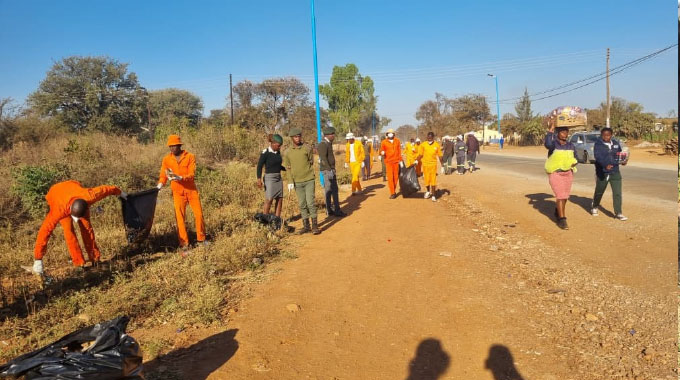
FILABUSI residents joined Government officials, community leaders and environmental stakeholders last Friday in a clean-up campaign aimed at tackling litter and promoting a cleaner, healthier environment.
The campaign, held at Filabusi Centre under the national Zero Waste Movement, saw participants cleaning streets, pavements and public spaces while spreading messages about proper waste disposal and environmental responsibility.
The initiative was organised through the Office of the President and Cabinet in partnership with the Environmental Management Agency (EMA), as part of ongoing efforts to encourage communities across the country to take greater responsibility for their surroundings.
Leading the campaign was Mrs Sibusisiwe Nguluvhe, wife of the Matabeleland South Minister of State for Provincial Affairs and Devolution, Albert Nguluvhe. She commended residents for turning out in large numbers and urged them to make cleanliness part of their daily lives rather than something that only happens during organised campaigns.
“I urge the community members to come in numbers for such programmes so as to maintain cleanliness in our communities,” said Mrs Nguluvhe.
Throughout the morning, participants moved through different parts of the business centre collecting litter and clearing areas that had accumulated rubbish. The clean-up transformed several public spaces and served as a visible reminder of what communities can achieve when people work together.
For many residents, the exercise was about more than simply picking up litter. It was also an opportunity to promote a culture of cleanliness and encourage people to take pride in their community.
Mrs Nguluvhe said maintaining a clean environment begins with individual responsibility. She urged residents to stop littering and adopt better waste management practices that protect public health and improve the appearance of communities.
She noted that business owners also have an important role to play in keeping the town clean.
According to Mrs Nguluvhe, one of the simplest ways businesses can help is by making bins available for customers to dispose of waste properly.
“I appeal to shop owners to keep dustbins on their verandahs so that people will throw litter in them after buying and using their items. This will minimise litter in our business centre,” she said.
Her call comes at a time when littering remains a challenge in many business centres, where food wrappers, plastic bottles and other forms of waste often end up on streets and open spaces.
Residents who participated in the campaign agreed that proper waste disposal facilities could go a long way in reducing litter and making the town more attractive. Environmental officials who took part in the campaign emphasised that a clean environment benefits everyone. They noted that poor waste management can contribute to health challenges, environmental pollution and an overall decline in the quality of life.
Clean surroundings, they said, help create healthier communities while also making business centres more appealing to both visitors and investors.
The campaign also highlighted the importance of community participation in environmental conservation. Organisers stressed that Government and environmental agencies alone cannot keep communities clean without the support and involvement of residents.
For that reason, the Zero Waste Movement is encouraging citizens to take ownership of public spaces and adopt responsible waste management practices in their homes, workplaces and communities.
Mrs Nguluvhe used the occasion to announce plans for another environmental awareness programme in Insiza District, which will specifically target women from various church denominations.
She said women play a critical role in shaping behaviour within families and communities and can be powerful advocates for environmental protection.
“I will return next time for the Zero Waste Movement and I wish to meet women from different churches. I will advise on the date and, before my coming, I want you to go to every church during their worshipping day and invite them to the programme that I will be initiating,” she said.
The planned programme is expected to bring together women from across the district to discuss practical ways of promoting cleanliness, responsible waste disposal and environmental conservation.
Mrs Nguluvhe said churches have a unique ability to mobilise communities and spread positive messages, making them important partners in environmental programmes.
The clean-up campaign was well received by residents, who said they were encouraged by the turnout and the level of cooperation shown during the exercise.
Many expressed hope that similar programmes would continue throughout the year and be extended to other communities within the district.
Others said regular clean-up campaigns help remind people that keeping the environment clean is everyone’s responsibility and not the duty of local authorities alone.
The Filabusi campaign forms part of the broader Zero Waste Movement, a national initiative that promotes reducing, reusing and recycling waste to create cleaner and more sustainable communities.
The programme seeks to encourage behavioural change by promoting responsible waste disposal habits and raising awareness about environmental protection.
For Filabusi residents, the clean-up served as both a practical exercise and a call to action.
While the rubbish collected during the campaign was removed in a single day, organisers said the bigger challenge is changing attitudes and ensuring that people continue to dispose of waste responsibly long after the event has ended.
Mrs Nguluvhe said the success of the campaign should mark the beginning of a longer-term commitment to cleanliness across the district.
She urged residents, businesses, churches and community leaders to work together to keep their surroundings clean and ensure that the spirit shown during the campaign spreads beyond Filabusi to other parts of Matabeleland South.
The message from the day was simple: a clean environment starts with individual action.
Whether it is placing litter in a bin, providing waste disposal facilities at a business, or taking part in community clean-up activities, every effort counts. By working together, residents can help build cleaner, healthier and more attractive communities for future generations