admin
admin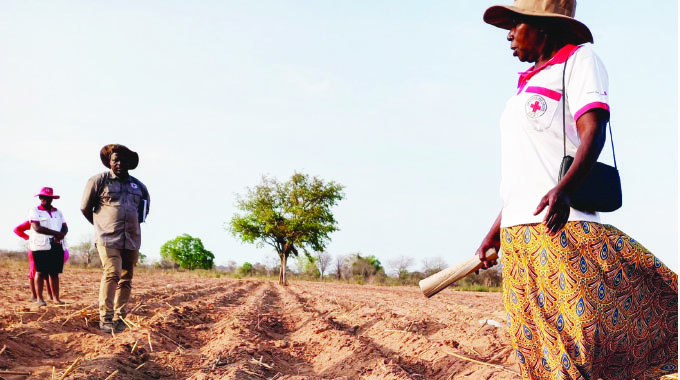
Phyllis Kachere
Deputy News Editor (Convergence)
As vulnerable communities come face to face with the daily horrors of climate change in Binga, Matabeleland North, a noticeable impact on their livelihoods has been the declining harvests recorded over the years.
One such community is Siansundu area under Chief Saba, where Gogo Rebecca Munkombwe (80) and Gogo Sophia Mudhimba (78) told this reporter how their once-wildlife filled and heavily Mopane-wooded land has turned dry, with declining harvests being recorded over the years.
“This is a naturally dry area, falling under Region 5 with minimum rainfall during the summer season. In the olden days, with the little rains, we were guaranteed of sufficient harvests that would almost last us to the next harvest. But now, it’s no longer the same. We grow mostly traditional grains like pearl millet,” said Gogo Munkombwe.
Most boreholes in the area have dried up. The nearby Mlibizi Dam, where the villagers say they used to water their livestock, has dried up, leaving them stranded.
“The few remaining boreholes are under so much pressure that water runs out and one has to wait for hours before the next drops start trickling out,” said Gogo Mudhimba.
To mitigate the poor harvests experienced in Binga, Government, through its auxiliary, the Zimbabwe Red Cross Society (ZRCS) with the support of the Finish Red Cross (FRC) and Danish Red Cross (DRC) has been implementing a climate smart resilience project in Binga from last year and is expected to end in 2025.
“The project’s goal is to contribute to enhanced individual, family, community and institutional resilience through strengthened capacities to cope, resist, endure risks and sustainably meet basic needs.
“The project has four key outcomes which include; strengthened capacities of targeted communities, and institutions to effectively prepare for, withstand, respond to and recover from climate change induced disasters and crises,” said the ZRCS secretary general Mr Elias Hwenga said.
He said Binga communities are particularly vulnerable to the devastating impacts of climate change and therefore, need assistance in adapting their livelihoods as a strategy of building resilience to the impact of climate change. Focus would also be on expanding and connecting community early warning systems.
“Binga is mostly affected by droughts and climate change has worsened the situation with an anticipated 30 percent increase in droughts by 2030. These droughts have already accounted for the declining harvests.”
As part of the climate resilience strategy, the ZRCS with the support of the Finnish Red Cross and the Danish Red Cross has trained farmers in Binga on seed production to allow communities to set their own seed banks for drought-tolerant seeds and not rely on seed aid.
Over 4 000 households have received drought-tolerant seeds (5kg pearl millet and 2.5kg cowpeas). These should assist farmers to produce enough food during this anticipated El Nino season.
The pilot seed production project has 30 farmers drawn from the two wards of Siansundu and Saba.
The 30 farmers will work on a 0.4ha plot each guided by seed production principles such as observation of isolation distance to avoid cross pollination from similar varieties.
For easy management and ensuring that all farmers understand the principles, the 15 farmers from each ward were divided into two groups. The group members with assistance from the local extension officer, identified one lead farmer to host a farmer field school. The lead farmer provided a field that is used for learning purposes. All lessons that need practical sessions, will be carried out at the field.
Four farmer field school plots have been established across that two wards.
These were established at equidistance to all the farmers who are involved in seed production.
In Saba Ward, Ms Ever Mugande, of Mupambe Village said she was happy to volunteer a plot to help train her and fellow villagers in seed production.
“I am a widow and I have to feed my four children. The recurrent droughts have resulted in my harvests declining. So, this is an opportunity for me to learn how to improve my harvest and ensure food security for my family. I am hoping that our group will produce surplus seed of the short season pearl millet and cow peas, widely used in this area, which we hope to sell.
“You realise it is a long distance from here to Binga town where we get our provisions and supplies. If we produce enough seed, we will cut costs for local farmers as they will buy from us instead of travelling the distance to Binga town,” said Ms Mugande.
Mrs Vivian Saba of Saba Village said she was excited about the seed production project as it will bring great benefit to her family.
“I have young children that I need to feed. Producing seed for this area will definitely be the pinnacle of my livelihood as a small scale farmer,” said Mrs Saba.
The Siansundu farmer field schools are hosted by Mr Millias Munkuli at Sianjomwa Village.
Mr Bester Mudenda who is hosting another farmer field school plot at Siameja Village said since they are a pilot group, they wished to excel and provide a good reference point for the success of Binga small holder farmers.
In the spirit of inclusivity and taking a cue from President Mnangagwa’s ‘Leaving no one and no place behind’ mantra, the ZRCS also incorporated a visually-impaired small holder Mr Mowa Mkhuli (56) among the 4 000 households that have received drought-tolerant seeds.
“I am visually impaired and over the years, I have mostly been overlooked when distribution of donations is conducted despite that I have a wife and five children and two grandchildren. I am glad I have benefited from the Red Cross donation of drought-tolerant 5kg of pearl millet and 2,5kg of cow peas seeds. We hope to get a better harvest from this,” said Mr Mkhuli.



 Online Reporter