admin
admin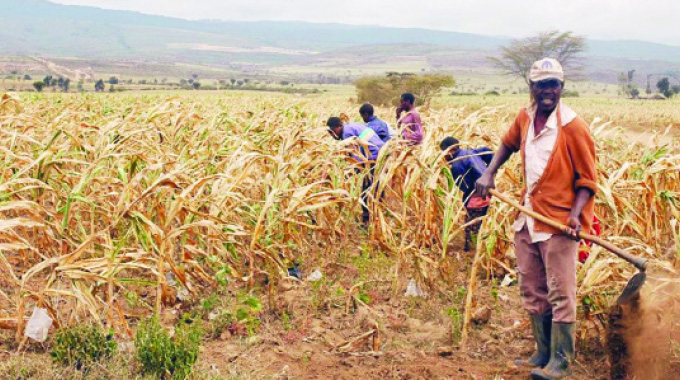
Sam Matema–Herald Correspondent
Climate change has a bearing on the attainment of Sustainable Development Goals (SDGs) and there is no debate about that given the cross-cutting nature and impact of the same.
Sustainable Development Goal 2 (SDG2) aims to achieve “zero hunger”.
It is one of the 17 Sustainable Development Goals established by the United Nations in 2015 with an express target to “End hunger, achieve food security and improved nutrition and food safety.
“While the crisis is immense, the possibility of ending hunger and nutrition-related crises once and for all remains within reach,” says Mary Njeri, global hunger response director for World Vision.
It is within reach on account of global response as well as response at a local and national scale based on clear policy direction and policy position that directs interventions.
Climate variabilities have both a primary and secondary impact on the entire food system and dimensions that is production, availability, accessibility, and affordability.
The Second Republic has responded well and continues to adapt and adopt new ways of dealing with the climate change shocks to climate-proof its people from the negative impacts of the phenomenon.
This is guided by the mantra, “leaving no one and no place behind.”
From the construction of large dams to the drilling of boreholes under the Presidential Borehole Drilling Scheme, solarised community nutritional gardens are being rolled out at a rate never witnessed before to support irrigation at a local scale, and nutrition at the household level.
The government is committed to combating climate change as evidenced by the pronouncement by the Speaker of the House of Assembly, Jacob Mudenda, at COP28 in the United Arab Emirates, that “Climate change must not conquer humanity. Humanity must conquer climate change decisively”.
The Climate Bill will soon be before the House of Assembly for debate so that it is couched in a manner that will put Zimbabwe on a profitable footing concerning achieving zero hunger and ending poverty as captured in SDGs 1 and 2, as well as the net zero target in terms of our carbon footprint.
Climate change impact on food
Climate change affects the food system in a four-pronged manner, the four dimensions of the food system — production, availability, accessibility and affordability.
Concerning production, drought reduces output whereas climate shocks like floods and veld fires destroy both the crops and related infrastructure.
All the aforementioned do have a direct and indirect bearing on food availability in terms of quantity and quality, and to a larger extent the accessibility in cases where infrastructure is destroyed.
Affordability speaks to the economics of climate change as it relates to the supply and the aggregate demand of the available product(s).
This relates to the stability of the food system in terms of production, supply, and prices.
Scarcity in the face of constant demand, ceteris paribus, pushes prices upwards. Drought occasioning food shortages is inflationary. There is excess demand chasing after too little grain on the market, and that, naturally, pushes prices through the roof beyond the reach of many.
Climate change has a bearing on the incomes of farmers on the back of poor yields and this will affect health expenditures with a bearing on nutrition and well-being especially concerning vulnerable groups, the women, children, the girl child, the elderly, and people living with disabilities (PWDs).
Government response to end hunger
A person is considered to be hungry when they fail to access the minimum calories per day in terms of their food intake.
Ending hunger is hinged on the security of supply that revolves around sustainable food production, amount, and accessibility in terms of both quantity and quality.
We need to respond and adapt to and mitigate climate-induced challenges in a manner that we can sustain over time. Adaptation deals with the impacts/effects of climate change in a planned or anticipatory manner. Mitigation also deals with the causes, and can either be primary or secondary. Primary mitigation deals with direct causes whereas secondary mitigation deals with indirect causes of climate change and the attendant impact(s).
To achieve zero hunger, there is a need for serious planning to alleviate the impact of the climate shocks. Planned adaptation is important and strategic as it food-secures the population in the current situation and circumstances, and facilitates planning for future potential disruptions occasioned by climate change.
This provides a fall-back position permitting some kind of soft-landing to our farmers, anchored on research and development.
Government response to achieve
food security
Food security is defined as when all people, at all times, have physical and economic access to sufficient safe and nutritious food that meets their dietary needs and food preferences for an active and healthy life (World Food Summit, 1996).
It is the responsibility of every government to ensure food security for its people, and the Second Republic has been deliberate to ensure physical availability and accessibility concerning both quantity and quality of food which addresses the supply side of the food security equation.
We cannot rely on the outside world to feed us because if those food sources are disrupted significantly by natural or man-made events, the impact is huge and uncontrollable.
The impact of the Russia-Ukraine conflict on the global food market is a good example of the level of exposure to those who do not look inward for solutions. We need to voluntarily ramp up local production with urgency.
To manage the supply side, the Government is working on increasing production by putting in place the necessary infrastructure such as major water bodies.
The Gwayi-Shangani Dam will be a game-changer and a key enabler in Matabeleland North on completion. From Chivhu Dam, Muchekeranwa, Marovanyati, and Kunzvi, the groundwork is being laid to support commercial agriculture.
The Pfumvudza/Intwasa is a Government programme introduced to climate-proof farmers, and the results have been rewarding.
In its deliberate policy to bring water to the people, through the Presidential Borehole Scheme that is targeting 35 000 boreholes across villages, that target is slowly but surely becoming a reality. Within that target, there are solarised nutritional community gardens that are to be set up per ward across all districts.
An additional 12 000 hectares will also be put under irrigation across the country.
The prayer is for farmers and direct and immediate beneficiaries to seriously seize the opportunity and begin to sweat the resources given to them at no cost by the Second Republic for their good under the servant direction of President Mnangagwa.
The Second Republic is setting up irrigation schemes across the country to accelerate the contribution of small-scale farmers to national food security.
The Nzvimbe irrigation scheme in Ward 31, Makoni South in Manicaland, is a clear testament the Government’s intentions. 585 families in Nzvimbe stand to benefit from 585 hectares being put under irrigation supported by centre pivots.
This model is being replicated elsewhere in the country, and the impact will be significant in ending hunger and poverty through food availability and improving local incomes and livelihoods.
We should however do the needful in terms of managing the natural environment from where we get our forest services.
Government response to improved nutrition and food safety
Food safety, nutrition, and food security are closely linked, and unsafe food creates a vicious cycle of disease and malnutrition, particularly affecting the vulnerable groups in our society.
The Second Republic has been deliberate and aims to build and enhance the capacity to prevent, detect, and respond to public health threats occasioned and associated with unsafe food at both local and country levels.
The issue of Genetically Modified Organisms (GMOs) in our food systems needs serious interrogation and strictness in terms of adhering to food safety standards set within the provisions and prescriptions of the law.
Farmers are encouraged to organically grow indigenous crops and vegetables that adapt well to their environment and have been proved to be highly nutritious. Let us go organic and stay and operate in that space for the greater good.
Traditional grains (sorghum, pearl millet, finger millet should be promoted for their health and medicinal benefits vis-a-vis processed foods.
In regions 4 and 5 across Zimbabwe, there is a need to revisit our old way of life, and promote the production of traditional grains as they are nutritious, and are both tolerant and resilient to harsh weather conditions.
Sustainable future
Sustainable development according to the Brundtland Report, is the development that meets the needs of the present without compromising the ability of future generations to meet their own needs (Todd Reubold, 2014).
As responsible stewards, we should strive to interface and interact with the environment in a way that will not upset it so that it continues to give us more and better in terms of both farm produce and forest service. Research and development should help us with the correctness and adequacy of response as both the internal and external environments evolve at micro and macro levels respectively.
The future looks bright for Zimbabwe on the back of a solid thrust anchored on Education 5.0 that celebrates research and development as well as the domestication of solutions to the challenges of the day and the future relating to food security or lack thereof.
The innovation hubs housed at our institutions of higher learning are a good investment that will help the Second Republic to glance into the future and offer solutions that are domesticated across the entire value chain in the quest to arrest the cascading impacts of climate change on food security.
We are on the right trajectory, the vectors are correct so is the speed, and on that basis and account, food security success will admit us. Inevitable!
l Cde Sam Matema is the MP for Buhera Central constituency and ZANU PF Manicaland spokesperson and writes here in his capacity.


 Online Reporter