Chronicle Editor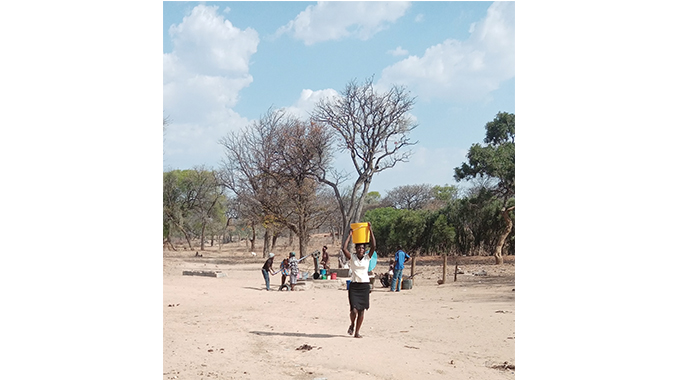
Fairness Moyana
LINDIE Ndlovu (15) shrugs in despair as she adjusts her three-month-old baby strapped on her back while balancing a 20-litre bucket of water on her head as she prepares to walk back home.
She woke up before the break of dawn to make the 5km walk to the nearest borehole in Nekabandama Ward, Hwange District after the closest one dried up last year due to drought.
Meanwhile, nearby, *Susan Mudenda who is doing Grade Five at a local school limps her way home with a pile of firewood and a five-litre container after having walked several kilometres in search of the two essential resources. After fetching water, Susan will have to assist her mother with the household chores before she prepares for school.
However, today she might be forced to skip school after a huge thorn pierced her foot as she foraged for firewood.
Like Lindie and Susan, many children have been impacted negatively by climate change which experts say is likely to exacerbate the stress levels already being felt by poor communities.
Climate change has resulted in recurring droughts and floods that have ravaged livelihoods as hunger characterises most households. This has had a negative effect on children who walk and spend longer hours looking for water before going to school. The unavailability of adequate food has also resulted in health complications in children which include stunted growth and nutrition deficiency.
As a result of household incapacity to fend for their families, there has been an increase in the number of children dropping out of school due to hunger, failure to pay fees, pregnancy and child marriages. Children in rural communities are at greater risk of the effects of climate change because of lack of coping or adaptive strategies.
Most droughts are associated with decreased water availability. Women are forced to travel long distances to get water and firewood, sometimes carrying babies on their backs.
“I dropped out of school when I was in Grade Seven after my parents failed to pay for my education. We survive on tilling the field and over the past years, the rains have not been good leading to the loss of crops and the few livestock we had. We survived mostly on handouts and following my failure to register and write my examinations, my parents gave me away to a certain rich man in exchange for money (lobola). I fell pregnant at 14 when I moved in with him,” said Lindie.
Luckily for Lindie, a local child rights organisation learnt of the issue and instituted investigation by authorities leading to the arrest of the 41-year-old man who now faces rape charges. Her parents have also been implicated in the matter and face child abuse charges for their role in the child marriage. However, without any source of income to care for herself and the baby, Lindie has become a statistic as one of the child prostitutes plying the trade at Cross Dete.
Poverty continues to be one of the major underlying causes of food and nutrition insecurity as well as precarious livelihoods in Zimbabwe. According to the Zimstat Poverty, Income, Consumption and Expenditure Survey 2017 Report, 70,5 percent of the population was poor while 29,3 percent was deemed extremely poor.
The deteriorating macro-economic situation, underfunding of the adaptive measures, disruptions to school feeding and climate-induced drought are negatively impacting the well-being and protection of learners. The drought and economic situation have heightened protection risks, particularly for women and children. Women and girls are disproportionately affected by the protection consequences of climate change and economic hardship, and those with disabilities are three times more prone to gender-based violence and harmful practices.
The Zimbabwe Vulnerability Assessment Committee (ZimVac) 2020 report says Matabeleland North has a 14 percent prevalence rate of underweight children compared to the national figure of nine percent.
Mashonaland Central recorded the highest prevalence rate of Global Acute Malnutrition by province at 5,3 percent against a national rate of 3,7 percent.
“In terms of Food Consumption Score, 31 percent of the households were consuming poor diets and the province with the highest proportion was Matabeleland North (53 percent). In addition, the majority of households had low Household Dietary Diversity Score (HDDS) while those with adequate HDDS were two percent. Matabeleland North (88 percent), Matabeleland South (83 percent), were the provinces with the highest proportion of households with a low HDDS,” read the report.
Headman Lawrence Dingani of Dingani Village in Dete said women in his area were forced to walk long distances in search of water and firewood after most water sources dried up as a result of unreliable rainfall patterns.
“Our communities are suffering under these conditions which are being brought about by climate change. We see children walking long distances to look for water and firewood as boreholes have dried up due to the heat and low rainfall. You will find that in some instances, some unscrupulous parents are selling off their children and our area has recorded an increase in girls dropping out of school because of early pregnancy.”
Hwange-based child rights organisation, Hopeville Zimbabwe director, Mrs Ruth Bikwa said the effects of climate change on children were far-reaching and severe.
“Climate change is affecting children in a different way compared to adults. One of the major effects being the health aspect, children are vulnerable with climate change resulting in very high temperatures as has been the case. Children are dehydrated, become vulnerable to waterborne diseases such as diarrhoea and hence can’t participate well in sporting activities. When it’s hot you find that children are not comfortable and it trickles down to their development where we see children not going to school because there are not feeling well that’s a negative impact. When it comes to issues of food supply, extreme heat can lead to drought thereby affecting production and at the end of the day, children suffer from food shortages. Children are also affected by floods as they can’t go to school because rivers will be full. Some are swept away while others end up contracting waterborne diseases,” she said.
Child psychologist, Mrs Robina Chimowa said climate change exposed children to various elements that had long term effects on their development and wellbeing.
“The effects of climate in Zimbabwe are that it has increased the workload of children due to water shortages and hunger. The girl child has to fetch water far away making her vulnerable to sexual abuse and dehydration affecting her health. The boy child is equally affected as he has to walk several kilometres in search of grazing which also results in dehydration, starvation and physical abuse from older boys or men. Psychologically, the boy child is also forced to conform to drastic situations yet the child has the right to food and good shelter,” said Mrs Chimowa.
She said hunger in most households was compelling young girls to solicit for food using unconventional and often severe ways which exposed them to abuse.
“With regards to the girl child, she is forced to exchange food for sex as a result of hunger while others become victims of child marriages. They also don’t have time to study hence perform poorly at school.”
Another children’s rights activist, Mr Calvin Manika said there was need to come up with mitigatory measures against the effects of climate change arguing that the livelihood strain was pushing parents to marry off their children.
“Climate change-induced droughts have long term consequences on the wellbeing of children. Most parents are failing to fend for their families especially in education and provision of nutritional food. The 2019 Multiple Indicator Survey (MICS) noted that education completion rates for all levels are low in Mashonaland Central, Matabeleland North and Masvingo. Such an observation speaks to the need for measures to mitigate effects of climate change. In Matabeleland North, such effects have been worsened by the Covid-19 pandemic. The lack of a stable income and hunger has seen some parents facilitating child marriages for monetary benefits. Education and social economic status are key determinants of child marriage. Marriage before the age of 18 is a reality for many young girls in the province as parents want to relieve financial burdens on the family,” he said.
An official from the Hwange District Education office said as a response strategy to climate change induced hunger in schools, feeding programmes had since been launched across the district with development partners such as World Vision complementing Government efforts.
*Not their real names.



 Online Reporter