Chronicle Editor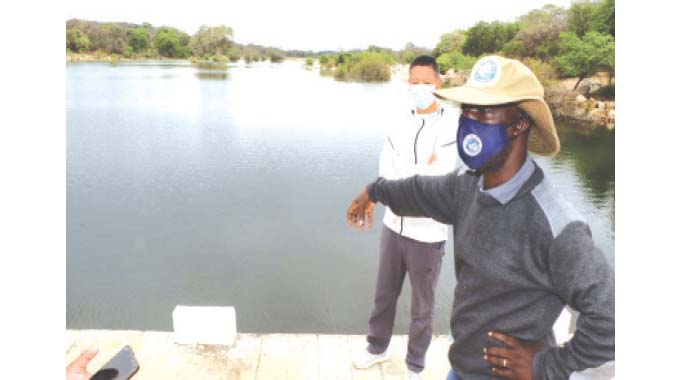
Sukulwenkosi Dube-Matutu , Chronicle Reporter
A 100 megalitre cofferdam built to pave way for the construction of Tuli-Manyange Dam in Gwanda district is now a major source of water for livestock and domestic use.
The cofferdam receives water from Tuli River. Villagers used to rely on water from Tuli River for their livestock.
During this time of the year the river would have long dried up forcing animals to travel far to get water.
The cofferdam was built mainly to supply water for Tuli-Manyange Dam construction works.
Work on the construction of Tuli-Manyange Dam in Matabeleland South resumed after Government released $43 million.
The dam with a holding capacity of 35 million cubic metres, is set to be completed in December next year or the beginning of 2023.
It is envisaged that once the dam is complete, at least 2 000 hectares will put under irrigation. The dam is expected to service Vela, Guyu Business Centre, Ntalale Business Centre, Chelesa Business Centre, Sizhubane Barracks, Manama Mission and Business Centre, Sebasa and Mankonkoni irrigation schemes. The project is being spearheaded by the Zimbabwe National Water Authority (Zinwa) while China International Water and Electric Corporation (CWE) was contracted to do civil works.
Contractors are also expected to tar the 7km dusty stretch leading to the dam site from the Gwanda-Ntepe road.
The project highlights Government’s investment in key and strategic water bodies around the country. Government under the Second Republic prioritises the completion of key water bodies with Treasury having set aside $10,7 billion for dam infrastructure in the 2021 National Budget. It is envisaged that construction of new water bodies will help support the switch from rain-fed agriculture to cultivating crops under irrigation which enables farmers to grow crops throughout the year.
Mr Phumulani Moyo of Zhokwe Village said they were relieved that they now have water for their animals.
“During this time of the year we used to face a lot of challenges as Tuli River dries up.
“We had to drive our animals over 10 kilometres away to water them. We are relieved that we now have water close by for our livestock,” he said.
Ms Glorai Tshuma from Vela Village said they hope to establish nutrition gardens close to the cofferdam.She said their area is generally dry which makes it difficult for them to embark on agriculture projects.
Mr Solomon Siduli from Zhokwe Village said they were looking forward to benefit from the completion of Tuli-Manyange Dam.
Ward 14 councillor, Mr Phineas Maphosa said the community was relieved that work on the Tuli-Manyange Dam had resumed.
“As a community we want to thank Government under the leadership of His Excellency President Mnangagwa for bringing such huge development to our area. A few months after work resumed, the community is already benefiting from the cofferdam. We are excited as a community as we know that this project will improve our lives,” he said.
When the Chronicle news crew visited the dam site on Tuesday works on the first saddle dam were underway.
In an interview at the cofferdam Zinwa site engineer Mr Maxwell Zulu said the coffer dam had about 100 megalitres of water. He said the main purpose of the cofferdam was to supply water for construction works.
Eng Zulu said work at the dam site resumed in April and the cofferdam had brought relief to the community.
“This is a drought area and by now this river would have dried leaving livestock without water but now villagers are watering their animals at the dam,” he said.
He said the dam was also supplying water for domestic use.
“We have a treatment plant which is about a kilometre from here. We have already installed the pipe line to draw the water from the dam to the treatment plant,” said Eng Zulu.
He said they were working on the foundation for the first saddle dam. He said two saddle dams will be constructed before moving to the actual dam. He said they hoped to finish working on the foundations of the saddle dams this year.
The dam project was mooted way back in the early 1960s but its only now that it is being implemented under the Second Republic.
In 2006, Government awarded the contract for the construction of the dam, but due to financial constraints, the contractor suspended works. — @DubeMatutu


 Online Reporter