peter
peter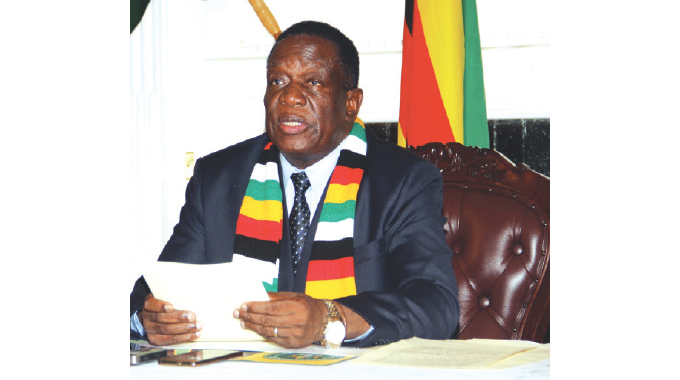
PRESIDENT Mnangagwa has reiterated that bona fide non-governmental organisations (NGOs) have nothing to fear and that they will continue with their Godly work and vocation by serving the needy and the poor, thus augmenting the many safety nets which Government put in place and continues to finance for the benefit of the vulnerable and the less privileged in our immediate communities and in our broader society.
In addition, organisations involved in genuine advocacy work will not be affected by the Private Voluntary Organisation (PVO) Bill which will be signed into law by the President soon.
“The new law allows them to raise awareness and arouse the collective conscience of our society on those rights and interests we must never overlook; rights and interests we must seek to safeguard and protect at all times. Indeed, any society, ours included, is as humane and as compassionate as it treats and provides for its needy, weak and vulnerable,” said the President in his weekly column in this paper last week.
President Mnangagwa said; “the PVO Bill has passed the various stages of the legislative process. It is now being cleaned up for my assent. I will sign it into law once it reaches my desk.

Thereafter, Zimbabwe will enter a new era of genuine philanthropic and advocacy work, unsullied by ulterior political or financial motives. This has been our goal as Government in drafting such a law. To protect our society, specifically the needy and the vulnerable against the greed, wiles and subterfuges of the crooked, found both here at home and abroad.”
The majority of NGOs in the country and Africa at large have been accused of meddling in politics and fighting governments. The have been accused of being champions of the “shock doctrine”
“The shock doctrine” is the influential but little understood theory that in order to push through profoundly unpopular policies that enrich the few and impoverish the many, there needs to be some kind of collective crisis or disaster — either real or manufactured. A crisis that opens up a “window of opportunity” — when people and societies are too disoriented to protect their own interests — for radically remaking countries using the trademark tactic of rapid-fire economic shock therapy and, all too often, less metaphorical forms of shock,” according to a review done by penguinrandomhouse of the book, Shock Doctrine written by Naomi Klein.
The principle of the shock doctrine or shock therapy is however, not an alien phenomenon on the African soil and academic, Dr Tafataona Mahoso argues civic society and NGOs have been using it to hoodwink the masses so as to pursue their anti-government agenda.

And many civic society organisations have been accused of manufacturing a crisis on paper, so as to come up with proposals which they send to the West to get funding, funding which they then use the way they want. Many civic society organisations have misled people, and many have stolen from the very people they purport to serve.
In an article that critiqued the role of civic society during the GNU era, Dr Mahoso wrote: “(…) the strategy of the US government was to provide through MDC-T- aligned NGOs and ministries, those services which the people could no longer get because of sanctions. The trick which was supposed to produce victory for the US-MDC-T ticket is based on the theory of what Naomi Klein calls “the love shock.” It is a form of criminal humanitarianism, whereby imperialism triggers a crisis which produces shock in the people.
Later on, many NGOs are then funded and unleashed on the shocked people to provide some relief and a good name for the proxies of the same empire.” (Mahoso, “Why ask Goliath for a level playing field?”, The Sunday Mail, June 29, 2013).
The President has reiterated that the PVO Bill is a Zimbabwean law, which is meant for Zimbabwe and its people.
“Unlike those other imperious nations we all know; Zimbabwe makes no laws for other nations or peoples. We make laws which are good and which are needful to our country. We do not need the approval of foreigners from whatever quarter to write such laws. Foreigners must keep out, as we realise and fulfil our sovereignty through the laws we make for ourselves.”



 Online Reporter