Online Reporter
Theseus Shambare, [email protected]
AT the Agricultural and Rural Development Authority (Arda) Antelope Estate in Matobo District, Matabeleland South Province, the future of farming did not arrive with clouds gathering on the horizon.
It arrived in a machine.
Across sun-scorched land long accustomed to drought and uncertainty, technicians moved through fields collecting soil samples and feeding them into modern testing equipment capable of analysing nutrients within minutes.
Where farmers once relied on instinct to judge tired soils, data was now giving the land a voice.
For a province where every failed season carries human cost, the significance was clear that Southern Africa’s next agricultural revolution may begin beneath the soil.
Hundreds of kilometres away at the 66th Zimbabwe International Trade Fair, that future was on display.
Under the theme, “Connected Economies, Competitive Industries,” this year’s showcase became a mirror of what the region must now confront — how to turn agriculture from climate-vulnerable subsistence into a competitive, technology-driven engine of growth.
From artificial intelligence and robotics to seed science, tissue culture, drones and rural connectivity, ZITF 2026 suggested the next industrial leap in Southern Africa may start not in factories, but in fields.
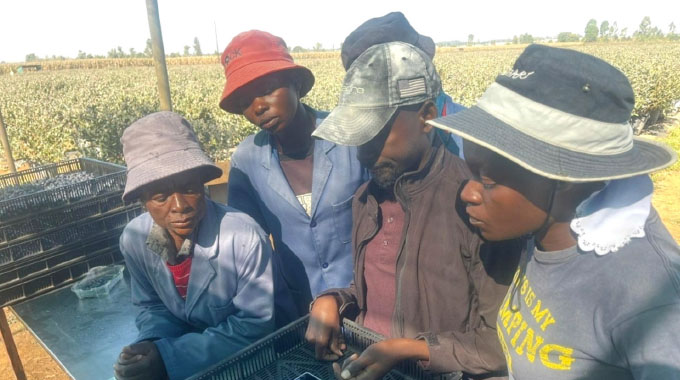
Picture: Theseus Mauruki Shambare
Wheat, water and national confidence
Few symbols of resilience are more political, or more personal, than bread.
For years, Zimbabwe relied heavily on imported wheat, exposing the country to global price shocks and pressure on scarce foreign currency reserves. But a sustained push in irrigation expansion, mechanisation and co-ordinated production systems has helped reverse that dependence.
National wheat output has risen sharply in recent seasons, from about 375 000 tonnes in 2022, to 468 000 tonnes in 2023, before climbing to more than 560 000 tonnes in 2024, one of the strongest harvests on record and well above estimated annual national demand of around 360 000 tonnes.
During the severe 2023/24 drought season, he said Arda supplied 68 percent of Zimbabwe’s national wheat requirements, helping cushion the country from shortages, while about 106 000 tonnes of grain were distributed through social welfare systems to vulnerable communities.
At the Agricultural and Rural Development Authority ZITF exhibition stand, chief executive officer, Mr Tinotenda Mhiko, said technology now drives the authority’s transformation.
“There is no way we can talk of an upper-middle income economy when our production performance is poor. So, increased production and productivity is the starting point,” he said.
He said Arda now uses advanced soil testing systems, geographic information systems, satellite mapping and AI-powered yield prediction models. For a drought-prone region where fertiliser, fuel and foreign currency are expensive, and efficiency matters.
He said production has surged in recent years, while irrigation expansion is reducing dependence on erratic rainfall — a growing threat across Southern Africa as climate change intensifies.
This is not only an economic story.
It is also Sustainable Development Goal (SDG 2): zero hunger and SDG 13: climate action in motion.
A female farmer, four villages, one shift
In Goromonzi, another version of transformation is unfolding.
Violet Mayingire is among farmers from four villages benefitting from technology as they expand horticulture production.
With improved irrigation systems, more organised production planning and better access to market information, small village plots are becoming commercial units.
“With this Village Business Unit, our lives have been transformed, we no longer wait for our husbands to come for us to have something to eat, because we now get money on a daily basis selling our horticulture produce,” she said recently during a visit at the Gosha Village Business Unit in Goromonzi established by Arda.
For female farmers, who often shoulder the burden of food production while facing unequal access to land, finance and information, technology can be catalytic.
When women gain access to tools, productivity often rises, household nutrition improves and incomes stabilise.
Young coder in the orchard
If agriculture once pushed young people away, digital farming may now pull them back.
Patrick Mambo, a former cricketer, is among a new generation building home-grown agri-tech systems. His latest platform, Harvest Link, developed for Komani Integrated Agriculture and Selby Enterprises, links harvesting teams and pack-shed operations in real time.
The system tracks harvest blocks, crop varieties, reaping teams, transport details, temperatures, weights, quality checks and traceability across shipments.
“It is precision agriculture in action and a major step forward for data-driven decision-making in Zimbabwe’s horticultural value chain,” he said.
In practice, it means exporters can identify delays, trace defects to exact batches and improve standards for competitive markets. Agriculture is no longer only about muscle. It is also about software.
New regional divide
Technology only transforms lives when it reaches ordinary people.
That challenge took centre stage during the Digital Villages Initiative side event hosted by United Nations Food and Agriculture Organisation (FAO), where Government officials, universities, telecoms firms, innovators and development partners debated how AI can move from laboratories into villages.
Econet Wireless Zimbabwe executive, Farai Mutyasera, said the company now has more than 6 000 base stations, with new rural towers and micro-stations extending connectivity deeper into farming communities.
That matters because the greatest divide in modern agriculture may no longer be between large farmers and small farmers. It may be between connected farmers and disconnected farmers.
A farmer with weather alerts, mobile payments, price discovery, disease diagnostics and digital credit can compete differently from one relying only on guesswork.
Across the Southern African Development Community region, from cattle ranchers in Botswana, maize growers in Zambia, horticultural exporters in South Africa, to communal farmers in Zimbabwe and Mozambique, digital access increasingly determines competitiveness.
AI in local languages
At the same event, Chinhoyi University of Technology Pro-Vice Chancellor, Professor Taurai Bere, said researchers were developing practical farming applications such as Hurudza AI and Maminda AI.
“The tools help farmers decide what to plant, where demand exists and how weather patterns may affect decisions,” he said.
Crucially, some are being adapted into local languages. That may prove as important as the algorithms themselves.
Technology imported without language inclusion often excludes those who need it most. But AI that speaks Shona, Ndebele, Setswana, Chichewa or Portuguese can democratise productivity across borders.
Seed sovereignty starts
In the lab
While drones and AI drew attention, another quieter revolution was on display.
Kutsaga Research showcased tissue culture and seed production systems at ZITF 2026. Tissue culture is a set of techniques that enables the rapid multiplication of disease-free planting material.
For countries that spend scarce foreign currency importing seed and planting material, the implications are strategic.
The technology supports seed sovereignty, local resilience and stronger domestic value chains. Kutsaga chief executive, Dr Frank Magama, said the institution was repositioning itself into a more dynamic and commercially responsive research organisation.
“We are evolving into a broader agricultural innovation hub underpinned by science, innovation and commercial sustainability,” he said.
He said the state-of-the-art plant tissue culture laboratory at the station in Harare can multiply high-value crops and seedlings, with a capacity of one million plantlets per production cycle.
Between 2021 and 2024, it produced over 3,8 million plantlets, according to a May 2025 report.
Why the region should care
Botswana President Duma Boko, speaking at the official opening ceremony, praised Zimbabwe’s 6,6 percent economic growth in 2025, saying it inspired confidence not only in Zimbabwe but across the region.
“The Zimbabwean economy is now buoyant and this phenomenal growth inspires confidence not just in your country, but in the region and ultimately across Africa,” he said.
His words underscored a larger truth. Southern Africa’s economies are deeply connected. A stronger wheat harvest in Zimbabwe can ease import pressure. Better logistics in Botswana can improve corridors. Smarter horticulture systems in Zimbabwe can create export models for neighbours.
If countries align standards, share climate data, strengthen transport systems and scale agro-processing, agriculture can become more than survival. It can become an industry.
Beyond the fairgrounds
What ZITF 2026 revealed was not simply machinery, software or scientific exhibits, but it revealed a contest over the future.
Will Southern Africa remain vulnerable to drought, imports and low-value commodity exports?
Or can it build connected economies powered by productive farms, smart industries and regional trade?
At Antelope Estate, the answer was being read in tested soil. In Goromonzi, it was growing in village gardens. In a pack-shed, it was appearing on a digital dashboard. In a laboratory, it was multiplying in disease-free seedlings.
And across the region, the next industrial revolution may begin not in a factory, but in a field.