Online Reporter
Government has announced that it has stopped borrowing to finance budget support or consumption as it wants all future loans to be channelled towards revenue generating infrastructure projects.
Finance, Economic Development and Investment Promotion Minister Professor Mthuli Ncube said the new policy will ensure every dollar borrowed is invested in productive assets that generate cash flow to service the debt while supporting economic growth.
Projects eligible for debt financing under the new framework include toll roads, railways, dams, irrigation schemes border posts and power infrastructure whose revenues are supposed to meet repayment obligations without placing additional pressure on the fiscus.

In the past Government at times borrowed to finance budget deficits or balance-of-payments support. The new financing model comes as Zimbabwe intensifies efforts to unlock long-term, affordable funding from international development finance institutions following progress in macroeconomic reforms, fiscal consolidation and debt servicing.
Central to Government’s reforms has been the tightening of fiscal discipline and prioritising public investment.
Presenting his Mid-Term Budget and Economic Review in Parliament recently, Minister Ncube said the country’s stable inflation environment had created conditions for stronger- than- expected economic growth hence the economy expanded by 6,8 percent in the first quarter of 2026.
He said disciplined macroeconomic management had delivered low and predictable inflation, strengthened confidence in the Zimbabwe Gold (ZiG) currency and provided a solid platform for sustained economic expansion despite global uncertainties.
Prof Ncube said the combination of price stability, robust economic activity and ongoing structural reforms demonstrated that Government policies are beginning to deliver tangible results. The
International Monetary Fund (IMF) late last year commended Government for maintaining fiscal discipline which it said had helped to contain inflation and stabilise the exchange rate.
The IMF said Government stopped printing money to finance projects as was the case in the past hence it made significant progress towards restoring macroeconomic stability.
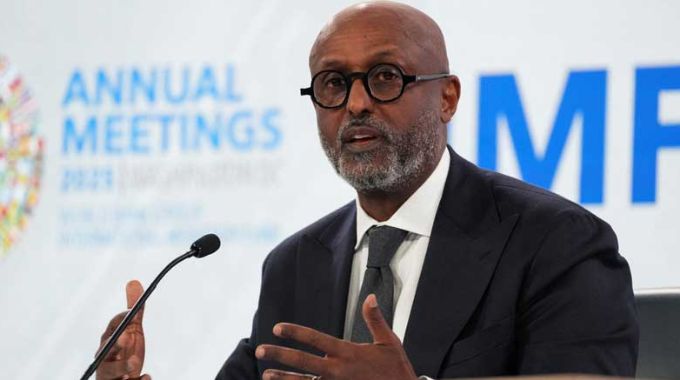
The fund’s African Department Director, Mr Abebe Aemro Selassie, told journalists during the presentation of the new regional economic outlook for sub-Saharan Africa at the IMF-World Bank
Annual Spring Meetings in Washington DC, United States, that the diminished recourse to the Reserve Bank of Zimbabwe (RBZ)’s financing window has been a key policy shift aiding progress towards restoring macroeconomic stability in an economy long plagued by hyperinflation and exchange rate volatility.
Mr Selassie said Zimbabwe’s policies had contributed to solid economic performance, even in the absence of concessional financing that other countries in the region were benefiting from.
“Zimbabwe has faced considerable challenges in recent years and one of the distinguishing factors has been its limited access to concessional financing, which has helped other countries cushion the impact of global shocks. Against this difficult backdrop, it is encouraging to see Zimbabwe implementing sound policies,” he said.
Mr Selassie said Government’s recourse to central bank financing has declined significantly. He said it was therefore important to sustain this trend as reliance on central bank funding has in the past contributed to inflation and exchange rate volatility.
“We are encouraged by the Government’s recent actions and implore it to maintain this momentum” said Mr Selassie.
We want at this juncture to commend Government for taking yet another bold move to stop borrowing to finance budget support or consumption which will further enhance the macro-economic stability that the country is enjoying.