

 Online Reporter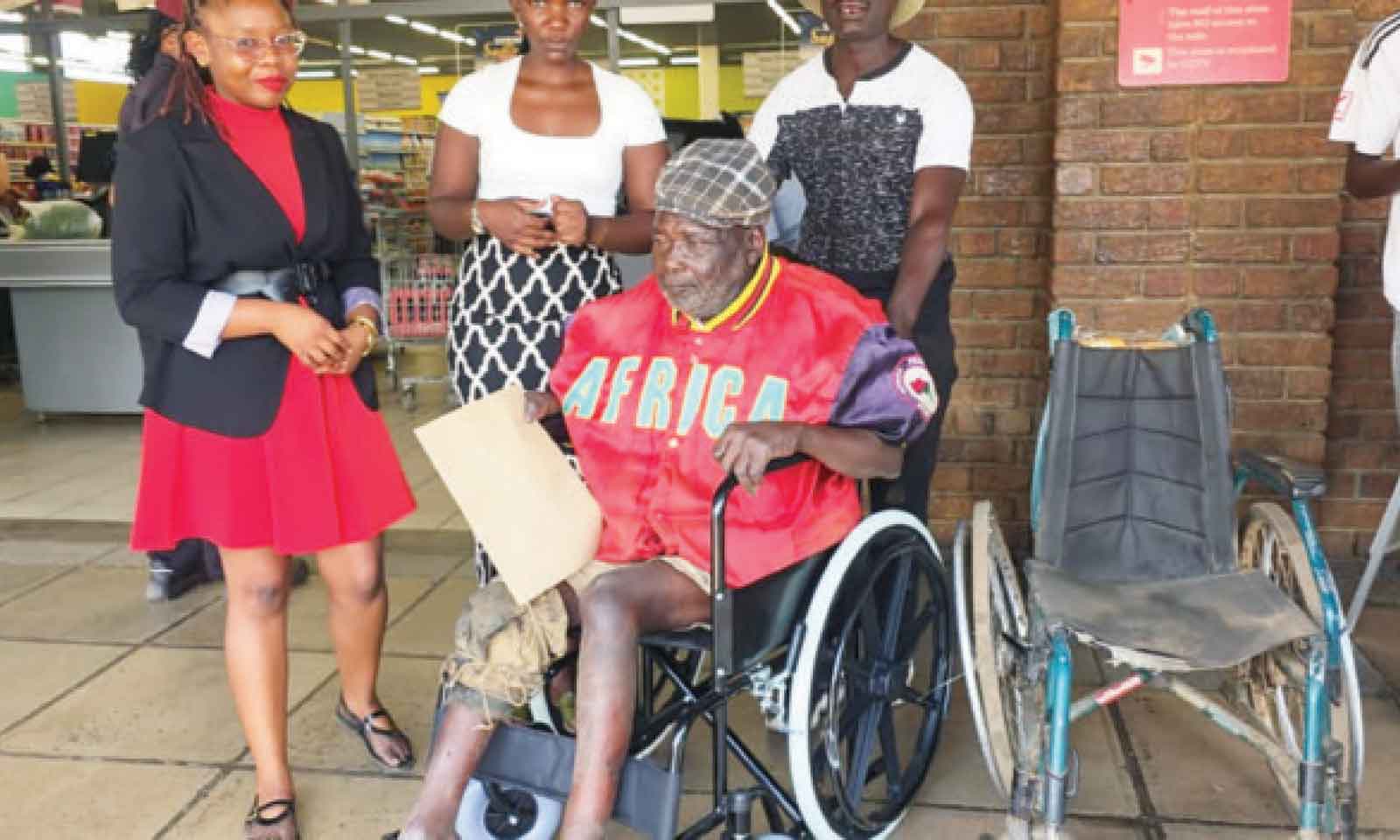
Conrad Mupesa
Features Writer
FOR more than seven decades, all that Mr Felix Manhenga ever prayed for was a decent meal and the strength to face another day.
Food topped his list of needs; money came a distant second.
Born with a disability and confined to a worn-out wheelchair for most of his adult life, Mr Manhenga’s story is one of lack, perseverance and faith against all odds.
At 76, the frail but cheerful man has been a familiar face outside a popular supermarket in Chinhoyi’s central business district, where he often sits in his wheelchair, a silent plea to passersby for assistance.
Loneliness has been his constant companion since the death of his wife several years ago.
Together, they had six children, but tragedy struck repeatedly, robbing him of four of them.
Only two survive today.
“Life hasn’t been easy,” he said softly.
“When my wife passed away and the children started dying one after another, I felt like the world had turned its back on me.”
In an effort to fend for himself, Mr Manhenga once tried his hand at farming.
With help from his surviving children and some neighbours, he attempted to cultivate a 12-acre plot in Doro, Hurungwe District.
But poor soils and unfavourable weather conditions dashed his hopes.
Unlike many able-bodied people in the district facing the negative impacts of ever-changing climatic conditions who have since adjusted by venturing into labour intensive tobacco farming, Mr Manhenga was forced into begging.
“When the crops failed, I had no choice but to come back to Chinhoyi. I never thought I would beg again, but hunger has no mercy,” he recalled.
For years, he relied on well-wishers for food and small donations.
Yet, despite the pain and rejection, he never lost his faith.
Recently, that faith was rewarded.
A local property developer, through the Vinecity Housing Trust, surprised Mr Manhenga with a brand-new wheelchair and a residential stand, marking a new chapter in his life.
The presentation took place at the spot where he normally sits, outside the supermarket in the CBD.
Overwhelmed with emotion, he could not hold back tears of joy.
“I am grateful beyond words. This wheelchair means freedom. I used to struggle to move even a few metres to the toilets behind the supermarket. My old one was broken, and I fell many times. I still have scars from those falls,” he said, beaming as he tried out his new chair.
The gesture came shortly after he had been robbed of his US$49 savings at the Gadzema Bus Terminus, where he often sleeps.
A knife scar on one of his thighs near the groin, which he still nurses, bears the tale of the ordeal.
The cruel incident had left him devastated, until help came unexpectedly.
Help also brought smiles and cheers to vendors near the supermarket who have often been his hands and legs to push him around.
One vendor, Farai Muronda who ended up dropping Mr Manhenga twice from the old wheelchair while trying to assist, was elated.
“I dropped him twice after the old wheelchair that was fastened by wires got stuck. Because of those two incidents, everyone here was now afraid of helping him. We were afraid of injuring him or the worst, so the coming in of this brand-new wheelchair brings relief to those who help him on a daily basis,” he said.
Through the Vinecity Housing Trust, the land developer has also pledged to help build a modest home for Mr Manhenga, and is appealing to residents and well-wishers to contribute building materials.
“We were moved by his story and wanted to make a difference. No one deserves to live in such conditions, especially at his age,” said youthful Mind Musokeri, managing director of the land development company.
“As a beneficiary of the Government, I saw it fit to contribute towards attainment of Vision 2030 by helping underprivileged members of our societies.”
He called members of the community to help contribute towards material needed to construct the old man’s house.
Local councillor, Ignatius Zvigadza, who confirmed the recent attack on Mr Manhenga by robbers and his sorrowful stay at Gadzema Bus Terminus, said the donation of a residential stand bears testament of how Zimbabweans rise towards helping the needy.
“We have had cases of homeless and mentally ill patients being physically attacked. The donation of a stand to Sekuru Manhenga will give him a decent lifestyle.
“The onus is now upon us to raise funds and materials for the successful construction of his house,” he said.
As the evening sun sets over Chinhoyi’s skyline, Mr Manhenga sits in his new wheelchair, not as a beggar this time, but as a man rediscovering hope.
For someone who spent decades praying just for food, the gift of mobility and a home is nothing short of divine abundance.


