Online Reporter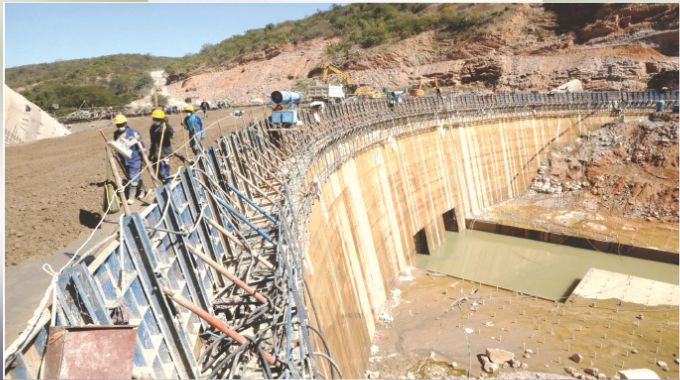
Judith Phiri Sunday News Reporter
Government has reaffirmed its commitment to completing major dam projects across the country, saying the infrastructure is central to transforming Zimbabwe’s agricultural landscape, boosting rural industrialisation and strengthening climate resilience in the face of increasingly erratic weather patterns.
With construction progressing on several strategic projects, authorities say the dams will address water shortages, expand irrigation, improve livestock production and unlock new economic opportunities under the Agriculture Food Systems and Rural Transformation Strategy 2 (AFSRTS2) (2026-2030) through the Dam as an Economy Model.
The renewed focus comes as Zimbabwe seeks to maximise the potential of more than 10 600 water bodies to stimulate agricultural production, create employment and enhance food security.
The programme is also expected to cushion the country against the projected El Niño phenomenon by improving water storage and supporting hydropower generation, irrigation and downstream economic activities.
Speaking on the sidelines of a tour of BJ Ellerman and Sons Farm in Ward 11, Mangwe District, Matabeleland South, Permanent Secretary in the Ministry of Lands, Agriculture, Fisheries, Water and Rural Development, Professor Obert Jiri, said Government was intensifying efforts to complete priority dam projects.
“There are 12 dams that were active in the last two or three years. Over the last two years, we have really been focusing on two major dams, which is Gwayi-Shangani Dam and Kunzvi Dam.
“Those two dams have been the particular focus of the Government over the last two years. For Gwayi-Shangani, we are now over 70 percent in terms of its progression. We expect that with the current support from Treasury, we should be able to complete this dam at the end of 2026,” he said.
Prof Jiri said Kunzvi Dam had also made significant progress.
“For Kunzvi Dam, it’s also progressing very well, now also over 75 percent in terms of completion. It will be able to support Harare in terms of water requirements and already pipeline development from Kunzvi to Harare is already underway. We expect the dam to also be able completed by end of 2026.”
He said Kunzvi Dam had already started impounding water while finishing works continued.
The Permanent Secretary said Vungu Dam in Lower Gweru was now more than 60 percent complete and could be finished early next year, while Sengwa Dam had surpassed the 50 percent mark after construction gathered momentum.
“We also have Sengwa Dam, which has been quiet, but is also now over 50 percent in terms of its development and moving quite well,” he said.
Prof Jiri said the completion of Gwayi-Shangani Dam would significantly improve water security for Bulawayo, with pipeline installation to the city already underway.
“We expect that Gwayi-Shangani will feed into Bulawayo and already the pipeline from the dam into the city is already also being installed. So, we expect that the next rain season, once the dam wall is complete water will be impounded.”
Beyond supplying water to Bulawayo, he said the project would unlock irrigation potential from existing dams such as Upper Ncema, Lower Ncema and Insiza as demand for potable water shifts to Gwayi-Shangani.
Prof Jiri said the country’s extensive network of dams presented enormous opportunities for irrigation development.
“For us to put it into perspective, we have more than 10 600 water bodies. A lot of these are actually large dams with the capacity to irrigate more than two million hectares.
“If you look at Tugwi-Mukosi Dam, it has the capacity to irrigate over 40 000 hectares, Marovanyati Dam can irrigate more than 5 000 hectares and Gwayi-Shangani Dam, which is coming up, can irrigate up to 10 000 hectares.”
He said Zimbabwe required at least 350 000 hectares under irrigation to guarantee cereal self-sufficiency.
“Constructing the dam wall is the easier part. The important thing is converting every water body into an economy that supports irrigation development, fisheries, hydropower generation, livestock production and water reticulation for surrounding communities.
“If we do that, we improve livelihoods around the dam. We develop industries around the dam and create centres of economic activity, employment and prosperity.”
Livestock specialist and farmer Mr Mhlupheki Dube welcomed the accelerated dam construction programme, saying it would help farmers mitigate the impact of the anticipated El Niño-induced drought.
“It is very important when it comes to establishment and construction of dams or rehabilitation of existing dams to improve their capacity. These dams support irrigation schemes and can actually be put to further production, which can be used to supplement animals during the dry season,” he said.
“Also, if the irrigation schemes are functioning because the dams have enough water, it means there is enough forage material or cereal stover coming from the production within the irrigation schemes.”
He said reliable water supplies were critical for livestock survival during droughts, noting that many livestock deaths were linked to water shortages and starvation.
“So, the rehabilitation of dams, the construction of new dams in anticipation of the El Niño as a mitigatory effort is a very noble exercise that should be commended for all intents and purposes.”
Economic analyst Mr Reginald Shoko said investment in dams was essential for safeguarding the country’s livestock sector.
“The livestock sector faces significant challenges, with a substantial portion of the national herd at risk due to water and feed shortages whenever rains fail.
“Without reliable water points, herds face starvation and mass die-offs long before the next rainy season arrives, a pattern already witnessed in recent droughts, when falling dam and lake levels forced communities into disaster declarations,” he said.
Mr Shoko said accelerating dam construction ahead of the predicted El Niño would secure irrigation water for crops while ensuring livestock had dependable access to water throughout the dry season.
“Dams are, in effect, the nation’s insurance policy against an increasingly erratic climate,” he said.
Zimbabwe National Chamber of Commerce Matabeleland Chapter past vice-president Mr Louis Herbst said the accelerated dam construction programme represented one of Zimbabwe’s most strategic long-term investments.
“With recurring El Niño events expected to bring prolonged droughts, water security has become a fundamental economic issue rather than simply an agricultural concern.
“Dams are far more than water storage facilities. They are critical national assets that underpin food security, industrial growth, energy production and rural livelihoods. Every new dam strengthens Zimbabwe’s resilience against climate shocks while creating opportunities for sustained economic development,” he said.
Mr Herbst said reliable irrigation would stabilise agricultural production, reduce food imports, conserve foreign currency and protect jobs.
He added that the livestock sector also stood to benefit significantly from improved water infrastructure.
“Strategically located dams provide permanent water sources for cattle, goats, sheep and wildlife, helping farmers preserve their herds, improve animal health and sustain rural economies throughout the dry season,” he said.
Mr Herbst said the benefits extended beyond agriculture, with dams supporting mining, manufacturing, fisheries, tourism, hydroelectric power generation and urban water supply, while also attracting investment, stimulating industrial growth and creating employment opportunities.