

 dyton mupawaenda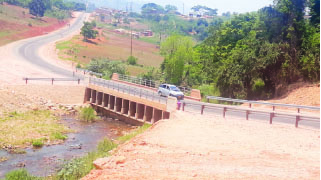
Elliot Ziwira-Senior Writer
Every kilometre that one covers, every bridge that one may need to cross, and every step one takes to reach out to where one’s heart leads, goes a long way in the transformation of relations, which is the starting point in the realisation of shared dreams.
Relationships are vital cogs in the transportation of dreams from one station to another, and bridges are resplendent markers of the power of compromise and unity against adversity.
Building bridges, roads and railroads, therefore, is the starting point in the appreciation of linkages as vehicles of transformation that give other modes of transport impetus.
All journeys start from the heart, which informs the faith that it is possible to reach out to others. And, there is no better way to get to the station of dreams than taking the initiative to fly on the wings of the benu (the divine bird of blessings and eternity).
Travelling is all that it takes to mend relations, kindle ties, unlock dreams, appreciate the joy of life, and open up limitless horizons; all for the common good.
Hence, transport is a part of, and is a catalyst to economic development. As such, its developmental strides are also dependent on the development of other sectors that use transportation, like commerce, agriculture and tourism.
This is why President Mnangagwa’s commissioning of Rwenya Bridge in Mudzi District, Mashonaland, which connects the province with Nyanga in Manicaland, last Friday, is crucial.
For the transport sector to function efficiently and effectively, there is a need to also consider relevant soft infrastructure, such as policies and legal instruments that govern the sector.
Therefore, The Second Republic led by President Mnangagwa, through the Ministry of Transport and Infrastructural Development, has provided more than transport to Zimbabweans, but also services cutting across the entire gamut of human endeavour.
Owing to lack of resources over the years, the maintenance of infrastructure in Zimbabwe has been problematic. This has seen a devastating deterioration of infrastructure across all transport sub-sectors.
In addition to these challenges, natural disasters have become rampant, from severe droughts to cyclones, thus negatively impacting existing infrastructure.
Notwithstanding financial challenges in the past 20 years, induced mainly by economic sanctions imposed on the country by the West, and natural disasters like Cyclone Idai, which have seen some roads deteriorating, in the Second Republic, the ministry has done a lot in the rehabilitation and construction of road infrastructure since 2018.
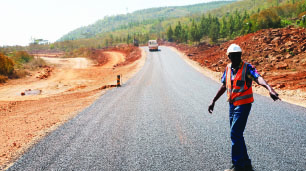
A 35km stretch that covers the Charter-Machongwe Junction in Rusitu has been fixed by the Second Republic.
In a bid to address these challenges, the Government has heightened support on transport infrastructure through various programmes and initiatives. These initiatives have seen the rehabilitation, upgrading and construction of infrastructure projects such as the Victoria Falls International Airport, Plumtree-Harare-Mutare Road, among others.
Zimbabwe’s road network is about 88 133km, 14 000km of which are surfaced, 50 000km are all-weather and the remainder are earth roads.
Roads are classified in relation to their functions. There are regional trunk roads, which cover roughly 3 391km, with 94 percent of them surfaced. Secondary roads and tertiary roads also make up the road network in Zimbabwe.
Secondary roads link regional, primary, tertiary and urban roads, industrial and mining centres, minor borders and tourist attractions.
Roads that provide access to schools, health centres, dip tanks and other facilities in rural district council areas, or link and give access to secondary and regional roads, are referred to as tertiary roads.
The road network is incomplete without bridges that enable road and rail crossing of waterways, flyovers, interchanges, road over road and road over rail.
There are approximately 1 051 bridges in Zimbabwe.
Road transport permeates livelihood routes for many Zimbabweans in the agricultural and mining sectors, which are the backbone to economic expansion. The need arises, therefore, to have an efficient transport system, and make products from the attendant sectors competitive on both domestic and international markets.
Transporters usually shun inaccessible areas due to poor roads, as such farmers and other citizens are affected as transport costs become steep.
Also, due to the perishable nature of farm produce, a bad road network has the effect of destroying livelihoods, and negatively impacts on overall economic development.
Farmers and miners need to link up with international markets as well.
It is with this view in mind that the Ministry of Transport and Infrastructural Development intervenes through rehabilitation and construction of roads in such areas.
Milestones in Second Republic
The following projects, among many others, are a representation of the efforts by the Government to address the existing challenges.
Wengezi-Skyline Road
(JR Goddard)
Under the programme to address the damages caused by Cyclone Idai, the ministry, through the Department of Roads, embarked on a framework to rehabilitate the road, and introduce sustainable initiatives that are more resilient to the effects of the cyclone should such magnitude reoccur.
This includes the construction of approaches, reconstruction of three new bridges; and introduction of erosion protection works. The road has since been completed and is open to traffic.
Charter-Machongwe-Junction-Rusitu
The project involved road realignment, re-gravelling, road construction, and development of erosion protection works on the 35km stretch.
Kopa-Jopa
The development involved road formation, creation of a sub-grade, base and surfacing of 23km of the stretch. In addition, 82 culvert crossings were installed on the road.
President Mnangagwa officially opened the Kopa-Jopa refurbished road on November 10, 2021.
Ngundu-Tanganda Highway
The Ngundu-Tanganda Highway, which links Manicaland and Masvingo provinces via Chiredzi, was rehabilitated at a cost of US$20 million in 2019. The road also links the Eastern Highlands and South Africa, the country’s major trading partner. It also connects the Eastern Highlands to South Africa, Zimbabwe’s major trading partner.
The project covered 85km, from the 188km peg to the 273km peg. The initial 30km were done between February 12, 2018 and April 10, 2018. An additional 55km stretch was done from February 12, 2019 to June 7, 2019.
Other road projects
The following are on-going projects:
The other road development is Murambinda-Birchenough Road construction, which encompasses the surfacing of 7,4km of the 120km stretch.
In Mashonaland East Province, there are quite a number of road projects underway, chief among them being the 56km Murehwa-Madacheche Road project, which links the mineral (gold and black granite) rich Uzumba-Maramba-Pfungwe area to Harare and Mashonaland Central Province.
Leveraging on its highly qualified and experienced engineers, the Ministry of Transport and Infrastructural Development aligns with the devolution thrust as it is well-represented at provisional levels, and even at village level.
The philosophy behind this is putting in place a policy formulation process and prioritisation of projects that benefit citizens in their localities.
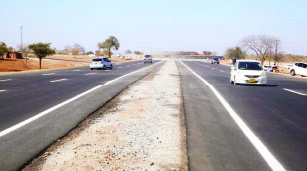
The Beitbridge-Bulawayo highway is being rehabilitated by the Government.
Another massive ongoing road construction project is the US$1 billion Harare-Masvingo-Beitbridge Highway. Five local contractors were engaged in 2019 to build and rehabilitate the road to SATTC standards.
The plan to rehabilitate the highway was mooted a long time ago, and a number of tenders were awarded, but failed to take off in 2002, 2016 and 2018. These tenders were awarded to ZimHighways (2002), Geiger International (2016) and Anhui Foreign Economic Construction Corporation (2018).
The completion of the Harare-Beitbridge Highway will attract traffic that has been diverted to Victoria Falls-Kazungula Road, and facilitate intra-trade within the country.
More than 400km of the 580km stretch, have now been completed and opened to traffic. More local contractors are set to be engaged to expedite the rehabilitation of the Harare-Chirundu Road.
Other road projects that will considerably improve Zimbabwe’s transport system proficiency, and are crucial in the value chain in the medium-term are Mbudzi Traffic Interchange and the Mabvuku Overpass.
Complementary efforts by Zinara
The Zimbabwe National Road Administration (Zinara), which falls under the purview of the ministry, has complemented the Government’s road construction and rehabilitation efforts through collection of road users’ charges.
The tollgate initiative, which started in 2009, has created employment opportunities for hundreds of citizens, more than 30 percent of whom being women. The enterprise benefited more than 220 local companies that were contracted as suppliers of different goods and services for the tollgates.
The fees collected, and other road users’ charges, are channelled towards road rehabilitation and maintenance through authorities such as urban councils, rural district councils, Rural Infrastructure Development Agency (RIDA) and the Department of Roads.
Public-Private Partnerships
Alive to the urgency required in guaranteeing an efficient road infrastructure for Zimbabweans, the ministry strongly encourages and pursues public-private partnerships (PPPs), which have seen some roads being set aside for such ventures. These include Beitbridge-Bulawayo-Victoria Falls, Mvurwi-Guruve-Kanyemba and Gweru-Zvishavane-Rutenga-Boli-Sango.
Since Independence in 1980, the transport sector in Zimbabwe has been going through massive transformation. The liberalisation of the sector in the early 1990s opened up spaces for more indigenous players in the sector. Business opportunities and employment opportunities were created for citizens.
It may be that only about 20 percent of the country’s road network is surfaced, and the rest are gravel or earth roads, but the Second Republic ushered in a new dawn to the transport sector through road construction projects that are underway across the country.
The Government has committed to road infrastructure by up-scaling investment in the form of Public Sector Investment Programmes (PSIPs). The Ministry of Finance and Economic Development allocated nearly $2,2 billion for the construction and rehabilitation of roads and bridges countrywide in the 2020 National Budget.
Road construction projects are crucial since they are non-inflationary, and have positive multiplier effects on the economy. Research on global trends shows that huge investments in infrastructure can, if there is unity of purpose, give a country a lifeline by pulling it out of recession.
Recessions are not new, nor are they unique to developing countries. The 2008/2009 economic downturn did not spare developed countries. They were, however, able to rebuild their economies through investments in infrastructure.
Zimbabwe needs such investments, and the starting point is inculcating a shared vision. In this vision, every citizen should put their shoulders to the wheel.
The ministry keeps on learning; from past experiences and from others, so that the ultimate winner is the common good. More feasibility studies, therefore, are underway for other road construction projects to make them bankable for private sector participation.
Investor inertia towards road development in Zimbabwe can only be removed if Zimbabweans as a collective take active participation in the development of their country. New entrepreneurs, particularly young people and women, should participate in tenders for road maintenance and rehabilitation. It is this that goes a long way in attracting investors.
Development partners and donors have been unwavering in their support towards the construction of physical infrastructure in Zimbabwe. The Government extols institutions such as JICA for their support in the rehabilitation and upgrading of sections of the Makuti-Chirundu Road.
Emergency Road Rehabilitation Programme 2 (ERRP2)
Following the declaration by the President that the state of our entire road network is a national disaster, the Cabinet directed that the Ministry of Transport and Infrastructural Development, together with other road authorities, implement the Emergency Road Rehabilitation Programme 2 (ERRP2).
To date, the following achievements have been made:
Rehabilitation: The programme has so far seen 318,7km of roads being rehabilitated against a target of 627km.
Resealing: At least 146km out of a set target of 1 425km have been resealed.
Gravelling: About 10 946km have been gravelled, exceeding the set target of 8 339km.
Grading: So far 11 528,9km, against a target of 16 284km, have been graded.
Drainage structures and wash ways: About 1 150 drainage structures have been constructed or repaired across all road authorities, while 240 wash ways have been reclaimed against set targets of 556 and 167, respectively.
Storm water drains: A total length of 7 092km, out of 22 683km of drains have been attended to.
Verge clearing: Of the set target of 22 489km, at least 10 309,1km have been cleared.
Potholes: Not less than 7 156km of roads have been patched against a set target of 10 119km.
Building of roads and bridges, therefore, as is the case in all relationships, begins with the understanding that no man is an island, and that a return journey is only possible if the initial voyage is undertaken.
All has to start from somewhere; brick on brick, heart to heart, and with all eyes on the ball, for a nation is as good as its people.



 Online Reporter