

 admin
admin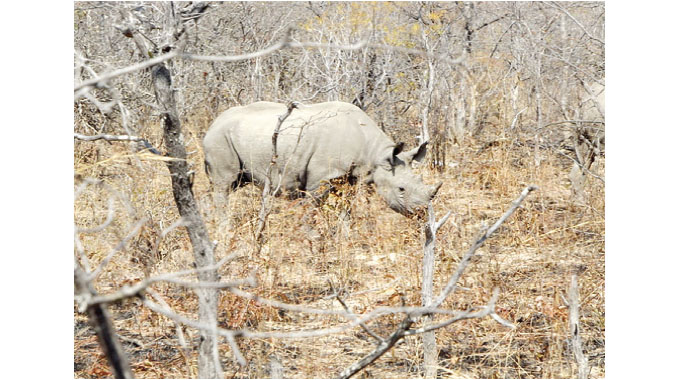
Michael Magoronga, Midlands Correspondent
FOR little Geraldine, life has not been rosy since he came onto this earth.
Beyond the territorial fights with fellow rhinos and travelling miles to find water bodies, Geraldine has to contend with climatic shocks never experienced by his parents.
Perhaps in their language, his parents tell Geraldine that growing up, they never experienced such extreme weather conditions and never travelled long distances to access water.
Geraldine’s mother probably also tells him that growing up, trees were infinite and they would live freely; it was not an uphill task to find a territory and easily defend it.
Sadly, Geraldine’s habitat, the Midlands Black Rhino Conservancy (MBRC), which was solely created for the rare species of black rhino, has been invaded by both humans and other animals.
Registered in 1992, the main objective of the trust was to protect and conserve the environment and wildlife particularly but not limited to the black rhinoceros.
The trust also sought to promote and engage in best practicable wildlife and land management practices appropriate to the attainment of the primary objective.
The MBRC is a less drought-prone area and offers much better protection with few rhino losses being recorded hence a sizable number of black rhino were translocated to the area where they found protection and flora and fauna suitable for their breeding.
Although specifically created for the black rhino, the MBRC has become home to other wildlife including among other species
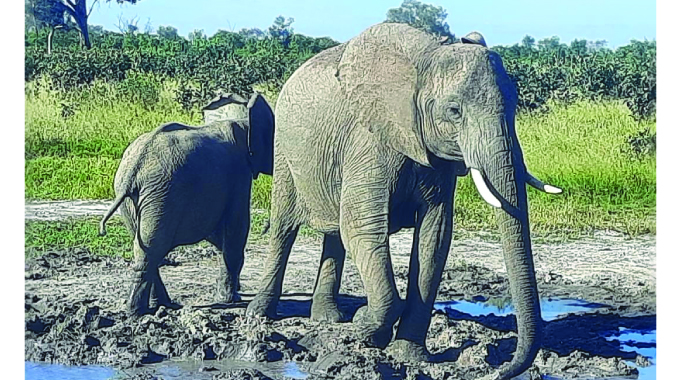
, resident sable, leopard, eland, kudu, giraffe, crocodile, painted African dog, African rock python, waterbuck and the lion.
Land degradation caused by artisanal mining and some farmers has left the rhinos exposed to climatic shocks. The people are not only cutting down trees for firewood, construction and farming purposes but are also poaching the rhino as well as other wild animals.
MBRC conservator, Mr Brilliant Chibura recently said the lives of the rhinos were in danger due to increased human inhabitation in the conservancy.
“MBRC is unique in that in some conservancies, animals are caged unlike ours where they’re free range. As such, a rhino is a territorial animal which is supposed to defend and protect its territory from animals including its own species. It’s unlike the home range rhinos which are caged and are fed by the owners,” he said.
Mr Chibura said the fragmentation caused by deforestation was destroying the ecosystem and disturbing the animals’ diet and free movement.
“The habitat fragmentation causes change in behaviour of both the trees and the animals. The animals have to fend for themselves and it becomes difficult for each animal to get at least 150kilogrammes daily due to lack of trees. Above all, it’s not all the trees that are edible to the animals,” explained Mr Chibura.
The general security of the rhino has been under threat due to poaching, mining and human activity.
“The settlements are not regulated hence the ecosystem is compromised putting the lives of the rhinos under severe danger,” he said.
The rhinos almost reached extinction after the conservancy was left with only three of the rare species but the number seems to be increasing.
“We now have eight of the black-rhino and we’re expecting two more any time from now. We’re doing all we can to protect them from poaching and any other endangering activities,” said Mr Chibura.
The conservancy has rolled out education and tree planting programmes to try and protect the remaining few rhinos.
The increase in bio-fuels leading to deforestation has led the conservancy to come up with ideas to replace the trees.
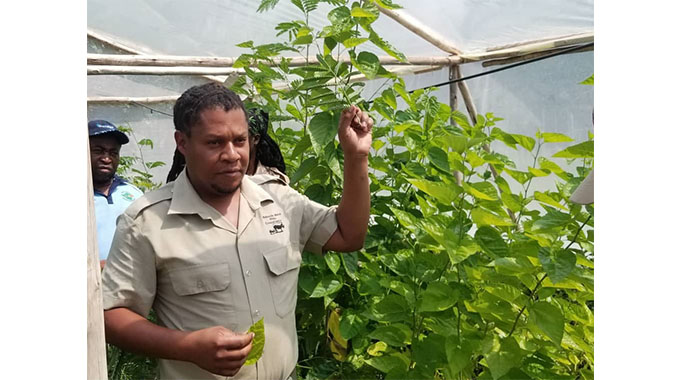
“We’re working together with the community, traditional leaders, schools, churches and households in a programme earmarked to plant trees across the conservancy so that we protect what we have. We’ve come up with a nursery at the conservancy whereby anyone who needs a tree to plant can come and get it for free,” said Mr Chibura.
Besides exotic trees, the program is also targeting fruit trees where value addition is being undertaken.
“We’re also planting trees for timber targeting export and domestic markets. This is so that people don’t resort to looking for food and end up poaching the animals. Above all, we’re teaching them on how to co-exist with the wild animals. If they come across wild animals, it’s not always about killing them but giving each other way,” said Mr Chibura.
Traditional leaders have also pledged to play their role in educating their subjects on the dangers of poaching, deforestation and land degradation.

“We have serious challenges when it comes to poaching of wild animals. People are not yet used to living in harmony with wild animals. We also have serious challenges with the cutting down of trees as a result of power shortages. The serious one is that of land degradation caused by mining activities and sand poachers. All the construction works happening in Kwekwe get river-sand from this area,” said Headman Vurayayi.
He said they would continue with engagements with both their subjects and stakeholders.
“We’ll also be giving exemplary sentences to offenders to try and deter them from committing such crimes. We will continue educating our people and we hope that the situation will change in due course,” he said.
Headman Vurayayi said they were working with the Environmental Management Agency, Forestry Commission and the Zimbabwe Parks and Wildlife Management Authority among other stakeholders to ensure normalcy returns to the conservancy.

He said veld fires were not helping matters.
“During the 2020/21 fire season, as Ward 2, we lost about 8 500 hectares of vegetation to veld fires. This is the biggest in the district and it has not helped matters for the wild animals we have in the area.”
The prevailing situation has also exacerbated cases of human wildlife conflict and the Government says it will continue working tirelessly to ensure such cases are reduced.
Last year, a man was trampled to death by an elephant after they had met at a water body which the now deceased used for mining activities in the area.
Permanent Secretary in the Ministry of Environment, Climate, Tourism and Hospitality Industry Ambassador Raphael Tayerera Faranisi said the Government is concerned about the increasing cases of human wildlife conflict resulting in unnecessary deaths.

He said the Government would see to it that there were no continued unsanctioned resettlements in areas such as conservancies.
“We’ve set aside projects to try and curb movement of people into areas meant for wildlife so that life is preserved. We’re also going to continue with education on how to coexist with wildlife so that we curb unnecessary deaths,” said Amb Faranisi.
He said the Government had already set aside a fund to ensure that the affected families can get assistance.
Ambassador Faranisi said they were also embarking on other projects such as the drilling of boreholes and establishment of firewood plants in protected areas to avoid conflict.

“In most cases, girls are the ones who clash with the animals as they fetch water. So, these projects are meant to deter people from getting into areas infested by the animals to avoid conflict,” he said.
Amb Faranisi said the Government is concerned with the cases of people perishing as a result of human wildlife conflict.
Last year, 66 people were killed by animals in various areas across the country.


 Online Reporter