

 Online Reporter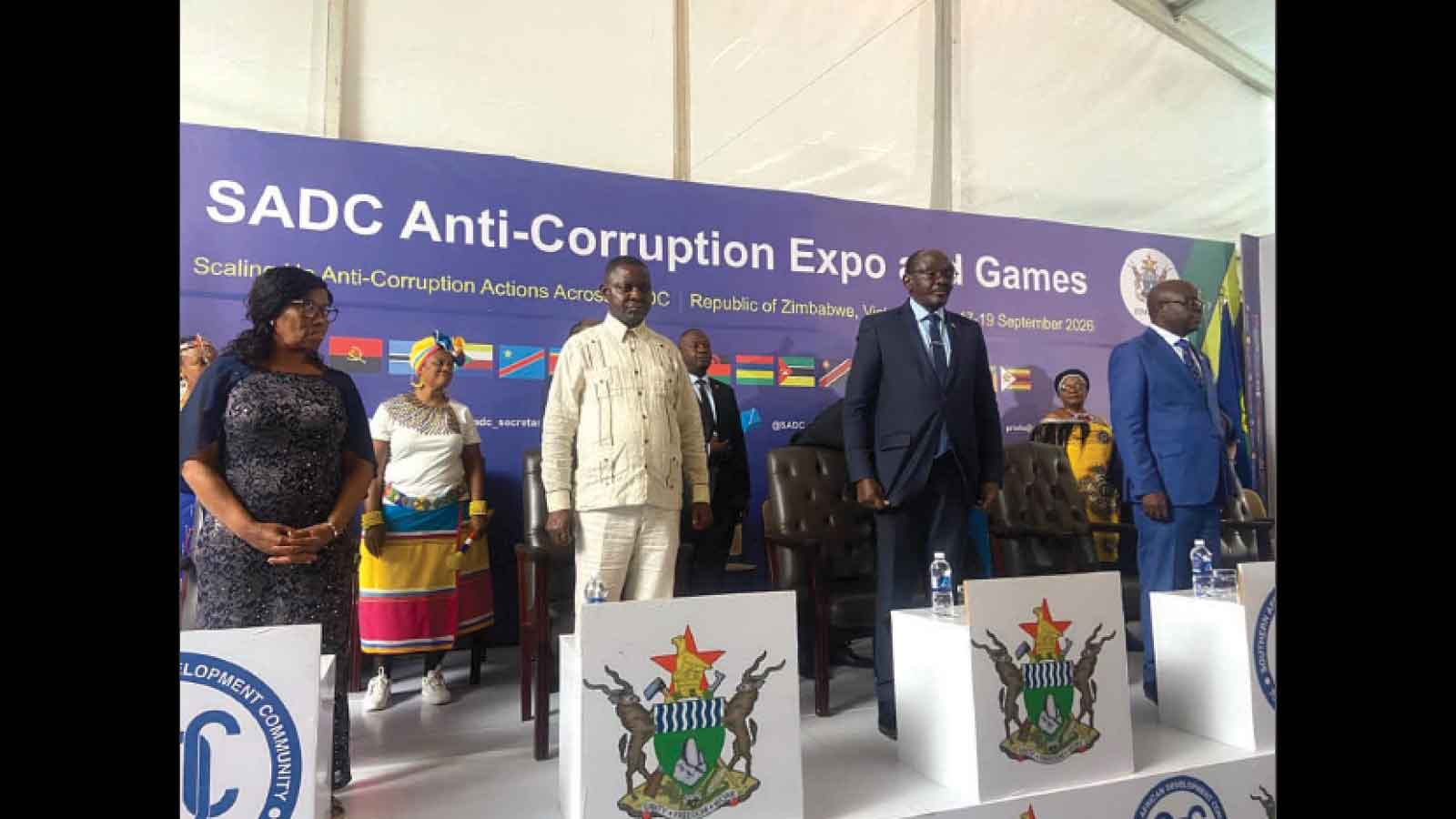
Rutendo Nyeve-Victoria Falls Bureau
VICE President Kembo Mohadi has called for anti-corruption efforts to be firmly anchored within broader regional and continental development goals, saying corruption remains one of the biggest obstacles to sustainable growth and prosperity.
Speaking at the official opening of the 2026 Sadc Anti-Corruption Expo and Games in Victoria Falls yesterday, VP Mohadi said the fight against corruption could not be separated from the region’s development agenda, as resources lost through graft deprived citizens of essential services and economic opportunities.
“The fight against corruption is, therefore, inseparable from our development agenda. Every resource lost to corruption could have been invested in schools, hospitals, roads, water infrastructure, agriculture, industry, social protection and employment creation,” he told delegates. Corruption is, therefore, not merely a legal or ethical problem; it is fundamentally a developmental challenge.”
The event, hosted by the Zimbabwe Anti-Corruption Commission (ZACC) under the theme, “Scaling Up Anti-Corruption Actions Across SADC”, has attracted more than 800 delegates from eight SADC member states.
VP Mohadi described the gathering as historically significant, recalling that Victoria Falls hosted the Third Regional Roundtable on Ethics and Governance in August 2000, where member states resolved to pursue collective action against corruption.
That initiative later culminated in the signing of the SADC Protocol Against Corruption in Blantyre, Malawi, in 2001.
“More than two decades later, we have returned to Victoria Falls to continue that legacy. Our gathering is, therefore, more than a ceremonial occasion; it represents the renewal of our collective regional commitment to combating corruption as a threat to development, public trust, democracy, the rule of law and the welfare of our people,” he said.
The Vice President said anti-corruption efforts must be aligned with the African Union’s Agenda 2063, particularly Aspiration 3, which promotes good governance, democracy, human rights, justice and the rule of law, as well as the SADC Regional Indicative Strategic Development Plan (RISDP 2020-2030).
“The fight against corruption must be situated within our broader regional and continental development aspirations,” he said.
He added that in Zimbabwe, principles such as good governance, accountability and transparency are central to the country’s Vision 2030 and National Development Strategy 2 (NDS2).
VP Mohadi urged SADC member states and regional anti-corruption bodies to prioritise implementation of the SADC Strategic Anti-Corruption Action Plan 2023-2027, saying its success would depend on sustained political commitment, strong institutions, adequate resources and effective cooperation among member states.
He also commended the SADC Anti-Corruption Committee for developing the Regional Anti-Corruption Effort Index, which has already been piloted in Mauritius and Tanzania, saying the tool would help countries assess their progress and identify areas for improvement.
Highlighting Zimbabwe’s anti-corruption framework, VP Mohadi said Government had established specialised Anti-Corruption Courts and introduced a Fast-Track Courts System to speed up the handling of corruption and economic crime cases.
“Zimbabwe has made it mandatory for public institutions to establish Integrity Committees to identify corruption risks and design appropriate preventive measures. More than 300 institutions have established functional Integrity Committees, and Integrity Pledges continue to be signed across the public and private sectors,” he said.
He also outlined progress towards strengthening protection for whistleblowers and witnesses through the proposed Whistleblowers and Witness Protection Bill, which seeks to establish stronger institutional mechanisms, including a Witness Protection Unit within the National Prosecuting Authority.
VP Mohadi said citizens who expose corruption should be protected, adding that the principle of leaving no one and no place behind must extend to those who come forward with information.
On asset recovery, he stressed that the fight against corruption should not end with arrests and convictions.
“We must follow the money and ensure that the proceeds of corruption are recovered and returned to productive use. Corruption must not be allowed to remain profitable,” he said.
He further called on the SADC Anti-Corruption Committee to review the SADC Protocol Against Corruption to ensure it remains responsive to emerging threats such as cybercrime, virtual assets, artificial intelligence and increasingly complex financial systems.
VP Mohadi said strengthening digital forensics, financial intelligence and cross-border cooperation would be critical in confronting new forms of corruption.
He emphasised that the fight against corruption could not be left to Governments and law-enforcement agencies alone, but required the active participation of Parliament, the judiciary, the private sector, civil society, academia, the media, traditional leaders, community leaders, youth and ordinary citizens.
Zimbabwe is the first country to host the SADC Anti-Corruption Expo and Games under new rules adopted in July 2025 by the SADC Ministerial Committee of the Organ on Politics, Defence and Security Cooperation.
VP Mohadi concluded by expressing appreciation to the SADC Secretariat, the SADC Anti-Corruption Committee, ZACC, the Joint Executive Committee and the Technical Working Committee for organising the event before officially declaring the 2026 SADC Anti-Corruption Expo and Games open.



