

 admin
admin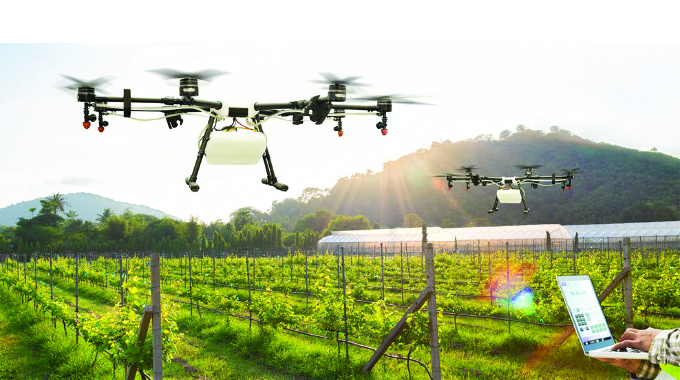
Enacy Mapakame Business Reporter
SMART farming, which leverages technology across value chains, is the way to go to improve productivity and efficiency, but limited access to technological gadgets by smallholder farmers has slowed the adoption of the concept in Zimbabwe.
The introduction of smart farming enables increased yield through more efficient use of natural resources and inputs, and improved land and environmental management, which experts say can help Zimbabwe restore its breadbasket status again.
Commenting during the Global Renaissance Investments (GRI), a local firm seeking to drive the growth of entrepreneurial initiatives, Smart Farming Indaba and Business Dinner in the resort town of Victoria Falls last week, GRI chairman Professor Joseph Kamuzhanje said smart farming initiatives should be adopted across the agriculture value chain to maximise production and efficiency.
“We need to improve the quality and quantity of production. The smart concept has to be incorporated everywhere for us to achieve good results.
“We need a smart farmer, smart supplier, smart consumer, smart financing mechanism and not to address just one component of the value chain and expect it to influence the whole agriculture sector. Everything has to be smart,” he said.
Agriculture is the backbone of Zimbabwe’s economy accounting for almost three quarters of the raw materials needed in manufacturing while employing over half of the employable population.
The sector is also seen playing a critical role in helping the country achieve the upper middle-income economy by 2030 as espoused in Vision 2030. Experts have also said employing smart farming techniques such as those practised in India will see the country more than double output, largely driven by smallholder farmers.
The concept of smart farming refers to managing farms using technologies like Internet of Things (IOT), robotics, drones and Artificial Intelligence (AI) to increase the quantity and quality of products while optimising the human labour required by production.
This becomes ideal at a time yields have been declining among small holder farmers, creating scope for the adoption of such to boost food production and food self-sufficiency.
In line with plans for the country’s development and transformation, the Government has also developed an all-inclusive, focused and forward-thinking guideline that articulates how the country will develop, deploy and manage ICTs across all sectors – The Smart Zimbabwe 2030 Master Plan – which works through key specific sector-focused integrated pillars that act as Smart Solutions. These include Smart Government, Smart Cities, Smart Agriculture, Smart Education, Smart Transport, Smart Health, Smart Tourism, Smart Mining.
However, the cost of ICT products and services to drive these initiatives is still a challenge, especially among low income smallholder farmers. For instance, the cost of data and Internet services where virtual offices, conferences and e-learning are fast growing.
Commenting at the same indaba, Powertel Communications’ Lindaray Marembende highlighted the need to bridge the technology and connectivity divide at grassroots level with a multi-stakeholder approach.
“While we are looking at bridging the connectivity divide, we also need partners on board in terms of the devices needed especially by those in rural communities to ensure total connectivity and access to information,” she said.
Organisations such as telecoms giant – Econet Wireless Zimbabwe have seen data usage grow through the introduction of its device strategy, which is also meant to increase smartphone penetration and bridge the digital divide.
Econet introduced the Smart Kambudzi device, which saw smartphone penetration going up by 2,6 percent to 63 percent, which also helped increase the data active customers per day to 2,56 million (December peak).



 Online Reporter