Online Reporter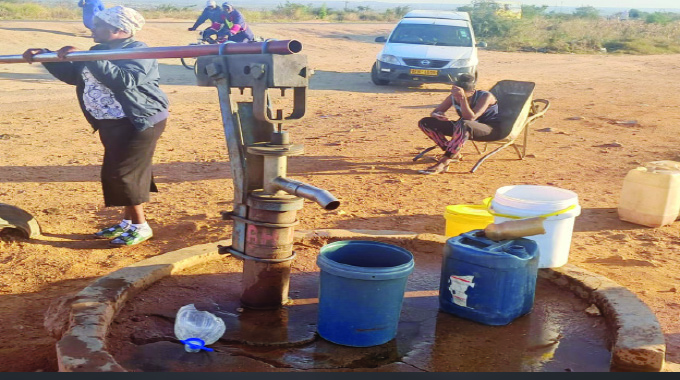
Raymond Jaravaza, [email protected]
FACED with chronic water shortages that have long plagued its residents, Bulawayo City Council (BCC) has accelerated a programme to augment existing water supplies by drilling 20 high-impact boreholes that will supply Emganwini, Nkulumane and Nketa suburbs in the proposed Umganin Aquifer zone.
The underground water source is expected to alleviate water challenges in the city.
The initiative follows a comprehensive groundwater survey conducted under the WaterWorX-WS2 Project.
The three suburbs were selected to benefit from the new water augmentation programme as they host the highest density of boreholes in the city and the Umganin Aquifer has the potential to supply the city with a daily yield of four megalitres..
The city’s daily water demand sits at between 155 and 160 megalitres per day.
Bulawayo relies on Mtshabezi, Umzingwane, Lower Ncema, Upper Ncema, Insiza and Inyankuni dams as well as water from the Nyamandlovu aquifer to meet daily demand. The Nyamandlovu aquifer, however, faces rampant vandalism of pumps and other critical borehole equipment.
The exploration of the Umganin site represents a strategic move to diversify these sources and reduce dependence on rain-fed reservoirs.
In its latest minutes, BCC said three pilot boreholes have been drilled within the Umganin Aquifer.
“The Umganin Aquifer could materially contribute to Bulawayo’s water security if development proceeded through targeted drilling, disciplined monitoring, and controlled scale-up based on proven performance.
“The Umganin Aquifer could support meaningful abstraction as one highly productive borehole was confirmed and sustained 4,5 m3/hour with minimal drawdown, indicating strong and stable inflow. Evidence suggested yields could safely increase to 10 m3/hour,” read a council report.
According to the council report, the other two boreholes were unsuitable for bulk supply and showed rapid drawdown and low yields that are limited to small-scale or community use.
“Twenty plus boreholes with performance to the high yielding borehole have the capacity to yield 4megalitres/day, output that matches the project’s original target. Groundwater could
therefore serve as a strategic drought-mitigation and supply-diversification measure not a replacement for surface water but a stabilising supplement,” read the report.
Council noted that Gwayi-Shangani Dam offered the city long-term water solutions.
“The dam has a capacity of 634 million cubic metres and will have a 252km pipeline, a water treatment plant and six pump stations. At the moment, the dam stands at 75 percent completion and water impounding is set to begin this year,” said council.
Residents have welcomed the water alleviation initiative as a short-term solution for the three suburbs.
“Nkulumane is one of the biggest suburbs in Bulawayo and if the aquifer can supply three suburbs with water, then it will mean other suburbs will benefit from the main supply from council. Our suburb is plagued by sewer blockages due to water shedding so we hope the water supply will be stable once we start tapping into the aquifer,” said Nkulumane resident Mrs Melody Mpofana.
Mr Mthuli Khumalo, a Nketa resident, however, questioned the long term viability of the aquifer, arguing that vandalism on council infrastructure is rife in western areas.
“We have so many boreholes that were drilled by council and non-government organisations here in Nketa that were vandalised, so I’m skeptical about how the new boreholes will be spared,” he said.