

 admin
admin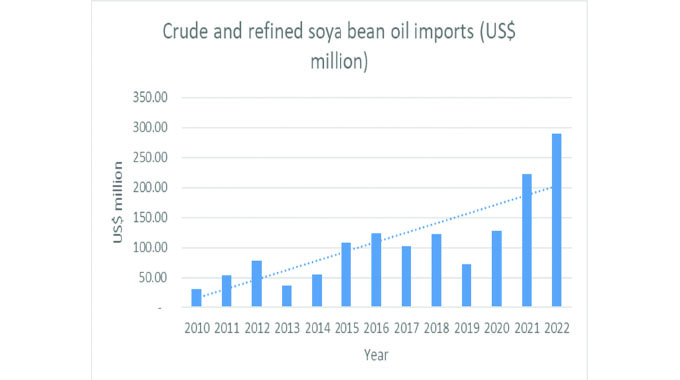
Edgar Vhera
Agriculture Specialist Writer
THE Government’s import substitution drive continues to gain traction with crude and refined soya bean oil imports set to drop by 55 percent from US$290 million in 2022 to US$130 million this year.
This has been revealed in the second and final Crop, Livestock and Fisheries Assessment report (CLAFA-2) released by the Government recently.
The report indicated that oil seed production had increased in both area and yield due to the combination of good agronomic practices and a favourable season.
The CLAFA-2 report shows that soya bean production was expected to increase 13 percent from 82 028 tonnes in the 2021/22 season to 93 086 tonnes this season.
Sunflower production was estimated to increase by a whopping 714 percent from 11 117 tonnes in the 2021/2022 season to 90 479 tonnes this year, said the report.
Cotton production was estimated to increase 172 percent from 56 043 tonnes in 2021/22 season to 152 472 tonnes in the 2022/2023 season.
The country requires about 140 000 tonnes of cooking oil per annum.
If the country is to process all the expected oil seed output locally, then 72 496 tonnes of crude oil will be produced from current production.
The country will be required to import 67 504 tonnes of crude oil to ensure sufficiency for local consumption.
Soya bean, sunflower and cotton are strategic crops, which produce raw materials for oil expressing, stockfeed manufacturing and food industries.
Though the country requires about 240 000 tonnes of soya bean per annum for cooking oil and stockfeed manufacturing, increased production of soya bean, sunflower and cotton seed will result in reduced imports.
The growth of livestock industry, especially poultry, piggery and fish as well as change in eating habits wherein an increasing number of consumers prefer white over red meat has driven the demand for soya beans.
Since 2010 the country’s imports of crude and refined soya bean oil has been on an upward trend from a low of US$30 million in 2010 to the 2022 value of US$290 million, a whopping 867 percent rise.
For import substitution, the Government has called on local industries to fund at least 40 percent of their raw materials requirements through increased local production as a smart way of avoiding exporting jobs and expenditure on foreign currency payments from cooking oil imports.
Efforts to get a comment from Oil Expressers Association of Zimbabwe chairman, Mr Busisa Moyo on the impact of increased production of oil seeds on cooking oil production were fruitless by time of going to press as he said he would only do so after going through the report on CLAFA-2.



 Online Reporter