admin
admin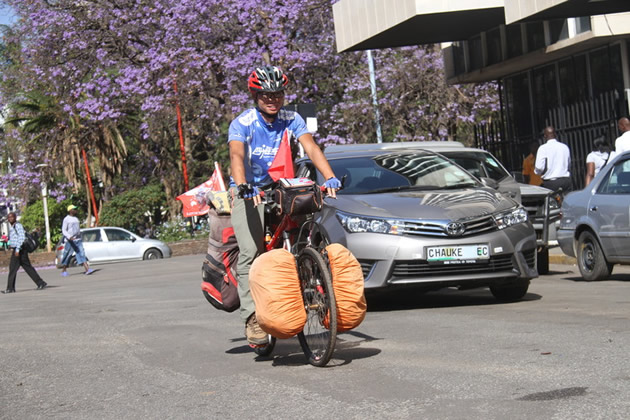
Monica Cheru-Mupambawashe Lifestlye Editor
Zhong Si Wei thinks that Harare is the most beautiful place to be in October and he gives all the credit to the giant jacarandas blooming all over the city.
“I am not saying that just because I am here,” he quips with a smile.
His judgment carries weight. Because he has had close encounters with 14 other countries beside his home country of China to compare it to.
Si Wei has set himself a target to get to the ground in as many places of our planet as he can. Since the fictional Phileas Fogg went around the world in eighty days in the nineteenth century, many more people have had their own versions of the sojourn with some doing it on the waters that separate the continents, some opting to drive and yet others choosing to take to the skies.
Si Wei has made the humble bicycle saddle the perch from which to view the world because for him there is more to a land than its tourist attractions.
It is not enough to just visit a country and pay the obligatory visit to its landmark sites. For him, it is so much more: It is about meeting the real people not the polished tour guides, eating their food, looking at the night sky from their neighbourhoods, and occasionally facing the monsters that they grapple with.
The 26-year old man set off from Hang Zhou in China in July last year. He jumped onto his Merida mountain bike laden with his luggage and equipped with a digital odometer, then waved goodbye to his family who were rather ambivalent about his dream.
“I worked for two years in the hospitality industry after college. I was saving money to fulfil my dream of cycling in many countries on all continents in three years. I have no sponsors and my family did not support the idea because they felt that it would be too dangerous.
Two months later in September he exited China for Nepal. It took him one month to traverse that nation then he had to forego his wish to see India as he could not get a visa. Instead he went to Sri Lanka and it took him 26 days. He decided not to risk Syria, Iran and Iraq and packed his bike for a plane ride to Jordan which stands out for its expensive food.
“I got to the Dead Sea which is the lowest point in the world being only 142 metres from the sea level,” Si Wei reminisces. He could not get a visa to enter Israel and he did not waste any time crying over that and instead made for the land of the Pharaohs.
He says that most countries that he has been to he has found the local people to be warm, welcoming and definitely worth knowing. But of course, there are bound to be bad moments.
Passing through a volatile part of Egypt he was mugged by some stone wielding brigands and it was only the timely arrival of some motorists which saved him and his property.
“The men stoned me. I fell off my back and grazed my knees. One of them immediately ran up to where I lay injured and tried to grab my money pouch. Then my saviours arrived and the robbers ran off. They took me to the police station where I was treated with much kindness. They put me up for the night and the next day they escorted me with a police vehicle alongside my bike. But at some point they said it was too dangerous and I put my bike in the back and rode in the car.”
Si Wei says the experience did not sour his views about Egypt as everyone else was good to him. Another unpleasant incident was in the mountains of Ethiopia when a cacophony of voices from little boys chased him asking for money. It was not dangerous but it made him uncomfortable. A strong constitution in addition to stamina has helped Si Wei.
“I was unable to get bottled water while passing through some remote desert areas of Sudan and I had to drink Nile River water. I had a permanent runny tummy.”
He has had nine burst tyres.
Other countries he has been to include Sudan, Kenya, Rwanda, Burundi and Tanzania.
He entered Zimbabwe on 18 September via the Victoria Falls border post. Although he carries some provisions including a bottle of cooking oil and noodles, Si Wei tends to eat local food when he can as part of the experience. The Zimbabwean staple of sadza did not come as a new treat to him.
“I had already eaten that under different names in places like Kenya and Tanzania. I had already learned to love it. Generally in Zimbabwe I had bread in the morning, sadza in the afternoon and noodles in the evening.”
When he set off from the remote town some cops asked him where he was bound.
“I said Harare and they did not believe me. So later when I was asked I would tell people that I was headed for Bulawayo but they still did not believe me.”
At one point he went for a 45-kilometre stretch without encountering a single human, even in a passing vehicle. He was beginning to feel rather desperate when he finally hit a village around six in the evening.
“I was so tired because I had pushed myself way beyond the daily limit. But I could not stop because I was afraid of wild animals. When I got to the village I was so relieved.”
Si Wei’s bike carries five bags which at 60kg weigh more than his 56kg body weight. Besides his cooking utensils and provisions, he also has some clothing including items for cooler temperatures, bedding, a tent, shoes, toiletries, medicines, and a bicycle repair kit.
“From the time I set out I have covered more than 22 000 kilometres and I have had to sort out my wheels nine times.”
Si Wei exits Zimbabwe today via Mutare and will eventually leave the continent on a plane to the American continent where once again Google maps and visa grants will determine where he heads next. But Alaska is not in his plans – too cold. After that he will tour Europe before finally returning home to take up another job in the tourism sector.
The Zimbabwean Chinese Business Association is keeping tabs on Si Wei’s adventures on their website (<http://zcba.org.zw>). The updates are to be found in the English section titled “Love in Africa”.


 Online Reporter