Online Reporter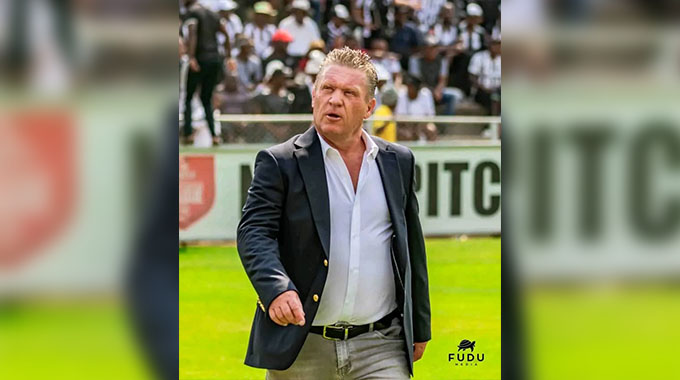
Lovemore Dube, Zimpapers Sports Hub
PIETER De Jongh believed his work at Highlanders was far from done. He had stepped in for a four month rescue job and kept Bosso safe from relegation, then pushed them into the semi finals of the Chibuku Super Cup. When the club let him go last week, he left feeling he had delivered on every promise, yet never got the chance to start the rebuild he thought the team needed.
Speaking from Nairobi, his adopted home, De Jongh said Highlanders had deeper problems than coaching changes.
His voice still carried that sharp edge his followers know so well.
“How many coaches have come and gone at the club. For their own failures, the executive fires coaches without looking at the real problems at the club. They start with the executive, which is in office and the lack of quality on the field. It is no point sacrificing the coaches for poor management,” said the fiery coach.
He said he was satisfied that he had done the job he was hired for. His mandate was simple. Save Highlanders from relegation.
And the team survived. Bosso finished the season in eleventh place and he came close to matching his 2019 run when he saved the club and won the Chibuku Super Cup. This time the journey ended in the semi finals after a penalty shootout loss to Dynamos.
“I achieved what I was engaged for. I was contracted to save Highlanders from relegation. Three days after I arrived I wrote to the club that there was no quality in the squad and that I needed reinforcements. I said to them, that being the case, what is important was to motivate the boys match by match to do better.
“They were stressed and demotivated because of signing on fees that have been owing for two to three years. Bonuses were taking too long to come. From the time I arrived there were four strikes for bonuses and signing on fees. That is not good for a big club like Highlanders. They must be more professional and take matters to do with the first team seriously,” said
He was stunned that some development players earned more than senior squad members. He felt the Bosso 90 project had drifted away from its purpose.
“First, it is criminal to have a player development side earning two times what a very good first team player is earning. That is not good for the club, its criminal. Club must act and have development played for by players who are 16, 17, 18 and 19, 20 is too late to develop, but we had some with 24 years. That is useless and coaches there not good for job. Bosso was famous for producing very good players 20 years ago. Junior teams must play first team philosophy and coaches need to be good for development,” he said.
Past Bosso structures consistently fed the senior team. Andrew Mbeba is the only academy product to cement a regular place since 2019.
De Jongh returned to Kenya on Thursday, frustrated that his contract was not renewed. He thanked the fans and singled out vice chairman Fiso Siziba, for backing him throughout his stay.
“I expected a contract extension, the vice chairman and supporters were very good to me. After saving the team, only the vice chairman called to congratulate me, he even said good bye and would come to our training sessions while other executive members never bothered,” said De Jongh
“Two times I save Highlanders. First time I win a cup in four months and this time I reach Chibuku Super Cup and survive but club decided not to give me a chance to build a new Highlanders,” he said.
He is now taking a break from coaching while running his businesses in Kenya, which include a bureau de change and farming with 40 employees. Yet he returned home upset that Highlanders had misplaced his original coaching certificates. He had handed them over on July 28 after agreeing to take charge, in meetings that involved chairman Kenneth Mhlophe, Siziba, acting chief executive Kindman Ndlovu and treasurer Nkani Khoza.
“They lost my papers when applying for my visa. Visa took more than four weeks, I had to push. Three days after starting work I told the executive that the team did not have quality for a club like Highlanders and recommended a striker from Malawi with 72 caps and another player from Namibia. But club was slow in everything,” he said.
He said he was troubled by the delays in paying players, the absence of training kit for new signings and even simple equipment shortages.
“They were using their own clothes, which is not good, I asked for electric ball pump, it’s worth less than US$100, but four months later the club had not yet bought,” he said.
There were moments he reached into his own pocket. He once paid US$1 000 to motivate the squad and covered US$120 for stadium hire at White City B Arena. The refund arrived three weeks later.
Through all this, De Jongh said Highlanders must shift their attitude and invest properly in the first team if they want real progress. He believes the club needs stronger recruitment and firmer football business decisions.