admin
admin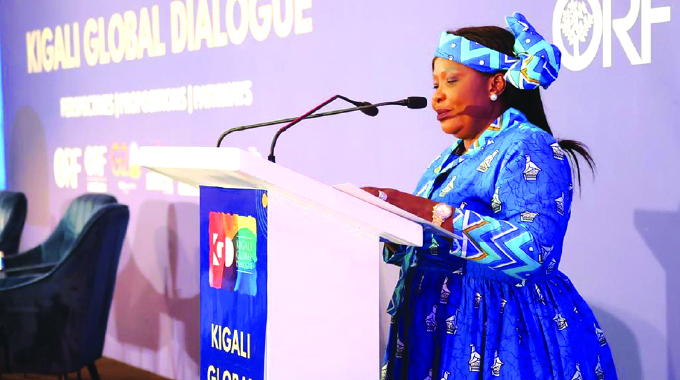
Tendai Rupapa in KIGALI, Rwanda
FIRST LADY Dr Auxillia Mnangagwa yesterday shone like a beacon at the Third Kigali Global Dialogue in Rwanda where guests roundly praised her charity work, tireless empowerment initiatives and tangible solutions to challenges affecting people, saying she had set a benchmark for other countries of the world to follow.
Her address as guest speaker on the topic “Elevating Young Voices and Catalysing Action” left the audience spell-bound and eager to learn more from her.
The First Lady expressed her heartfelt thanks and appreciation to the organisers and the attendees of the Kigali Global Dialogue where she said she was heartened to see many young faces participating in the critical proceedings.
The idea of dialogue, she said, was so important to everyone in this day and age.
“Dialogue allows us to discuss our differences, share what binds us in common and together find solutions to the problems and challenges that all our nations and communities face. My country, Zimbabwe, like many countries across our continent, faces similar challenges as we are well past the days of independence and well into the days of democracy, sovereignty and freedom. Many of these challenges confront our younger citizens. Citizens who are but mere children in primary school level and high school. Young people in university facing an uncertain job market, and young families working to provide the best they can for their own children and their communities,” she said.
Dr Mnangagwa said it was critical to invest in young voices and said she attended the dialogue not just as a First Lady of Zimbabwe, but also as a wife, a mother and grandmother.
“An investment in young voices is an investment in our future. An investment into prosperity, security and into stability. I also find it important to share with you that while I will certainly discuss what we are doing to invest in young voices, I have found that we must focus first on helping our young people ‘find their voice’. It is only after we give our youth the strength and self-esteem that comes with establishing their own voice, that we can then begin to invest in those voices.
“While the experiences I will share with you today are what I have been personally involved with in Zimbabwe, I firmly believe they can stand as examples for all Africa’s young generation. There are so many places one can look when wanting to invest in young voices. None is more important than education. By ensuring young people, especially those in underpriviledged communities, have the opportunity to learn and receive quality education, we immediately give them a strong and powerful voice for their own future,” Dr Mnangagwa said, to thunderous applause.

First Lady Dr Auxillia Mnangagwa, other philanthropists and influential delegates follow proceedings during the Kigali Global Dialogue where she gave her address
Even before becoming First Lady, when she was a legislator in Parliament, she started a scholarship programme for young people, especially in the poorer areas of Zimbabwe investing in the future of both boys and girls.
“I wanted to make sure girls had the same opportunities as boys. This was intended to avoid child marriages. Often families in underpriviledged communities married off their daughters at school-going age and in doing so, deprived these young girls of their education. And even worse, exposed these young girls to health challenges and even abuse. The scholarship programme I developed through my Angel of Hope Foundation seeks to stop this problem by offering these young girls the ability to get a solid education and even attend the most prominent of educational institutions in Zimbabwe. Thanks to this programme, we are having a meaningful effect of eliminating child marriages.
“It also has the impact taking children who are living and working on streets, away from such a hopeless existence and placing them in schools and vocational training centres where they can thrive and find their own voice,” she said.
Scholarships for education in schools, the First Lady said, were not the only way through which she was helping young people in Zimbabwe to find their voices.
“For some of our young people, especially those just beyond the age of school, we are focusing on training our young people in ways that economically empower them. In my capacity as First Lady, I have launched across all the provinces in Zimbabwe, a ‘skills development programme’ that aims to give certificate accreditation to young adults in a broad range of courses. We are teaching these young adults, especially women and girls how to produce detergents, liquid soap, perfumes, bars of soap and petroleum jelly. We are teaching them skills in dressmaking, bedding, interior deco, baking, carpentry, and cosmetology. We are even giving them training in information communication technology as well as cell phone and computer repairs,” she said.
Dr Mnangagwa said her aim was simply ensuring all young people, especially the most marginalised and disadvantaged, unlocked their potential through skills training in self-sustainable industries.
She said she was providing economic empowerment to men and women that would prove to be economically prosperous for them and their families.
“I believe this is something needed throughout our continent, Africa. Another area I am focused on as First Lady is leveraging Zimbabwe’s rich agricultural economy into opportunity for women and girls in many rural and agricultural areas. Zimbabwe has large amounts of agricultural land and this has been dominated by men. Under my leadership, we have started the “Agri4She” project. Farming aimed at women only.
“The Agri4She programme yields many benefits and not just to young women. But by empowering young women to take part in Zimbabwe’s agricultural sector, we are helping propel forward the aspirations of food security and nutrition under the Vision 2030 plan announced by the President of the Republic of Zimbabwe His Excellency Cde ED Mnangagwa.
“Under the Agri4She programme, tens of thousands of women have been given seed maize, sunflower seed, vegetable seeds, chemicals and fertilizer. We are encouraging young women in agricultural areas to become real partners in the industry across our country. These women are transforming their way of life, by not just becoming farmers, but also becoming income earners for their households. And by becoming an income earner, these women are finding their own voice in their homes and their communities,” she said.

First Lady Dr Auxillia Mnangagwa poses with Mr Isibor Aigbe Oaikhinan (Nigeria), Ms Vidisha Mishra, Ms Chada El Islam Manel Benmahcene (Algeria), Ms Aakanksha Tangri (UAE) and Mr Vene Seane Aljas (Philippines) after her address to delegates at the Kigali Global Dialogue in Rwanda
Dr Mnangagwa said Agric4She was not limited to just growing crops. There was also training for young women in livestock production.
The programme of Agri4She has also branched out into Livestock4She, Poultry4She and Goats4She to name a few. The Goats4She programme alone distributed over 600,000 she-goats and 35,000 he-goats.
“Our purpose is to give women the ability to partake in economic benefits of livestock rearing and become contributors to their households. The emphasis is on the women to grow more crops that are resistant to climate change. These are our domestic traditional grains such as millet, rapoko, sorghum, groundnuts and many others. Alongside the training, we also provide knowledge in bookkeeping, marketing and basic economics so that these young farmers are able to manage what amounts to their own small businesses. There are other benefits to these programmes as well. Now these families have the economic resources to educate their children. And as many of these young women become income earners, we see a better balance in their home lives, the strengthening of their relationships with their husbands and a decrease in abuse and divorce cases,” she said.
The First Lady said investing in young voices required an approach that met the individual needs of young people.
Some young people, she said, needed a pathway to a solid education.
“Others may need skills to help them start their own small businesses. Then there are some that need to be lifted as equals in their homes and share in the economic prosperity of the household,” she said. “I have tried to approach the challenges in Zimbabwe through the lens of a mother and grandmother. I want for every young person in Zimbabwe what I want for my own children and grandchildren first to find self-esteem and self-respect within themselves. This may come from going to school or it may come from raising livestock but whatever the source, self-esteem and self-respect are the foundations of having a strong voice.
“Next, I want every young person in Zimbabwe to feel there is a path to prosperity and a path to realising their own dreams. By giving young people the skills and education necessary, we put them on this path of success. finally, I want young people to grow up and find real partners to start a home with. “Partnerships based on mutual respect and admiration. I am taking the training of cultural background to boys and girls where I am imparting knowledge on how to behave, to carry oneself, respect, how one dresses and how to carry out household chores. This leads to good courtship which takes young couples to solid homes for the next generation who will continue to contribute to their own families, their own communities and their country respectively.”
This, she said, was a model that could be replicated in every country across the continent.
“I came here to speak about the investment in young voices. These investments go well beyond the individual. They are not just building up young people but building a prosperous future for all of us. It is my sincerest hope that as part of this dialogue many of you can take from our example in Zimbabwe and apply the lessons learnt to your countries. Together through dialogue we can build a prosperous future for our entire continent,” she said.
Immediately after delivering her speech, the First Lady’s works were beamed on a giant screen earning her many admirers as guests urged her to continue with her life transforming interventions.
Mrs Chada El Islam Manel Benmahcene, the CEO and Founder of ENTROGX, Algeria, said she was elated by the First Lady’s investment in time and resources towards improving people’s lives.
“I have been listening to the speech of her Excellency the First Lady of the Republic of Zimbabwe and I was very amazed by the impact that her programmes are having. We need such people who have others at heart. She is an amazing example of how a person can not only empower and enable the young population and the female population, but also be on the ground and actually be with them and show the way and lead the way as we say ‘walking the talk’. From what I saw in the video clip showing her works, she is indeed walking the talk. Agric4she, all those amazing programmes that she is doing, we need more of that on the whole of Africa and I am glad to see Zimbabwe leading the way in giving an example to the whole continent,” she said with a broad smile.
This dovetailed with the views of Mr Vene Seane Aljas, a Legislative Staff Officer III, Office of the President, Presidential Legislative Liaison Office, the Philippines.
He said Dr Mnangagwa had set a benchmark for Africa.
“When I heard the First Lady speak about the programmes that she is implementing, I believed that she has set a benchmark not only in the African continent but also globally and everyone can learn from her,” he said.
“I would like to commend the generous works of the First Lady of Zimbabwe Dr Auxillia Mnangagwa for empowering the youths which I believe is very important and I think that countries, especially the global south countries can learn from the benchmark. The best practices that she presented that she is advocating and I think that the First Lady is doing a really good job in honing the future leaders of Zimbabwe to take up their culture and become the leaders on their own and to address the global challenges that we are confronted with at the moment.”
Mr Isibor Aigbe Oaikhinan, a legal officer, was equally awestruck.
“I am really happy to be at the Kigali Global dialogue and I heard the First Lady and the work that she is doing in Zimbabwe which is very good and is a form of empowering the youths and that is what we need. We need youths to be empowered. In terms of whatever sphere you are in life, you need to be empowered. When you are empowered, you have that support from the Government and we need policies and not policies that are not responsive and impactful. I am pleased by the work that she is doing in Zimbabwe. I commend her efforts and she should keep doing it that’s what the youths need. The youth need to be heard and empowered. Once the youths are empowered, it brings social and economic impact into the society and that’s what we want,” he said.
Earlier, on introducing the First Lady, Mr Samir Saran gave a moving citation of her many activities.
“She is busy. She is someone who champions one of the most crucial issues that confront all of us. That’s been the problems we discussed in some of the previous sessions that we had. Through her trailblazing Angel of Hope Foundation, she has countless educative and empowerment programmes to uplift the girl child, orphans, widows, youths and those with disabilities. She started her work when she was a member of parliament way before she became the First Lady and in many ways this is her passion and she is committed to lightening the burden of others, especially those who need care and attention. On assumption of her role as First Lady, she has intensified her initiatives of empowering the vulnerable groups by creating the Angel of Hope Foundation. A champion of women economic empowerment, advocate of reproductive health and teaching the communities about the risks of not being checked regularly she is committed to this cause deeply and positively,” he said.



 Online Reporter