Online Reporter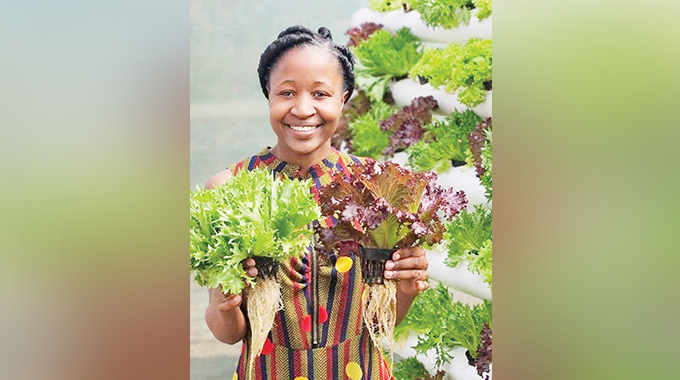
Patience Ndlovu, [email protected]
A GREEN revolution is taking shape in Bulawayo’s Waterford suburb led by a determined young woman who is redefining urban farming in the city.
At just 28 years old, Ntombifikile Ncube has defied traditional farming norms by embracing hydroponics, a soil-less farming method that uses nutrient-rich water to grow crops. Ncube is the founder and chief executive officer of Dexter Rising Spirit Technologies, a start-up that is already changing the city’s urban agriculture space.
“I started my journey in hydroponics in 2022 after struggling with traditional farming methods, which were labour-intensive and heavily reliant on irrigation equipment I couldn’t afford,” said Ncube.
Hydroponics farming is a method of growing plants without soil, using nutrient-rich water instead. It involves suspending plant roots in a water solution that contains all the necessary nutrients for healthy growth. This technique allows for controlled environment agriculture, potentially leading to faster growth rates and increased yields compared to traditional soil-based farming.
“Unlike conventional farming, hydroponics consumes up to 90 percent less land and 80 percent less water. This makes it not only sustainable but also ideal for resource-limited urban environments,” said Ncube.
Inside her backyard greenhouse, rows of leafy greens grow in precisely controlled conditions. Ncube specialises in lettuce production, but what sets her apart is how she’s added value to her produce. Faced with an oversupply and limited market access, she started experimenting and successfully launched lettuce chips, an innovative snack made from dehydrated lettuce.
“When I started, I didn’t have a strong market for fresh lettuce, and some of it went to waste. That’s when I decided to create value-added products like lettuce chips. Now I’m not only farming, but also processing and packaging,” said Ncube.
Her entrepreneurial journey received a major boost through a US$4 000 grant from SNV, a Dutch non-governmental organisation supporting sustainable development. With that seed funding, Ncube built her greenhouse and bought inputs.
While her business is still in its early stages, Ncube has already started inspiring others. She has travelled to several countries, sharing her experience with fellow hydroponics farmers and hopes to establish herself as a regional leader in climate-smart agriculture.
“As the project grows, I hope to create employment opportunities for young people in Bulawayo and train them in modern farming techniques,” she said.
The Government is actively promoting agricultural innovation and youth participation in farming, particularly through climate-smart and urban agriculture models.
Under the Agricultural and Food Systems Transformation Strategy (2020–2025), which is aligned with Vision 2030, the Government has prioritised modernising agriculture to increase productivity, food security and resilience against climate shocks. One of the strategy’s key pillars includes encouraging smart farming technologies such as hydroponics, aquaponics and precision agriculture.
The Second Republic wants Zimbabwe to be a regional leader in promoting youth involvement in the agricultural sector and its efforts to integrate them into the agrarian value chain serving as a model for the region.
The Government has introduced a cocktail of measures such as the youth business units, village business units, the Presidential 10-hectare scheme, the agriculture and food systems transformation strategy and school business units to make agriculture production a viable economic activity for young farmers.
The Second Republic’s decision to involve youth in agriculture is grounded in the recognition that farming is business. This approach endorses the crucial role that young people can play in the processes of transformation and the seamless replacement of the aging population of farmers.
The Government has developed and implemented a range of targeted policies and programmes that have effectively incorporated young people into different stages of the agricultural value chain.