Online Reporter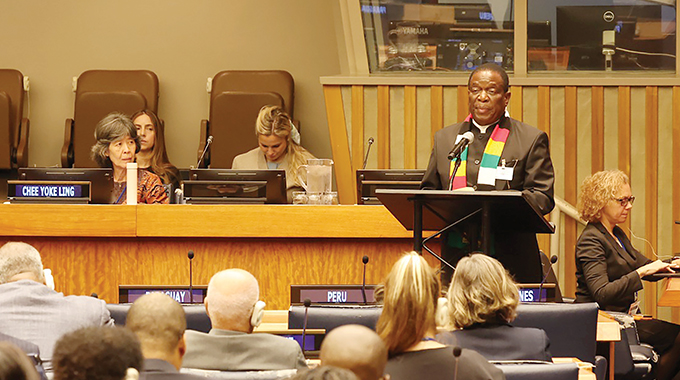
Wallace Ruzvidzo in New York, USA
Development acquires its fullest meaning when every person and nation has a genuine opportunity to shape its course and share the benefits, President Mnangagwa has said.
Addressing the High-level Meeting to Commemorate the 40th Anniversary of the Declaration on the Right to Development here yesterday, President Mnangagwa said development was a basic human right for all, rather than a privilege for a few within and among nations.
“Four decades later, the importance of people-centred development and fundamental principles of equality, participation, international cooperation, remains both critical and compelling. We commend the remarkable advances in science, technology, health and education,” he said.
The President, however, decried skewed global development, inequality, unsustainable debt, unfair trade conditions and inadequate development financing that remain prevalent.
He also said climate change and a widening technological divide continued to constrain the prospects of many people, particularly in the Global South.
“These challenges, for countries like Zimbabwe, are further compounded by unilateral coercive measures, that undermine international cooperation upon which the realisation of the right to development depends. This Anniversary, therefore, is an opportune moment for renewal and action,” said the President.
To achieve this, he said there was a need for conducive macroeconomic environments and enabling conditions for inclusive, equitable and sustainable development to ensure the Right to Development was realised.
“Furthermore, the sovereign preserve of our countries to pursue development pathways that are responsive to our unique circumstances, priorities and aspirations should be protected,” he said.
President Mnangagwa said Zimbabwe had made progress towards entrenching development that ensured the dignity of ordinary people, beginning with household and national food security.
“The quality of social services, including innovative education and wider access to potable water and sanitation, are priority areas for my Government,” he said.
President Mnangagwa said the next 40 years should see the world move from aspiration to implementation, and from the idealistic promises of inclusion to the lived experience of dignity, opportunities and a higher quality of life for all.
He assured the gathering of Zimbabwe’s unwavering commitment to a development paradigm that leaves no country or people behind.
“One that is founded on equality, solidarity and mutual respect,” said President Mnangagwa.
“As we celebrate this 40-year milestone, a legally binding international instrument on the Right to Development should be intentionally pursued towards translating our shared principles into more effective international cooperation and meaningful accountability.
“The measure of our commitment can no longer be the declarations we adopt, but the lives we transform.”
On climate finance commitments, President Mnangagwa said they should be honoured, adding that the Global South deserved greater access to concessional climate finance and technological support to strengthen resilience to climate-related shocks and accelerate sustainable development.
“Further, in this technology-driven era, the right to development must now be appropriately guided. Leveraging Artificial Intelligence, digitalisation and the energy transition to narrow inequalities, and not deepen them, is an area deserving our attention.
“Developing countries have a responsibility to humanity to actively help create, govern and benefit from new and emerging technologies,” he said.
In his remarks, UN Secretary-General Mr Antonio Guterres said development, human rights and international cooperation must advance together.
“The SDGs provide the blueprint to leave no one behind.
“And thanks to the dedication and resilience of countries, communities and activists of all ages, we’ve made remarkable progress,” he said.
The UN Secretary-General said the anniversary was more than a moment of reflection, but a call to action to deliver on the promise to protect the right to development for all.
He warned that the promise of development was facing new adversities, including inequality, rising debt, food insecurity, limited access to water and sanitation, conflicts and the climate crisis.
Adopted by the UN General Assembly in 1986, the Declaration on the Right to Development broke new ground in the universal struggle for greater human dignity, freedom, equality and justice.
It called for every member of society to be empowered to participate fully and freely in vital decisions and demanded equal opportunities and the equitable distribution of economic resources.
For the past four decades, the Declaration has provided a framework for advancing inclusive, sustainable and participatory development at all levels, while shaping related laws and policies.
The High-level Meeting to commemorate the Declaration’s 40th anniversary is being held in accordance with Assembly resolutions 79/170 of 17 December 2024 and 80/207 of 18 December 2025.