Patrick Chitumba, [email protected]
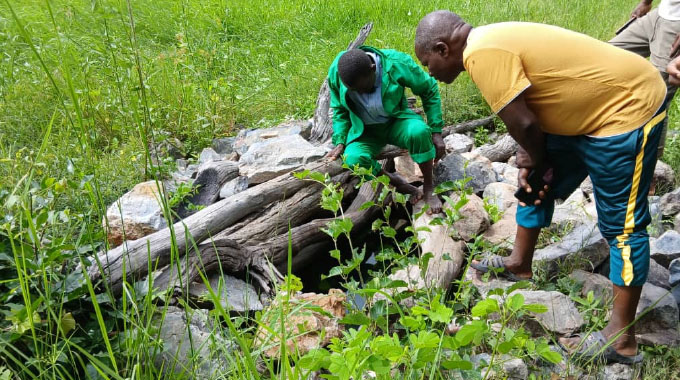
Village head Mr Richard Pedzisai (63), stands at the edge of Dewe Wetland in Dewe Village, Gokwe South District, his weathered face creasing into a smile as he gazes at the lush greenery.
“This is our lifeblood,” he says, his voice filled with reverence.
“We have protected it for years; it is still thriving, and it is our prayer that it will continue thriving for more years to come.”
The 2,5 hectare Dewe Wetland, located near Dewe Primary School in Copper Queen Farm under Chief Toringepi, Gokwe South District, has for decades been conserved through strict traditional methods that discourage deforestation, cultivation near the wetland, and other practices considered taboo. The wetland is a vital source of water and is also used for religious and cultural cleansing rituals.
Mr Pedzisai explained that the wetland’s survival has been hinging on strict traditional taboos, all standing firm and riding on co-operation from a united community. No one bathes or washes in the wetland, no one farms or cultivates near its banks, and no one cuts down its trees.
“It is not just about preserving nature. It is about respecting our ancestors and our traditions,” he explained.
The wetland, Mr Pedzisai added, is also a sacred space, where villagers visit to seek spiritual cleansing and connect with their heritage.
“You cannot bring your girlfriend here, or engage in romantic activities in the wetland,” Mr Pedzisai said with a chuckle. “That is taboo here, it is not just done here.”
Mr Pedzisai said the wetland’s survival depends on strict observances, warning that past violations had nearly destroyed it.
“This wetland dried up in 1974 after outsiders violated our traditions by bathing here and bringing girlfriends to this sacred place. Our elders consulted a spirit medium, cleansing ceremonies were done, and the wetland was restored,” he said.
Mr Pedzisai expressed concern that renewed violations now threaten Dewe’s future.
“Our fear is that the young generation is disrespecting our traditions . Some are using chemicals in gardens nearby and farming too close to the wetland. If this continues, Dewe may dry up again,” he bemoaned.
In Zimbabwe, traditional practices play a crucial role in conserving the country’s forests and biodiversity.
Among many Zimbabwean communities, these traditions are deeply rooted in cultural beliefs and serve as self-enforcing, eco-friendly conservation mechanisms.
The traditions are designed to protect sacred sites, biodiversity, and water sources by invoking fear of spiritual retribution, such as bad luck, sickness, or death. For instance, access to certain forests or areas is limited to traditional leaders or custodians during special ceremonies, and removing items like trees, grass, or animals is considered sacrilege.
Certain trees, like Muzhanje or Mutohwe, are protected, and cutting them is believed to be a bad omen. Harvesting wild fruits or insects before rituals is also taboo. Additionally, excessive noise, pollution, and defecation in sacred areas are forbidden, as is engaging in sexual activities.
Clan totems also play a significant role in protecting certain animals from being hunted or consumed, safeguarding species like elephants, monkeys and snakes.
These taboos are enforced by traditional leaders, who may impose fines or rely on spiritual consequences to maintain respect for nature.
The role of traditional leaders in enforcing these customs is crucial, and it raises questions about how these cultural beliefs conflict with modern, formal environmental conservation efforts. As Zimbabwe continues to grapple with environmental challenges, it is clear that traditional taboos will remain an essential part of the country’s conservation landscape.
According to Mr Pedzisai, those who violate these traditions are said to suffer mysterious misfortunes, reinforcing community compliance.
“This wetland sustained our parents, it is sustaining us, and we want future generations to benefit as well because there is no alternative source. The wetland supplies water for domestic use, livestock, and small businesses, including herds from neighbouring villages,” he explained.
As the world celebrated World Wetlands Day last month, Mr Pedzisai’s words echo with a sense of urgency.
“Our young people need to understand the importance of these traditions,” he said, adding, “We cannot afford to lose this wetland. It is our future.”
Government efforts to protect wetlands like Dewe are underway, with initiatives to increase sustainable management and rehabilitation.
The Environmental Management Agency (EMA) has taken notice of the villagers’ efforts. “Dewe Wetland is a shining example of community-led conservation,” said Mr Oswald Ndlovu, EMA’s Midlands Province spokesperson. “Their traditions are a powerful reminder of the importance of indigenous knowledge in protecting our environment.”
Zimbabwe is one of the 173 contracting parties to the Convention on Wetlands, having ratified it in 2014.
President Mnangagwa has said the various measures implemented by the Government to enhance wetland conservation include increasing the area under sustainable wetland management in alignment with the National Development Strategy 1 (NDS1), now NDS 2, the Wetland Rehabilitation Rolling Plan, and the National Biodiversity Strategy and Action Plan (NBSAP).
The National Wetlands Policy and the Environmental Management Act (Chapter 20:27) serve as key legal frameworks guiding wetland protection efforts.
“Zimbabwe is one of the 173 contracting parties to the Convention on Wetlands, having ratified it in 2014. This demonstrates our full commitment to ensuring that our wetlands remain pristine and capable of regenerating naturally,” said Mr Ndlovu.
He commended villagers for using traditional methods and cultural practices to protect Dewe Wetland, one of the largest wetlands in the district.
“We value traditional norms and taboos that are implemented in communities. This year’s World Wetlands commemorations focus on how traditional systems contribute to environmental protection, and Dewe is a typical example,” said Mr Ndlovu.
Climate change Communication Consultant Mr Peter Makwanya said wetlands are defined as types of landscapes, subject to temporary or permanent water logging, supporting aquatic or semi aquatic plant life cycles, permanently or temporarily in natural states.
The Midlands State University (MSU) lecturer said wetlands are normally viewed as resilient water infrastructure, characterised by plants growing in saturated conditions, complemented by a mixture of vegetation and a wide range of soil types.
“Wetlands are favourable sustainable natural water storage, moisture retention, carbon storage, and sinks, including serving as water treatment and retention. Wetlands are also important for supporting small water living creatures that provide ecosystem services, such as improving soil fertility, water quality, and ecosystem resilience,” he explained.
Wetlands, also known as Matoro/Amaxhaphozi in Shona and isiNdebele respectively, have sustainable roles in fighting greenhouse gases through carbon capture and storage. Mr Makwanya noted that wetlands are also sources of cultural, economic, and biological diversity.
“Wetlands are good at providing wetland ecosystems and information value chains if integrated with indigenous knowledge systems (IKS). African communities lived side by side with the wetland landscape, hence they crafted traditional taboos with the dearest wish of saving wetlands, and these worked in their favour by building sustainable and resilient communities,” he said.
Mr Makwanya added that the taboos used to work as people would not tamper with wetland territories for fear of assumed traditional punishment. He noted that certain gadgets and colours were not allowed at these wetland territories, including bathing with soap, as it would scare away traditional spirits.
Some wetlands are known as dwelling places for mermaids and spirit mediums, which were seen as providing traditional guidance and protection.
“At some wetland sites, early in the morning, drums could be heard playing in the sacred pools. Because of the critical roles played by wetlands in sustaining human, animal, and ecosystem lives, they need to be protected and reclaimed,” he said.
Mr Makwanya said many wetland sites were destroyed through human greed, expansion of settlements, agricultural production, land degradation, and a total disregard for taboos and other forms of indigenous knowledge systems.
“While some wetlands have totally disappeared, some can still be redeemable. Wetlands can be resuscitated by establishing sustainable wetland food value chains. Fruit trees can be planted in certain wetland areas where their leaves would fall and add manure to the soil,” he said.
Their roots, he explained, would improve vegetation and grass, which would retain moisture. He said the fruits would be harvested, sold, and improve financial services for communities.
“Some wetland areas would act as ponds for fish farming and other aquatic creatures that are important in providing ecosystem services and livelihoods. Communication, education, and awareness are important for communities to have knowledge and information about the value of wetlands in people’s livelihoods,” he said.