
Arthur Marara-Point Blank
A single ant, scurrying across the forest floor, is a creature of modest ambition. It carries a crumb, follows a chemical trail, and lives a life measured in inches and hours.
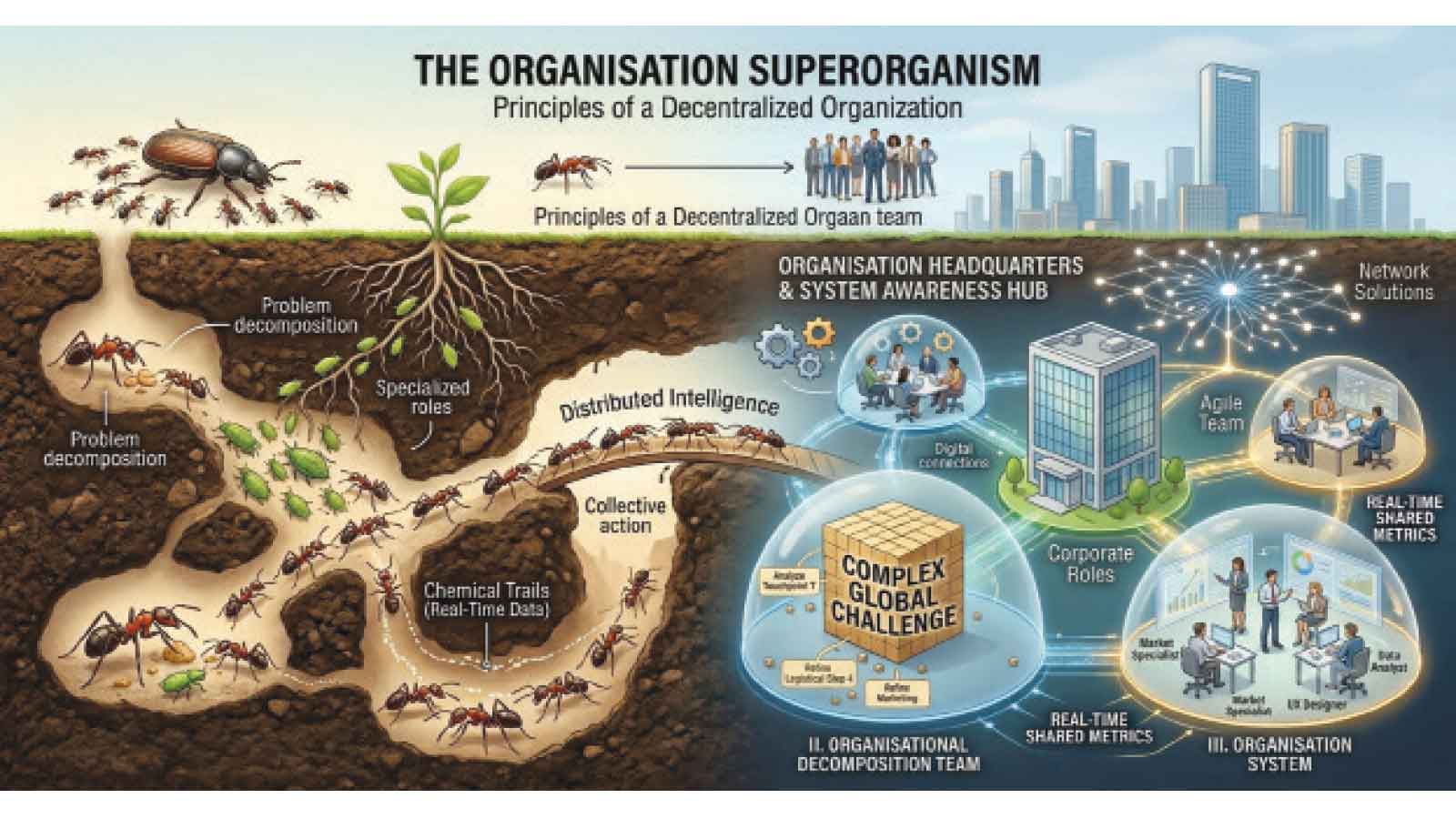
An ant colony, by contrast, is a superorganism of staggering complexity—a civilisation that builds underground cities, farms fungi, herds aphids, wages wars, and constructs bridges of living bodies to cross gaps.
Its success is not the triumph of any individual but the miracle of distributed intelligence, where thousands of simple agents, each following local rules, create global solutions that no single ant could conceive.
In an age when business problems grow ever more complex—global supply chains, sprawling digital ecosystems, fragmented customer expectations—the ant colony offers a profound leadership lesson: wisdom does not reside at the top. It emerges from the collective.
The organisations that will solve the most intractable challenges of the coming decades are not those with the most brilliant individual leaders, but those that have learned to harness the intelligence of the many. This is the art of building an empire from the ground up.
I. Complex Problem Breakdown: The Power of Decomposition
When an ant colony encounters a challenge too large for any individual—a dead beetle too heavy to move, a river too wide to cross—it does not despair. Instead, it deconstructs the impossible into the possible. A team of ants swarms the beetle, each gripping a small section. No ant lifts the whole; each lifts a corner. Together, they move mountains. When a gap appears, ants link legs to form living bridges, each bearing a tiny portion of the weight so that the colony as a whole can cross.
This is complex problem breakdown: the transformation of overwhelming challenges into thousands of simple, executable tasks. The colony’s genius lies in its ability to decompose a seemingly impossible goal into actions that any individual can perform, guided by local cues.
The Business Translation: Too often, organisations are paralyzed by the scale of their ambitions. The goal is too large, the market too crowded, the transformation too daunting. Leaders respond by creating ever more complex strategic plans, which then gather dust. The ant teaches a different approach: break the problem until it becomes simple enough for everyone to act.
This means deconstructing a grand vision into concrete, distributed actions. Instead of a single team tasked with “digital transformation,” imagine hundreds of small teams each responsible for reimagining one customer touchpoint. Instead of a centralised innovation group, empower every employee to experiment with incremental improvements. The ant colony succeeds because it makes complexity manageable—not by reducing ambition, but by distributing execution.
II. Role Specialisation with System Awareness: The Genius of Flexible Structure
An ant colony is a marvel of specialisation. There are foragers, nurses, builders, soldiers, and undertakers. Each ant is exquisitely adapted to its function, its biology shaped by its role. Yet this specialisation is not rigid. When the colony’s needs shift—when a predator threatens or a food source appears—ants fluidly change roles. Soldiers become diggers; nurses become foragers. The colony maintains structure while embracing flexibility.
This balance is critical. Specialisation enables efficiency; ants become experts in their domains. But system awareness—the understanding of how one’s role serves the whole—enables adaptation. An ant does not need to see the entire colony to know when to switch tasks; it responds to pheromones, density, and interactions with nestmates. The intelligence lies in the interplay.
The Business Translation: Modern organisations often swing between extremes. Rigid hierarchies with siloed departments create efficiency but resist change. Fully fluid structures can descend into chaos. The ant colony offers a middle path: specialized roles embedded in a system of shared awareness.
Leaders can design organisations where teams have deep expertise but are also connected through shared metrics, cross-functional rituals, and permeable boundaries. Just as ants use pheromones to communicate shifting priorities, businesses can use real-time data, transparent dashboards, and regular “swarming” sessions to keep everyone oriented toward the collective mission. When a crisis hits, the specialised team does not wait for orders; it senses the need and reconfigures—like soldiers who, sensing a breach, become builders to fortify the nest.
III. Emergent Intelligence: Letting Solutions Arise, Not Imposing Them
Perhaps the ant colony’s most astonishing feature is that no one is in charge. There is no queen directing traffic, no ant with a master plan. The queen lays eggs; she does not command. The colony’s sophisticated behaviours—building, foraging, defence—emerge from countless simple interactions. A forager leaves a trail of pheromones; others follow and reinforce the trail; the trail becomes a highway. This is emergent intelligence: complex, adaptive, and resilient, arising from the bottom up.
Emergence is powerful because it is scalable. The colony can grow from a few hundred to millions without redesigning its decision-making processes. It is also robust: if a few ants fail, the system continues. And it is remarkably adaptive: when conditions change, new patterns emerge without waiting for a directive from above.
The Business Translation: Most organisations are built on the assumption that intelligence must be centralised. Strategy comes from the executive floor, cascades through layers, and is executed by the ranks. The ant colony challenges this orthodoxy. It suggests that the best solutions often emerge when we trust the collective.
This does not mean abandoning leadership. It means shifting the leader’s role from director to gardener. The leader’s job is to cultivate the conditions for emergence: clear principles, open channels of communication, feedback loops that amplify what works, and the psychological safety to experiment. Then, step back and let intelligence flower.
In practice, this looks like empowering frontline teams to make decisions based on real-time data; creating “marketplaces” of ideas where promising innovations attract resources; and using algorithms or simple rules to let solutions surface rather than forcing them from the top. When problems are complex, the best strategy is often to stop trying to solve them centrally and instead set the stage for the organisation to solve them collectively.
Arthur Marara is a corporate law attorney, keynote speaker, peak performance and corporate strategy speaker. With his delightful humour, raw energy, and wealth of life experiences, he captivates audiences and inspires them to unlock their full potential. Arthur is the author of “Toys for Adults” a thought-provoking book on entrepreneurship, and “No One is Coming” a book that seeks to equip leaders to take charge. Send your feedback to bookings@arthurmararaattorneys.
com visit his website www.arthurmarara
com or contact him at +263772467255.