Online Reporter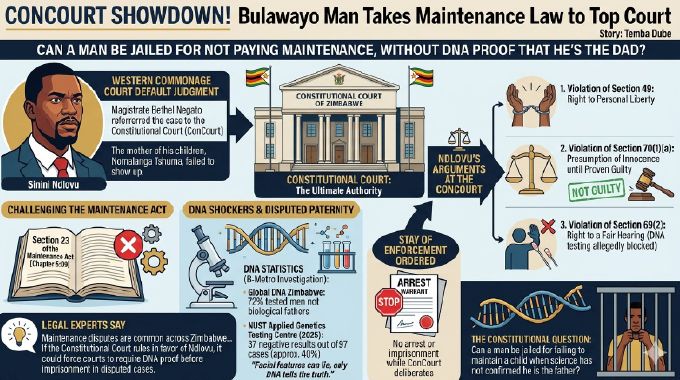
Temba Dube
A BULAWAYO man has dragged Zimbabwe’s maintenance laws to the highest court in the land after winning a crucial default judgment that has now triggered a constitutional showdown over whether a man can be jailed for failing to pay maintenance before DNA proves he is the father.
The issue exploded at the Western Commonage Court. Magistrate Bethel Negato granted Sinini Ndlovu’s application after the “mother of his children,” Nomalanga Tshuma, failed to show up in court to oppose the matter.
With no resistance in court, the magistrate ruled that the issues raised were serious and ordered that they be referred to the Constitutional Court, the ultimate authority on interpreting the country’s supreme law.
The Constitutional Court, commonly called the ConCourt, is the final referee on whether laws passed by Parliament pass constitutional muster. Once a matter lands there, its ruling can reshape how courts operate nationwide. Ndlovu pushed for referral there because magistrates’ courts cannot strike down laws, yet his fight directly challenges Section 23 of the Maintenance Act (Chapter 5:09).
His case rides on a growing national storm around disputed paternity. A recent B-Metro investigation revealed a surge in DNA shockers, with Global DNA Zimbabwe reporting that 72 percent of tested men were not biological fathers (see this link: https://www.heraldonline.co.zw/men-beware-facial-features-can-lie-only-dna-tells-the-truth/), while the National University of Science and Technology’s Applied Genetics Testing Centre recorded 37 negative results out of 97 cases in 2025, roughly 40 percent. The report warned that “facial features can lie, only DNA tells the truth,” as more men challenge paternity claims.
At the heart of Ndlovu’s case is a bitter maintenance dispute under Case No. WC M 808/ 25. Tshuma dragged him to court claiming he is the father of two children and must pay upkeep. On 5 September 2025, the court ordered him to pay US$85 per month and cover school fees for one child.
However, Ndlovu has consistently denied paternity.
The court ordered DNA tests to settle the matter scientifically. Tshuma allegedly refused to avail the child for testing despite repeated requests, leaving the issue unresolved.
Ndlovu told the court that Tshuma threatened that if he defaulted on maintenance, he would be jailed. That threat is backed by law under Section 23 of the Maintenance Act, which allows imprisonment for non-payment.
Faced with possible jail without DNA proof, Ndlovu escalated the fight. He applied for referral to the Constitutional Court in terms of Section 175(4) of the Constitution of Zimbabwe, which requires lower courts to send serious constitutional questions to the top court.
His arguments strike at the core of Zimbabwe’s legal system.
He says jailing a man without proven paternity violates Section 49 of the Constitution, which protects personal liberty. He also argues that forcing payment without proof breaches Section 70(1)(a), the right to be presumed innocent until proven guilty.
He further claims that threatening imprisonment while DNA testing is allegedly being blocked violates Section 69(2), the right to a fair hearing.
In granting the application by default, Magistrate Negato ruled that the constitutional questions are serious and not frivolous, paving the way for the ConCourt to decide.
The magistrate also ordered a stay of enforcement, meaning no arrest or imprisonment can proceed while the Constitutional Court deliberates.
The ruling effectively shields Ndlovu from jail for now.
The case mirrors real-life DNA bombshells reported in Bulawayo, including a man who paid maintenance only to be cleared after a zero percent DNA result, and another who is suing for US$163 000 after raising a child for 11 years only to discover he was not the father, according to the B-Metro investigation.
Legal experts say the implications are huge.
“Maintenance disputes are common across Zimbabwe, and many involve contested paternity. If the Constitutional Court rules in favour of Ndlovu, it could force courts to require DNA proof before imprisonment in disputed cases,” said a lawyer who cannot be named for professional reasons.
Ndlovu may have won the round in the magistrates’ court but the real battle has moved to the country’s highest legal arena.
And the question now before the Constitutional Court cuts deep:
Can a man be jailed for failing to maintain a child when science has not confirmed he is the father.