Chronicle Editor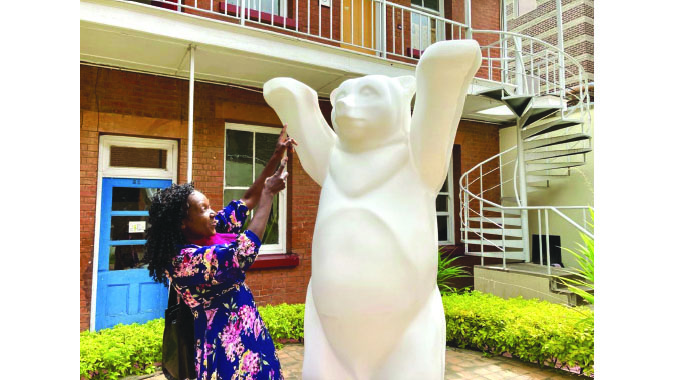
Pathisa Nyathi
A COLOSSAL two-metre white fibreglass German bear stands resolutely, defiantly and elegantly on a circular platform within the courtyard of the National Art Gallery of Zimbabwe in Bulawayo.
Here, once upon a time, stood Adam Madebe’s pioneering metal sculpture titled “Looking to the Future.”
That was back then before the then Minister of Local Government Enos Chikowore, unappreciative of art, ordered it removed and tucked away in some dingy out-of-public-view room within the gallery.
The metal sculpture had initially graced the gardens next to the City Council’s Tower Block.
Inside one of the Gallery rooms, 12 women from Matobo District are busy creating collages to be posted on the snow-white mammoth Bear.
The women have had experience from 2013 when the My Beautiful Home (MBH)/Comba Indlu Ngobuciko (CIN) Project involving hut wall painting, a visual art tradition that was on the wane in their localities was initiated.
Some of them, such as Sithokozile Dube from Mahusumani in Ward 17 have also been involved in the Bhudaza Face painting Project, which runs concurrently with the MBH/CIN Project.
Talent, a talented artist has mixed a wide variety of acrylic water-based paints that the creative women will use; initially using pencils on A4 bond paper and later use the availed watercolours on the A1 white manila papers.
It is all part of a rehearsal before the adjudication process that will identify the best three artists.
The winning women painters will then paint their designs on the life-size Bear, which is eagerly and enthusiastically awaiting a fresh coat of Ndebele artistic designs.
That way, it will assume a broader and loftier meaning, relevance and stature, will then post the best three collages.
Particular attention will be paid to the choice of earth colours that are available in Matobo and the designs that the women have used when embellishing their hut walls and during the painting of their faces.
The two aspects are the markers of relevance and meaningfulness.
Moving from table to table where the Matobo women are busy designing collages to post on the bear is the head of the cultural section Katrin Simon from the Federal Republic of Germany’s Embassy in Harare.
She has just arrived in Bulawayo to have a look at the work that is a product of her initiative and creativity.
The visual art traditions of the Matobo Cultural Landscape within Matobo District are being linked through her agency with the Bear that bears German symbolism and metaphor.
Katrin is thus the critical link person between the German Bear and the Ndebele visual art traditions within the Matobo Cultural Landscape.
Katrin first got to know about the vibrant visual art tradition of the Matobo women when she met Butholezwe Kgosi Nyathi in Harare.
Butho is one of the pioneers of the MBH Project at the time he was working for Amagugu International Heritage Centre (AIHC), also located within the Matobo Cultural Landscape.
Butho gave him the book we researched courtesy of the US Ambassador Brian Nicole.
The seminal book titled “Preservation of Ndebele Art and Architecture.” Deals with the visual art tradition in the Matobo Cultural Landscape, its historical background, execution processes and interpretation of the icons women applied.
Veronique Attala had been instrumental in putting together a team to spearhead the project.
Also, in that team were myself as director of AIHC, Professor John Knight from the National University of Science and Technology (Nust), Dr Andre van Rooyen from Icrisat, Clifford Zulu a curator from the Art Gallery and Violet Kee Tui.
Once Katrin was in touch with Veronique, it was systems go.
The bear has been the symbol of the Berlin City State and the city itself from the 13th Century. It symbolises openness, co-operation and solidarity among nations through the painting of the Bear and taking it around the world.
The concept is based on cities having coats of arms that depict some representative image of some identified icon, such as an animal.
Paris has the icon of a ship while Bulawayo has an elephant and dassies on the coat of arms.
Whereas the bear carries German symbolism, when it is emblazoned with Ndebele aesthetic designs and earth colours, it assumes a new level of refreshing importance and brings together two interacting cultures.
The bear is being domesticated in Matabeleland and finds a niche in the art landscape of an African community in Zimbabwe.
I often say, “Everything created bears the signature of the creator.”
This is true of the women creators from Matobo District.
As the bear is taken around the various parts both of Zimbabwe and the world, it assumes the role of ambassador of a visual art tradition that is tucked away within the Matobo Cultural Landscape.
It is a visual art tradition that was facing accelerated decline.
It is hoped the bear will carry and lift high the flag of Ndebele visual art tradition to the wider world.
The women execute artistic elements that have been handed down from past generations.
Indeed, the designs are in consonance with the Pan African aesthetic icons and motifs: chevrons, circles, triangles, spirals, herringbone and dentelle.
These icons have been placed based on known aspects of beauty: movement, repetition, rhythm/polyrhythm (regularity, periodicity, and seasonality), balance/equilibrium.
These considerations lend Africanness to the Bear and enhance its international relevance, allure, symbolism and meaning.
While the women were working and talking the name of the bear was born.
It came about as a realisation that the nearest animals to the bear in Zimbabwe are carnivorous animals such as the lion and other cats, which are referred to as izibanda in the IsiNdebele language. Isibanda in Sotho is Tau/Dawu; terms that have been indigenised to Mdawini.
So, Mdawini has become the assumed Ndebele name for the domesticated bear, now the ambassador for Ndebele visual art traditions.
Through the icons, use of appropriate earth colours and associated history and architecture, the bear will bear the sweet burden of the diverse traditions of an African community in Zimbabwe.
It is envisaged that when the process is completed there will be a presentation ceremony that the German Ambassador to Zimbabwe will preside over.
It is further hoped that the function to be held in Bulawayo will be thematic, featuring various distinctive aspects of Ndebele way of life such as cuisine, attire and music.
It will be a night to send off Mdawini on a mission to take Ndebele visual art traditions and its related cultural aspects to a wider world audience.
Explanatory and interpretive flyers and pamphlets will accompany Mdawini so that he tells authentic stories about the culture he has been entrusted with.



 Online Reporter