admin
admin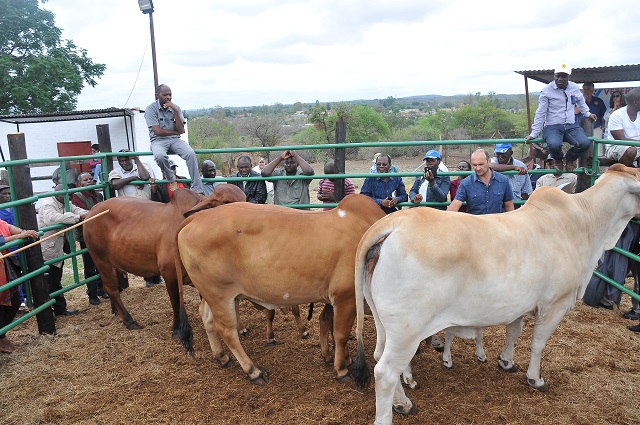
Cultural Heritage with Pathisa Nyathi
THIS week we conclude the diversion we took to unpack domestication as it related to both crops and animals. There is general agreement that animals were domesticated later than crops. Both impacted one way or the other on African communities. We saw the transformations that were wrought on communities by the domestication of crops. There was another level of domestication when crops were related or aligned to major community cosmologies, beliefs and worldviews.
However, it is important to note that communities related new crops to their social organisation, gender issues and worldviews in general. The domesticated crops led to societal engineering, new perceptions and acquisition of new cosmologies. Dual and complementary domestication led to more complex societies. In other words, communities underwent fundamental development which was on the terms of the receiving societies.
Let us now look at the implications of animal domestication. Animal domestication reinforced social, cultural, political spiritual and economic changes that were initiated by the domestication of crops. Men who had hitherto been hunters became, in a sense, ‘‘hunters’’ within cattle byres. That’s what being pastoralists meant. Their economic roles were made lighter. Inevitably, once animals were domesticated village layout changed to accommodate the new acquisitions. Cattle byres became integral components of village layout, a layout that got reflected in gender relations and distribution of wealth within the homestead.
Among the Zulu and Ndebele cattle in particular played so critical a role that village layout was adapted to the need to ensure defence and security of cattle. That was achieved through locating cattle byres at the centres of villages. Raiders or cattle rustlers had to breach the outer and inner palisades before they could get access to cattle. The villagers would, by that time, have raised alarm and taken measures to repel the invaders. This arrangement, where cattle byres are centrally located, is referred to as Central Cattle Pattern (CCP).
What may not immediately be clear is what happened first — domestication of animals or migration from matriarchy to patriarchy. We could hazard a guess and say animal domestication preceded the establishment of patriarchy. Patriarchy is traceable to the establishment of both Christianity and Islam in the last 2 000 years. What this may suggest is the initiation of gender roles and power negotiation after animal domestication. As we saw in earlier instalments the distribution of beef cuts reflects patriarchy, for example men among the Ndebele and other African communities consume cow heads from which women are excluded.
What is important for us to appreciate is that animal domestication brought about tangible changes at the level of village layout. However, there were more fundamental changes at the intangible level. The cattle byre acquired spiritual significance. It became the ritual citadel within the homestead. Men controlled that physic-spiritual domain, perhaps on the basis of having been hunters prior to animal domestication. Spirituality was attached to the domain that they controlled.
Inheritance of cattle was done in accordance with patriarchal principles. Men were the inheritors, with the eldest son getting the lion’s share. Those familiar with the history Matshologwane Lusinga who had a very large herd of cattle with some farmed out to men as far as Gwanda, Gwatemba and Masase had his eldest son Sibuzani getting the largest number of cattle when he died. He is said to have received 500 head of cattle. The arrangement of farming out cattle to those with fewer cattle was called ukusisela.
Beef cuts were allocated in a manner that reflected various social, cultural, political and economic aspects of the community. Cattle, and indeed other animals, made their way into the physical space but more importantly, they entered the community’s intangible domains. Cattle acquired a new meaning which facilitated their domestication in the second sense of domestication.
Wealth was perceived in terms of cattle, a perception that led to communities undertaking long haul raids on some pastoral communities. During unstable social conditions cattle were a better option in comparison to crops. Cattle resemble wild animals in that they can walk and be driven along by migrating or fleeing communities. This is not possible with crops which require growing and maturing in situ.
Among the BaKalanga chuma referred to cattle wealth. Beads were a special acquisition and chuma also referred to glass beads that were traded with the Swahili and later the Portuguese in the East Coast. Initially, the most basic and earliest beads were made from clay and were then fired. Among the San eggshells were used as beads. Among the elite who acquired monopoly over trade goods gold was fashioned out into beads.
Excavations of royal burials at Mapungubwe retrieved a lot of gold beads. In addition to gold beads there was a gold-plated rhinoceros, a gold-plated scepter and a wooden bowl. Gold, igolide in IsiNdebele, had replaced glass beads. People whose totem was Chuma/Tshuma (Nkomo/Ngombe) ended up being referred to as oGolide.
Acquisition of large herds of cattle enabled the royal elite to marry several wives. Cattle were used to pay amalobolo. Such acquisition of wealth led to some of these men becoming politically powerful. Powerful kingdoms sometimes had their genesis in such large families. The elite used cattle to cement relations with their rich counterparts. Such established relations avoided wars among the rich. The exchange of daughters in marriage for cattle produced an elite ruling class, at least among the Ndebele.
Once cattle had been domesticated relocations of communities took into account the availability of both pastures and water. A story is told that the Ndebele were directed to the Ntabazinduna area when the Afrikaners drove them out of the Transvaal. The said area had nourishing grass called imbanjana. Location of Ndebele settlements was related to availability of water — hence settlements were located close to perennial sources of water. Imbizo was close to Koce River while Intemba was close to the same river but further upstream. Umzinyathi and Amatshetshe were close to the Umzingwane (Muzungwana) River.
Cattle needed medication. Their domestication demanded that men attend to their health needs. Veterinary knowledge was developed, for example to deal with heart water (black quarter, umkhono), fractures, and eye ailments. Indigenous knowledge systems relating to cattle were enhanced to ensure maintenance of large herds in good condition. Predators were warded off and the sex of calves manipulated. This sort of knowledge declined tremendously when colonisation brought alternatives and people began to despise their own veterinary formulations.
Cattle entered the linguistic realm. Proverbs and folktales, inter alia, embraced aspects of cattle, eg injobo enhle itshukelwa ebandla, inkomo ngameva okuzibangula, inkunzi ikhethwa ematholeni, inkunzi ezimbili kazihlali sibaya sinye, ikhotha eyikhothayo . . . Attire was no exception. Women’s skirts (izidwaba), men’s loin cloths (amadumbu) and other forms of dress were derived from animal skins. Blankets (amaxaba) were made from tanned skins.



 Online Reporter