Online Reporter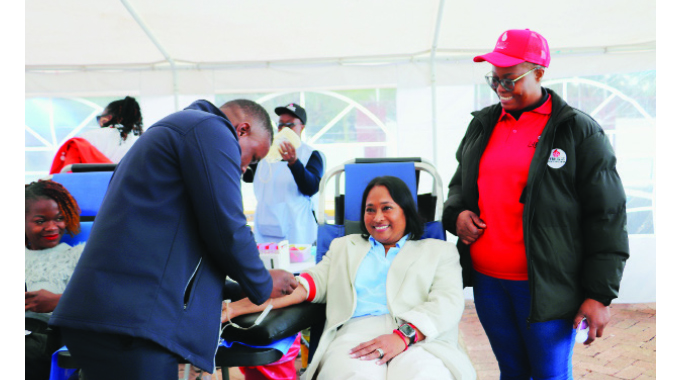
Trust Freddy-Herald Correspondent
ANYONE asked to pay for blood at a public hospital should immediately lodge a complaint with the hospital’s administration or the National Blood Service Zimbabwe (NBSZ) as it is supplied for free, NBSZ chief executive officer, Ms Lucy Marowa, has said.
The clarification follows public concerns over difficulties in accessing blood in major hospitals, with some individuals reporting that they were being charged for it.
She cleared the air yesterday during a blood donation campaign hosted by the South African Embassy in Zimbabwe, in partnership with NBSZ at the Heritage School, to commemorate International Nelson Mandela Day and promote humanitarian values.
“NBSZ is very proud of this partnership, and we have called upon the community to come to Heritage School today and donate blood. So, we know that people often say that we are donating the blood, and then it ends up being sold at hospitals. I would like to clarify that when you are in a public institution, the blood is free, but in a private institution, there is a user fee chargeable for the blood.”
She also added that any patient admitted to a public hospital will have their blood provided free of charge by the Government.
“But why is it free in a public health institution? It’s because the Government of Zimbabwe pays a 100 percent subsidy, which is the same user fee that is paid by a private patient.
“So the Government pays on behalf of the patient to the NBSZ and patients then get it for free.”
Ms Marowa added that normally, public hospitals charge a nominal fee, which should not exceed US$30.
“So, if anyone is charged for blood in a public health institution, they can lodge a complaint with the hospital administration. Alternatively, if they have a receipt for the fees they have been charged at the hospital, they can bring it to the National Blood Service Zimbabwe (NBSZ) to verify whether it’s a genuine receipt or take it up with the hospital authorities to determine its authenticity.
“The blood itself is issued free of charge, so it’s necessary to investigate the legitimacy of the receipt. A genuine receipt would reflect a nominal, cost-based fee for services rendered; normally, I think it’s about US$20 or US$30. Anything exceeding that, then yes, it means that there is some untoward event that has happened within the institution.”
She also highlighted that the National Blood Service Zimbabwe (NBSZ) and public hospitals are distinct entities, adding that they only distribute blood as per each hospital’s specific requests.
“Let me make it clear that NBSZ and the hospital are two separate entities. So when we have enough stock, the hospital itself has to place an order with us for the supply. What we cannot do is force the hospital to come and get the blood. We can only tell them the stocks are there; they should come and get it”.
The celebrations drew students, parents, and representatives from 15 embassies, senior Government officials, all contributing to a noble cause by donating blood as part of belated celebrations.
Proclaimed in 2009 by the UN General Assembly, the day is celebrated annually on July 18—Mandela’s birthday, serving as a reminder that every individual has the power to positively impact the world.
Director for Public Diplomacy, Communication, and Advocacy in the Ministry of Foreign Affairs and International Trade, Mrs Philisiwe Chidawanyika, commended the South Africa Embassy and all other countries that supported the programme.
“The National Blood Bank requires to be replenished continuously, given the surging demand for blood arising from many causes, which include childbirth, accidents and chronic illnesses.
“While the general assumption is that the demand may be higher in certain age demographics, the need for supplementary blood may arise out of unfortunate incidences which can affect anyone.”
Charge d’Affaires of the South African Embassy in Harare, Desiree Moodley said: “As the embassy, we chose to partner with the National Blood Services of Zimbabwe and the Heritage School to address two critical aspects in the world, involving the youth to become involved and to take action and understanding how critically vital the need for blood has become.
“The day is, therefore, an opportunity for citizens to recognise their individual power to change the world for the better, fighting injustice, helping people in need and advancing reconciliation.”