

 admin
admin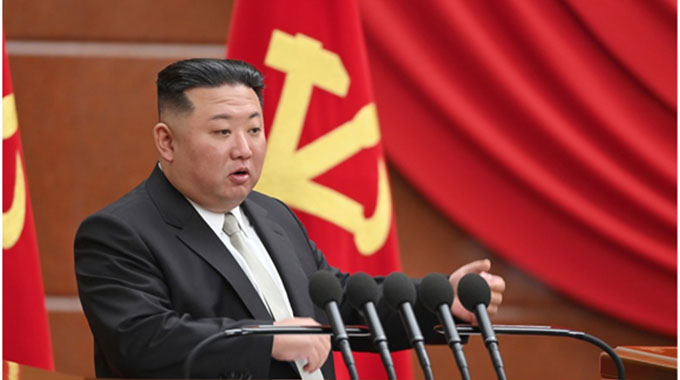
SEOUL. — South Korea’s military said yesterday that the Democratic People’s Republic of Korea (DPRK) is ready to conduct another nuclear test following its fifth nuclear detonation.
Defence Ministry spokesman Moon Sang-kyun told a press briefing that intelligence authorities of South Korea and the United States are assessing that the DPRK is “always ready” to carry out additional nuclear tests in its main Punggye-ri nuclear test site.
His comments followed the DPRK’s announcement on Friday that it successfully staged an explosion test of a nuclear warhead that can be mounted on ballistic missiles “at will.”
The warning of an additional test is based on three tunnels excavated at Punggye-ri in north-eastern DPRK, near which all of its underground nuclear tests were conducted.
“If the DPRK conducts additional nuclear test, it would be possible to happen both from a branch of the second tunnel or the third tunnel where all preparations are already done,” said Moon.
All of Pyongyang’s nuclear device tests happened in Punggye-ri. The first test was conducted in the first tunnel, while the second, the third and the fourth detonations came from the second tunnel.
Meanwhile, reports say South has adopted new concept of pre-emptive strikes.
The South Korean military has developed a new operational concept to annihilate Pyongyang with a barrage of pre-emptive missile firings once signs of a North Korean (DPRK) nuclear attack are detected, defence sources said Sunday.
A source said the plan, dubbed, Korea Massive Punishment and Retaliation (KMPR), is intended to launch pre-emptive attacks on North Korean leader Kim Jong-un as well as the regime’s military leadership if signs of their impending use of nuclear weapons are detected or in the event of a war.
Under the KMPR, the military would divide Pyongyang into several districts and completely destroy a certain section in which Kim and other military leadership are suspected to be hiding, before they use a nuclear weapon, the source noted.
“In other words, the North’s capital city will be reduced to ashes and removed from the map,” the source told reporters on condition of anonymity.
The disclosure of the detailed operation came after the isolated state conducted its fifth nuclear test, Friday, claiming to have detonated a nuclear warhead successfully.
In the wake of the test, observers say the North is now apparently in the final stages of making a nuclear warhead small enough to fit on a ballistic missile.
The Ministry of National Defence reported details about the KMPR to the National Assembly in response to the North’s latest nuclear test.
The source said that the South Korean military plans to mobilise its locally developed surface-to-surface ballistic and cruise missiles, the Hyunmoo, for the operational concept.
The Hyunmoo 2A and 2B ballistic missiles have ranges of 300 and 500 kilometres, respectively, while the Hyunmoo 3 cruise missile has a range of 1,000 kilometres. The military earlier said it plans to increase the number of Hyunmoo 2As, 2Bs and 3s that can simultaneously strike missile bases all across North Korea in a time of war.
The source noted that the military is also planning to complete tests of its newly developed ballistic missile with a range of 800 kilometres by next year for operational deployment.
“The KMPR is the ultimate operation concept the military can have in the absence of its own nuclear weapons,” the source noted.
Another source indicated the military has recently launched a special operational unit in charge of destroying the North Korean military leadership and launching retaliatory attacks on them.
Along with the military options, the government plans to adopt diplomatic ones, as well. — Xinhua/Korea Times/HR.
“In response to North Korea’s repeated provocations, including the nuclear test, that defy the United Nations Security Council’s resolutions, the government plans to make diplomatic and military efforts,” said Kim Kyou-hyun, the senior presidential secretary for foreign affairs and national security, in a briefing.
In addition, Foreign Minister Yun Byung-se plans to attend the UN General Assembly, scheduled to begin September 17, and urge cooperation in formulating a new set of international sanctions against the North. — Xinhua/Korea Times/HR.


 Online Reporter
 dyton mupawaenda