Chronicle Editor
Barnabas Masimba Online Reporter
WHEN one mentions Bulawayo Motor Club (BMC), race car enthusiasts pay attention. What crosses their minds is Drag racing, Circuit racing, Endurance racing, Car displays, Drifting.
For a layman, racing is simply one car competing to reach the finish line ahead of others. The aforementioned categories are jargon.
The weekly series will focus on demystifying the categories and increasing enjoyment of the races for everyone by increasing knowledge and appreciation all round.
Today we kick off by explaining drags.
Most people enjoy drags. The cheers and adrenalin rush as the roaring mechanical beasts dash through a quarter mile within the shortest possible time creates an electric atmosphere that attracts race fanatics in droves.
But what do we really understand about drags and what are the traits. Well fasten your seat belts and focus on the track because at the finishing line you will have full knowledge of drags and how they are done at BMC.
Drag racing is a sport or competition in which specially built or modified cars race over a short distance as a test of acceleration. In the case of BMC the distance is a quater mile, about 400m. In this race automobiles or motorcycles compete, usually two at a time, to be first to cross a set finish line.
According to experts such as Motorsport UK and BMC, drag
is the fastest, loudest and most spectacular motor sport pitting drivers and their cars against one another in pairs. The standard course is a straight quarter-mile – sometimes shorter, never longer – and the racing format is instant-knockout.
How does Drag Racing work?
Numerous different vehicle categories range from road-going production cars to Top Fuel Dragsters. Some eliminators feature vehicles of equal performance capabilities competing head-to-head without handicaps.
Classification at BMC is
Four wheelers
Class A: Up to 1600CC
Class B :1601CC – 2000CC
Class D: Up to 3000CC
Class E: greater than 3001CC
Class TA: Turbo ip to 2000CC
Class TB: Turbo up to 2500CC
Class TC: Turbo 2501CC and over
Bikes
Class BA: Up to 750CC
Class BB: greater than 751CC
Other eliminators allow vehicles of unequal performance capabilities to race each other using a timed handicap system with staggered starts. First to the finish progresses. It’s very decisive. The procedure repeats until a single winner is left standing in each eliminator.
The race begins from a standing start between two vehicles over a measured distance These contests are started by means of an electronic device commonly called a Christmas Tree because of its multicolored starting lights. On each side of the Tree are seven lights: two small amber lights at the top of the fixture, followed in descending order by three larger LED lights, a green bulb, and a red bulb.
Two light beams cross the starting-line area and connect to trackside photocells, which are wired to the Christmas Tree and electronic timers in the control tower. When the front tires of a vehicle break the first light beam, called the pre-stage beam, the pre-stage light on the Christmas Tree indicates that the racer is approximately seven inches from the starting line.
When the racer rolls forward into the stage beam, the front tires are positioned exactly on the starting line and the stage bulb is lit on the Tree, which indicates that the vehicle is ready to race. When both vehicles are fully staged, the starter will activate the Tree, and each racer will focus on the three large amber lights on his or her side of the Tree.
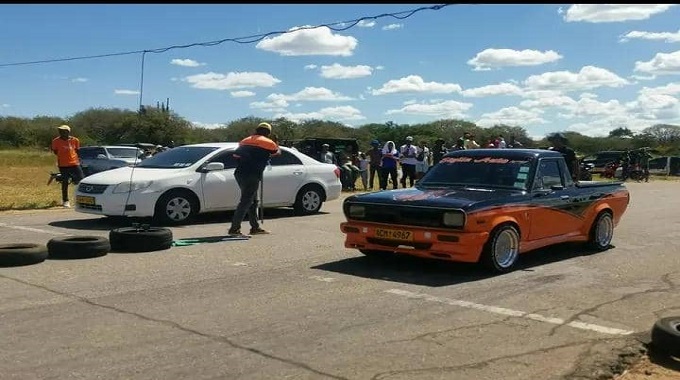
Depending on the type of racing, all three large amber lights will flash simultaneously, followed four-tenths of a second later by the green light (called a Pro Tree), or the three bulbs will flash consecutively five-tenths of a second apart, followed five-tenths later by the green light (called a Sportsman, or full, Tree).
Two separate performances are monitored for each run: elapsed time and speed. Upon leaving the staging beams, each vehicle activates an elapsed-time clock, which is stopped when that vehicle reaches the finish line. The start-to-finish clocking is the vehicle’s elapsed time (e.t.), which serves to measure performance. Speed is measured in a 66-foot “speed trap” that ends at the finish line. Each lane is timed independently.
At the BMC they currently use Optical timing sensors. It is a device used for timing purposes. there’s a pair in the start line and more in the finish line. They use optical sensors to detect if a car has passed then the timer starts and it stops once they cross the other sensors in the finishing line.
In a nutshell, that’s drag racing. Go to BMC and enjoy the races on weekends with full knowledge of what is happening and why.
Next week, we’ll break down circuit racing.


 Online Reporter