Online Reporter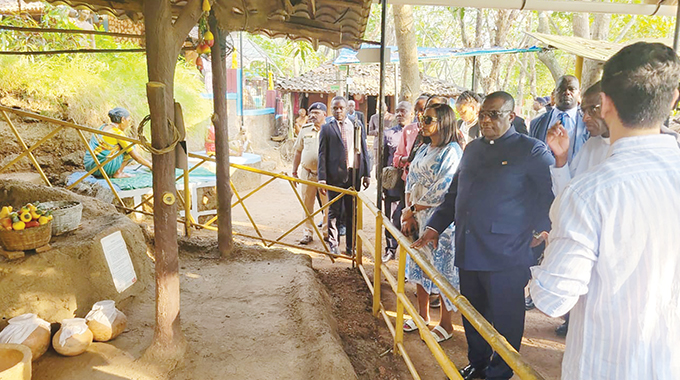
Mukudzei Chingwere in Goa, India
THE once-thriving Mutapa State, modern-day Zimbabwe, was a sophisticated and well-structured economic ecosystem on which India relied heavily for trade, while simultaneously being wary of possible invasion from this illustrious African state, historians have said.
The revelation came out here, where the historians are part of Vice-President Dr Constantino Chiwenga’s delegation, whose mission is to challenge the historical misconceptions that depict Zimbabwe and Africa as places that did not know civilisation until colonisation.
VP Chiwenga’s visit is centred around showcasing the important role played by the Mutapa State in spreading Christianity and civilisation beyond Africa, well before colonisation.
National Archives of Zimbabwe director Ms Brenda Mamvura said it has been proven that the Mutapa State was a formidable society with a rich economy that knew civilisation.
“Indian records show that the Mutapa State was a key global economic player and at one time, the Indians feared invasion from the Mutapa,” said Ms Mamvura.
“It is possible that we have contributed even more to the world beyond this narrow perspective (that only colonialism enlightened us).”
VP Chiwenga acknowledged the importance of this revelation.
“I remember laughing about how, at one time, India was afraid of an invasion from the African power known as the Monomotapa Empire,” he said.
“It is a revelation that comes with a lot of mixed feelings for the modern-day Zimbabwean and by extension, the modern Africa.
“It brings joy that this is how we used to be, this is how serious and highly regarded we used to be viewed.”
VP Chiwenga added that it now feels like a fairytale when people are told about how Africa was “civilised, more organised and wealthier.”
“Now, we need to summon this trailblazing spirit for the economic development of our country,” he added.
When the British occupied Zimbabwe in the 19th century, the country was already spreading civilisation, explained the VP, noting that it had established presence in India before the British and were in China before the British.
“This is now history, but all these truths must be made clear for this generation and those to come. It should be known that we have never been a dark continent,” he asserted.
“Today, we stand as equal partners, not second-class citizens. It is crucial that we are recognised and treated as such.
“Together, with the West, we seek collaborative growth and mutual prosperity. It (Zimbabwe) is called Great Zimbabwe and this is no accident. We collaborated with the Portuguese not as a colony, but as trading partners.
“When we traded as the Monomotapa and the Portuguese did, it was fair trade. We purchased weapons, rifles and clothing, using our gold and ivory. We were quite a formidable society, which is how we ended up establishing connections with Portugal in areas like India,” said VP Chiwenga.