shloboe boe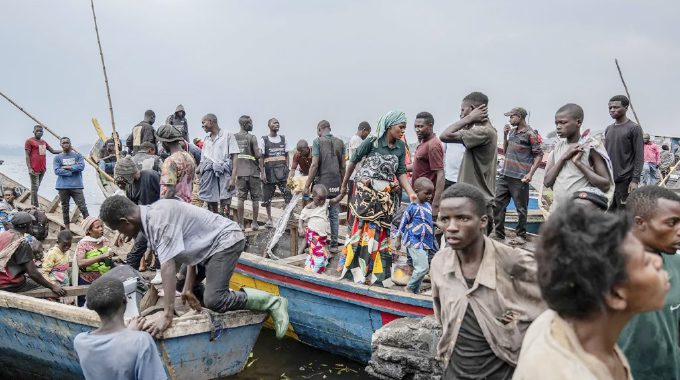
Gibson Nyikadzino, Correspondent
IT is indisputable that Africa today is suffering greatly from a curse invoked in Berlin at the colonial conference of November 1884 to February 1885, which was overseen by German Chancellor Otto von Bismarck.
This was a conference of European locusts that swarmed Africa to distort its politics, economics, and society; damaged indigenous cultures; and retarded its socio-economic development to the present day.
They divided and conquered Africa.
The German political sorcerer, Bismarck, and his European apprentices employed the western wizardry of the technology of the industrial revolution to set the rules for the scramble for Africa, paving way for their architectural designs on how they would plunder Africa.
Results of their treachery are seen today; the carved-out borders, the separated populations based on ethnicity, supporting chiefs that implemented their orders and using administrative procedures to prefer one ethnic group over another and also employing mechanisms that fuelled continued tensions, even disunity.
The existent military conflict in the eastern Democratic Republic of Congo (DRC) that has led to a humanitarian crisis which the words disaster and catastrophe cannot explain, is a problem that is symptomatic of the failure of the political economy in Africa but highly influenced by the Berlin curse.
This conflict has exposed unresolved deep-rooted ethnic tensions, poor governance, unequal resource distribution, and the legacy of colonial borders, as activating factors leading to widespread violence, displacement, and humanitarian crises. All these negatives can be blamed on the Berlin Conference.
The risk is this present an overt labelling of Africa as a cursed, dark continent with no hope through propaganda and placing the West region as superior on the global caste system.
It is also evidently showing that in some parts of Africa, tolerance, diversity and co-existence are terms that will be of theoretical importance, but pragmatically inoperable as what has been maintained are vestiges of colonial administration.
It is impossible to only read the challenges in eastern DRC as ethnical, between the Hutu and Tutsi Congolese. Because the issue has not been resolved for long since the colonialisation and independence of either the DRC or Rwanda which is in the equation, the problems continue to linger.
The problem is not only between Rwanda and the DRC, but it is colonially instituted to involve the Great Lakes countries, including Burundi and Uganda. The challenge is that in all these four countries, there are Hutu and Tutsi ethnic groups.
When colonisers drew borders, they separated these people deliberately, having known of their existing differences which they manipulated to become platforms of unending wars.
It is possible that the M23 rebels, as Tutsi, are grandchildren of people who were either displaced from Rwanda when the Belgian colonial administrators forcefully moved their fore-parents from Rwanda to the now DRC as slave labourers.
This means that from the time of DRC (then Zaire) was colonised in 1885 to its independence in 1960, the displaced populations were living under authorities in a territory that was Zaire. Therefore, to disregard their right to be Tutsi Congolese as the position of the Congolese government shows is something that needs governance over military solutions.
On the other hand, according to the 31 December 2012 United Nations (UN) resolution 2078 on the M23 rebels, it concluded that the group “receives general military supplies from the Rwandan Defence Forces (RDF) in the form of weapons and ammunition in addition to material support for combat operations”.
The belief is that Rwanda strategically supports M23 rebels to fight a group of Hutu extremists who were instrumental in the 1994 genocide against the Tutsi in Rwanda. The Hutu extremists allegedly backed by the DRC are the Democratic Forces for the Liberation of Rwanda (FDLR).
The other colonial complexity of this war and tension emanates from the idea that in all Great Lakes countries, the Hutu-Tutsi dichotomy is a transnational challenge that Africa has to deal with. These are the consequences of the Berlin curse, and if unresolved, the continent will be breeding a recipe for further incendiary disaster coming out as a clash of identities.
Credit, however, has to be given to Africa, on another hand, for its ability to remain diverse and have other groups living peacefully without using ethnical dimensions as roots of instability.
However, when one sees international media descend to cover a conflict happening in Africa, which from the onset they had turned a blind eye to, the simple understanding is that they have a vested interest.
The pattern is clear. The prominence given to the NATO proxy war against Russia in Ukraine; the Israeli-Hamas confrontation and recently the coming in of Al-qaeda in Syria cannot be compared to the prominence given to the situation in the Democratic Republic of Congo (DRC).
On the part of the African Union (AU), the commitment to silence the guns is no longer a feasible target. Five years past the deadline, there have been more intra-state conflicts that have been reported making
“ending all wars, civil conflicts, gender-based violence, violent conflicts and preventing genocide in the continent by 2020” something unfeasible.
This DRC-M23 rebels’ confrontation is one of the notable examples of intra-state conflicts that have seriously dented Africa for the past five years including civil wars in Ethiopia (2022-2022); Sudan (April 2023 to present); and the never-ending DRC war in the eastern part. Prior these wars, South Sudan also grappled with an internal military conflict (2013-2020). These wars have caused transnational challenges because of the humanitarian challenges that have accompanied them.
The Berlin curse is making price pay a heavy price. It should be exorcised. Will it be possible?
To reverse the scandalous act of cartographic mischief inflicted on the continent 150 years ago, African leaders should call another Berlin conference on their continent. This time, the conference will be renegotiate and come up with new terms that direct the course of trade, unity, co-existence, and the continent’s sovereignty to better suit the contemporary circumstances.
Leaders should be radically integrationist in nature, character and attitude and it could be through this integration that borders could be ‘erased’ very simply with an African treaty that is formulated to benefit the people.



 Online Reporter