Online Reporter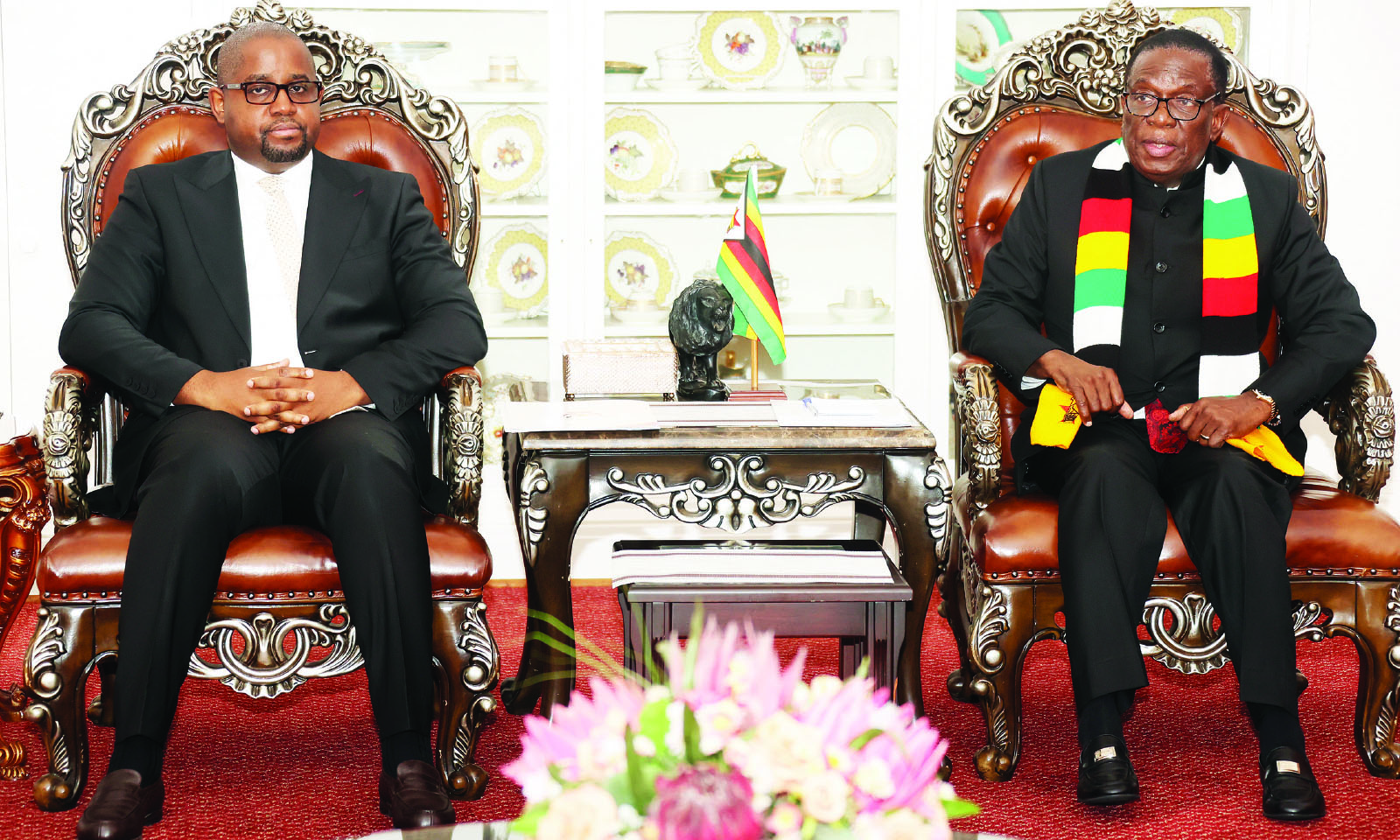
Wallace Ruzvidzo
Herald Reporter
AFRICAN countries and their leaders must play a central role in finding a lasting solution to the “strongly alarming” security situation in eastern Democratic Republic of Congo (DRC), the country’s Minister of Regional Integration, Mr Floribert Anzuluni Isiloketshi, has said.
Mr Isiloketshi was in Harare yesterday as a special envoy of DRC President Félix Tshisekedi and paid a courtesy call on President Mnangagwa at State House, where he briefed him on the situation in eastern DRC and ongoing international and regional peace efforts.
Speaking to journalists after their closed-door meeting, the Congolese minister said President Tshisekedi had dispatched him to update President Mnangagwa on the conflict and to seek his support as an influential African leader who has consistently advocated for peace and dialogue.
Mr Isiloketshi said the briefing focused on two parallel peace processes currently underway. The first is a diplomatic process facilitated in Washington, DC, where the DRC and Rwanda recently signed two agreements aimed at de-escalating tensions.
One agreement focuses on restoring peace and stability by committing both countries to dialogue, respect for sovereignty and the cessation of hostilities, while the second centres on trade and economic cooperation as a confidence-building measure intended to reduce conflict drivers and promote regional integration.
The second process is ongoing in Doha, Qatar, where the DRC Government is engaged in direct negotiations with the AFC/M23 rebel group.
The talks are aimed at securing a negotiated settlement to the conflict in eastern DRC, where the armed group has been accused of destabilising the region with alleged backing from Rwanda.
The Doha dialogue seeks to address core political and security grievances, including disarmament, reintegration of fighters and the restoration of state authority in affected areas.
“I was sent here by my President, His Excellency President Félix Tshisekedi, to brief his big brother and father, His Excellency President Mnangagwa, on the situation in eastern DRC,” Mr Isiloketshi said.
“He had a message, a special message, that I delivered to the President, but at the same time, it allowed me to update the President on two peace processes that are ongoing. The first one was in (Washington) DC, where the DRC and Rwanda recently signed two agreements, one peace agreement and one trade agreement.
“And the second one is still ongoing in Doha, where the DRC is in a dialogue, in negotiation with the rebellion called AFC/M23, which is backed by Rwanda, to also find a peaceful solution. So, there were two reasons, the situation and giving a briefing to the President.”
He said President Tshisekedi remained firmly committed to a peaceful resolution of the conflict and was actively participating in all initiatives that could lead to lasting stability in the region.
“I think the best way, as His Excellency President Tshisekedi says every time, is a peaceful solution,” he added.
“So, he is looking for a peaceful . . . it’s very important; he is committed to finding a peaceful solution.
“And he is taking part in all positive initiatives that could help to get a peaceful solution.
“But what is very important also, I think, is to involve the African countries; to involve the African leaders in any solution that will be found.”
Mr Isiloketshi stressed that African leadership was indispensable in resolving the crisis, noting that sustainable peace in the DRC could not be achieved without the active involvement of African countries and regional bodies.
He said his visit to Zimbabwe was part of a broader regional diplomatic mission, which had already taken him to Burundi, Congo-Brazzaville and Togo, and would continue to Zambia and South Africa.
The objective of the tour, he said, was to brief leaders on the situation in the DRC and mobilise continental support for peace efforts. President Mnangagwa has consistently called for the silencing of guns in eastern DRC and across Africa, a position he strongly advanced during his tenure as Chairperson of SADC.
Under his leadership, SADC intensified consultations on the conflict, reinforced calls for dialogue among all parties and backed regional and continental mechanisms, including collaboration with the East African Community (EAC) and the African Union, to stabilise eastern DRC.