admin
admin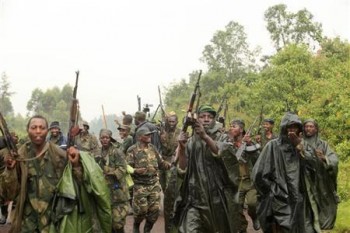
Kampala – The leader of the Democratic Republic of Congo’s defeated M23 rebels has warned of the possibility of renewed conflict, signalling mounting frustrations among the group’s confined-to-camp fighters.
The rebels’ 18-month war during which they briefly seized the key town of Goma, capital of mineral rich North Kivu province, was brought to an end a year ago by government troops and UN peacekeepers with fighters fleeing into neighbouring Uganda and Rwanda.
Most of the rebels signed an amnesty deal in May vowing not to fight again, but M23 president Bertrand Bisimwa said that if Kinshasa did not fulfil its side of the deal he could not “give guarantees for what will happen tomorrow.”
“The main causes of this conflict should be dealt with, the causes remain. Today the security situation in the country has completely deteriorated,” he said in an interview in the Ugandan capital Kampala.
“Negative forces continue to plunder the east,” he said, complaining that no other rebel force “has been disarmed or stopped.”
“They continue to kill. The number of women raped increases each day. The question of refugees hasn’t been resolved. The issue of national reconciliation has simply been forgotten,” Bisimwa said.
While the M23 were defeated, multiple armed groups still operate in a region that has been in turmoil for the best part of the past two decades.
Much of the rebel activity consists of abuses against civilians and illegal exploitation of natural resources, be it metals, ivory or timber.
He accused Kinshasa of reneging on its side of a deal, including the release of M23 fighters from prisons in DRC – and that this meant M23 fighters in camps in Uganda were fearful of returning to reestablish the group as a mainstream political party.
With their fighters disarmed and held under guard in camps in Uganda and Rwanda the M23 now hold little if any influence on the ground. The M23 chief, however, implicitly warned his men would fight again should agreements fail.
“When we took up arms, it was when we were forced to do so because to not take up arms would’ve meant dying. When our people are killed, out of view of the cameras, when our women are raped and our possessions looted, what do you expect us to do? And those that were doing it did so either with the knowledge of the government or its army. What should we’ve done?” he said. “We can’t give guarantees of what’ll happen tomorrow. If the government doesn’t respect its commitments, we regret to tell you that nobody will force us to respect ours,” Bisimwa said.
The United Nations and Kinshasa accused both Rwanda and Uganda of actively backing the mainly ethnic-Tutsi M23 rebellion, launched by mutinous soldiers, claims denied by both Kigali and Kampala.
DRC President Joseph Kabila announced the amnesty in February, to cover “acts of insurgency, acts of war and political offences”.
However, more serious transgressions are excluded from the amnesty, including crimes against humanity, torture, sexual violence, child conscription and embezzlement and looting.
Meanwhile, the head of the UN peacekeeping mission in the DRC has said he is sorry his forces reacted too slowly to prevent a massacre in the east of the country in June.
Armed men killed at least 30 civilians overnight between 6 and 7 on June 6 in the village of Mutarule in South Kivu province, in an ethnic dispute. A witness the next day saw dozens of burned bodies in the streets and in a church.
Human Rights Watch (HRW) said in a report on Thursday villagers had begged peacekeepers to intervene as the attack unfolded.
“It’s a very difficult situation and I express my regrets for the inactivity of Monusco. It’s really regrettable,” Martin Kobler, the head of the UN mission to Congo (Monusco), in Kinshasa. He spoke on Wednesday and UN officials disseminated his comments on Thursday.
“We’ve taken measures with our forces and our mobile operational base to have night patrols, to respond quickly to the needs of the population . . . to be able to save the lives of citizens in similar incidents,” he added.
Monusco has launched an investigation into its response to the incident, Monusco military spokesperson Colonel Felix Basse said.
“We’ve deployed a human rights investigation team in the area and established an operational base at Mutarule to prevent further attacks,” said Basse. – AFP


 Online Reporter