

 admin
admin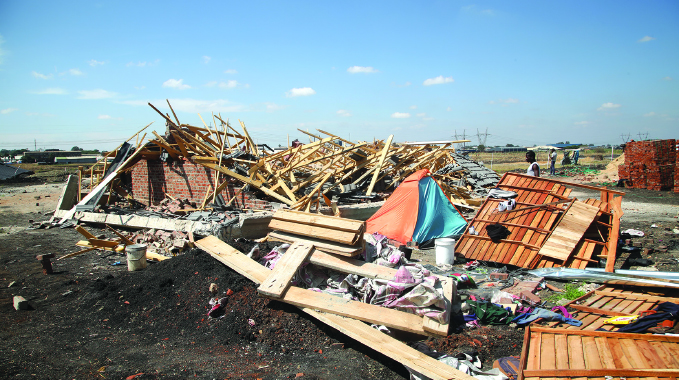
Trust Freddy, Herald Correspondent
It is late afternoon as the menacing sky threatens to unleash a torrent of rain to drench in more misery the victims of the recent demolitions in Ridgeview, Belvedere, Harare, who can only hold their breaths.
As The Herald toured the site of heartbreaks yesterday, the residents, who had already lost everything to the bulldozer, looked to the heavens for a timely intervention — to hold-off the rains — at least for a while.
Each gust of wind portents doom as their makeshift houses creak and groan under the weight of nature’s weaponry. While farmers are delighted by the onset of the rainy season, which is a harbinger of plenty, the inhabitants of the “ghost” landscape of Belvedere cannot afford that luxury.
Among the affected are five Harare Institute of Technology (HIT) students, whose rented home was also reduced to rubble.
“We’re not ready for the rains,” said Mai Ino, one of the residents, dejectedly. “Our cabins are not strong enough to withstand heavy rains. We are afraid that we will lose everything, all over again.”
While the rest of the city prays for rain to bring relief from the El Nino-induced drought, the residents of Ridgeview are praying for a reprieve. They feel hard done by the city’s authorities.
“That was unfair,” Mai Ino added, recounting how the Harare City Council had demolished their houses in Ridgeview.
The Government strongly condemned the act as “shocking, callous and inhumane”.
There were 30 houses under construction in the area, while some had already been completed on 52 demarcated residential stands. The council is said to have demolished the houses without notifying the owners, hence exposing them to huge losses.
Mai Ino had completed a two-roomed cottage, while the main house was still under construction. As the bulldozer approached, she grabbed a few belongings before her fate was sealed.
“Others were not so lucky,” she said, adding, “The pile of rubble over there are remnants of a mansion whose owner is based in Durban, South Africa.”
Her eyes glued on yet another partially demolished house, she contemplated her next move.
“The house belonged to someone who had just left for South Africa. Sparing only the parked car, the demolishers reduced the furniture and other belongings to waste,” she said.
Curiously, not all houses in Ridgeview, Belvedere, fell prey to the dozer — a sprinkling escaped its ominous grip.
A handful of people could be seen milling around, but they were said to be workers of property owners thus getting comments from the owners of the spared houses was futile.
As dark clouds gather for yet another downpour of hope on the thirst earth, Ridgeview resembles a war zone, with scattered debris, including broken solar panels, damaged lithium batteries, wardrobes, and windows, among other building materials.
These demolitions had far-reaching consequences, affecting not only residents, but HIT students, who called the area home, as well.
The five students reeling from the stress of writing examinations were met with more dejection when they returned from their end of semester examinations.
They had left their laptops behind as they headed to campus for their exams, and were met with sympathetic words of comfort from their peers upon return, instead of the usual congratulatory messages.
“When I came out of class, I was surprised to hear everyone saying, ‘Sorry'”, recounted one of the students, who wished to remain anonymous. “We had no idea that our leased home was going to be demolished.”
She was hesitant to reveal her name to the media, fearing that instead of receiving help, she might be stigmatised by fellow students, and ultimately left in the cold. She stressed that should anyone wish to assist, it wouldn’t be difficult to get access to the victims, since they are known.
“When we arrived here, we found all our belongings, including clothes, food, laptops, and other essential items, buried under rubble,” she said.
She lambasted Harare City Council officials for their “inhumane” behaviour, insisting that they knew that some of the houses in the area are used as boarding facilities.
“The least they could have done was to alert our college officials about the looming demolitions,” added the student.
The students are currently living in one of the three houses that were spared during the demolitions, but their future remains uncertain. They expressed gratitude to the caretaker at their demolished lodgings for facilitating alternative accommodation.
However, the other four male students couldn’t muster the courage to speak as they were still traumatised by the experience.
HIT director of communications, Mr Tinashe Mutema, confirmed that some students were affected by the demolitions, although none of them asked for assistance from the institution.
Mr Mutema highlighted that the incident occurred at a time when the majority of students were done with their end-of-semester examinations. The institute offers on-campus accommodation to 800 students out of an enrolment of 3 000.
Local Government and Public Works Minister Daniel Garwe recently condemned the council for demolishing houses without consulting the parent ministry.
He said the ministry directed the mayor and town clerk to stop the demolitions.
“We distance ourselves from, and the central Government distances itself from such behaviour. We have nothing to do with that,” said Minister Garwe.
However, he said while citizens had the right to housing, they could not abuse that right by establishing illegal settlements.
“People have a right to housing, but that said, we must not take the law into our own hands and say, I can build a house wherever I want. The law will still visit you. We do not want to take advantage of certain developments, and people must not start building recklessly,” he said.
In a statement, Harare City Council said it had demolished the structures because the development was not authorised.
“The stands do not have the requisite water, sewer, roads and storm water drains which are required before one can settle on land.”
Council claimed that before it could allocate the stands, the land was invaded by individuals led by a company called Brickstone Builders and Contractors (Private) Limited.
With an increasing student population in the country, the demand for on and off-campus accommodation has been increasing, affecting students enrolled at different institutions.
The houses in Belvedere, for example, are mainly used as boarding houses, with students usually sharing rooms, paying rentals ranging between US$100 and US$150 per head.
Approximately 80 000 university students in Zimbabwe struggle to secure accommodation, with the University of Zimbabwe being one of the worst affected institutions. As of 2018, only 15 000 students lived on campus across all institutions of higher learning.
In a report published in 2020, University World News noted a dramatic rise in Zimbabwe’s tertiary student population, increasing from 28 028 in 1999 to 116 324 by the end of 2020.
This sharp growth has stretched the capacity of university services and accommodation, with many students forced to seek accommodation off-campus.



 Online Reporter