


 malvernmugadzikwa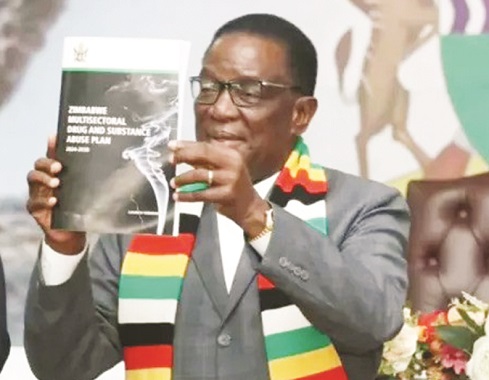
Vusumuzi Dube in BULILIMA
PRESIDENT MNANGAGWA has sounded the alarm on the growing menace of drug and substance abuse among Zimbabwe’s youths, declaring that it goes against all tenets of Ubuntu and is alien to the country’s culture.
President Mnangagwa emphasised the need for collective action in the fight against the scourge.

Defence Minister Oppah Muchinguri-Kashiri takes time to listen to a learner standing before a plaque after she presided over the groundbreaking ceremony for a clinic at Thekwane High School yesterday. Looking on are Ministers Dr Evelyn Ndlovu (with red scarf) and Nqobizitha Mangaliso Ndlovu (right), among others
He called on the Church, the community and other stakeholders to join forces in supporting the Government’s efforts to eradicate drug and substance abuse, and protect the well-being and future of the country’s youths.
In a speech read on his behalf by Defence Minister Oppah Muchinguri-Kashiri at the Methodist Church-run Thekwane High School’s centenary celebrations yesterday, the President said, with the Government launching the Multi-Sectoral Drug and Substance Abuse Plan (2024-2030), there was now need for action.
“My Government launched the Multi-Sectoral Action Plan to guide our actions in combating drug and substance abuse for the period 2024 to 2030. It is now time for tangible results, and I urge the Church and other key stakeholders to partner with my Government in implementing the action plan to eradicate the menace,” said President Mnangagwa.

“To students, I say no to drug and substance abuse. Our Ubuntu/Hunhu is not associated with drug and substance abuse; a drug culture is alien to us as Zimbabweans. A drug-free nation begins with me, it begins with you and it begins with all of us.”
He challenged the Church to continue preaching unity, peace, love and harmony, while also urging society to reject societal ills such as drug and substance abuse, gender-based violence, bullying, corruption and child marriages.
President Mnangagwa reiterated the Second Republic’s support for the education sector, saying the Government will continue to promote initiatives that encourage the establishment of school business units to foster entrepreneurship and self-sufficiency.
“The heritage-based education curriculum adopted by my Government is premised on having an education sector which contributes to the production of goods and services in our economy by inculcating a problem-solving mindset, science and technology, creativity and entrepreneurship.

“More so, my administration pioneered the implementation of Chapter 14 of our Constitution on devolution and decentralisation; the initiatives include availing devolution funds to empower communities to invest in infrastructure development projects based on their needs and aspirations,” said the President.
“Funded projects under the devolution and decentralisation programme include construction of schools, health centres and roads, among others. In addition, we have on board the OPEC Fund, which is earmarked to construct 50 schools, 10 of which will be boarding schools across the country.”
Turning to the school’s centenary celebrations, President Mnangagwa commended the Methodist Church in Zimbabwe for the strides it has made in promoting education.

He noted that Thekwane draws learners from all over the country and has always been an inclusive community, with children from all tribes and regions of the country.
“My Government, under the Second Republic, expanded the Church’s ability to advance our citizens’ spiritual and socio-economic development. My administration recognises the Church’s role in strengthening families, communities and the nation as a whole.
“We applaud the Methodist Church in Zimbabwe in particular for establishing schools and hospitals, and empowering its members across the country, which aligns with my Government’s developmental thrust of leaving no one and no community behind. With your support, we are already living into Vision 2030, of attaining an empowered and prosperous upper middle-income society, as espoused by the National Development Strategy 1,” said the President.
He further noted that the school left an indelible mark in the annals of the country’s liberation struggle.
The school’s location near the Botswana border, he added, served as a springboard for ZIPRA recruits who crossed into the neighbouring country on their way to Zambia for military training.
“In 1971, students from the senior classes were arrested for demonstrating against the colonial machinations during the Lord Goodman’s talks. In 1978, all of the students (nearly 400 boys and girls) crossed to Botswana at night to join the liberation struggle.
“After negotiations with Botswana officials, the students were returned to Zimbabwe; however, a few chose to stay in Botswana. A number were incarcerated when they were caught trying to join the liberation struggle. The mass exodus of the students led to the closure of the school in 1978 and only reopened after independence. When the exiles returned, the Patriotic Front utilised the school as a holding facility for students until they could be transferred to other schools within the country,” said the President.
He further applauded the Methodist Church in Zimbabwe for attaining autonomy from the mother church of the Methodist in the United Kingdom, saying that entailed assuming the responsibility to mobilise resources to support local activities.
“Such inward-looking policy is consistent with the development philosophy of the Second Republic that nyika inovakwa, igotongwa, igonamatirwa nevene vayo/ilizwe lakhiwa, libuswe, lithandazelwe ngabanikazi balo,” he said.
Founded in 1924 as Tegwani Upper Primary School for boys by Mr Herbert Carter, a Methodist Church missionary, Thekwane initially enrolled four boarders and two day learners — Elijah Mhlanamano, Mqiqima Mangoye, Jonathan Ntaisi, Dzinqilani Malumo, Vilani Nkobi and Kangezi Pile.
Alumni
Past learners of Thekwane High School include National University of Science and Technology Dean of the Faculty of Information Science Professor Bhekinkosi Jakobe Ncube; one of ZANU PF’s founding members and late national hero, Dr Edson Zvobgo; late national hero, former Home Affairs Minister Dumiso Dabengwa; the late Deputy Minister of Higher and Tertiary Education Lutho Addington Tapela; Dr Dabudabu; LD Bhala; former Education Minister Dr Lazarus Dokora; and one of the founding members of Lupane State University, the late Dr Mclean Mackson Bhala.
Other luminaries include ZANU PF Political Commissar Cde Munyaradzi Machacha; Major-General Emmanuel Matatu; Zimbabwe’s Ambassador to Angola, Major-General Thando Madzwamuse; former Zimbabwe Defence Forces spokesperson Major-General Chancellor Diye; Justice Sansole; Dr Michael Ndubiwa; Professor Eliphas Mukonoweshuro; former Attorney-General Prince Machaya; Ambassador Willie Zenzo Nsimbi; Witness Rukarwa; Tapiwa Mboyi Sibanda and former Victoria Falls Mayor Alderman Nkosilathi Jiyane.
History
In 1934, the school admitted its first intake of 11 girls.
The Famous Beit Hall was officially opened in 1958 by Vice-Admiral Sir Peverill William Polett.
The school is situated about 13 kilometres north of Plumtree town, in Matabeleland South province.
It is one of the earliest secondary schools in the country.
It is situated near Thekwane River, which takes its name from the hammer-headed stork, “uthekwane”, which used to be common along its banks, and which is depicted on the school badge.
Thekwane has had a difficult recent history, having struggled to re-establish itself after the destruction inflicted during the war of liberation, against a background of financial challenges.
Throughout this period, Thekwane has remained a school of accolades in all spheres — awards in quality academic practice, sports and religious undertakings, as well as intellectual and political cultivation of minds.
The school’s mission statement is: “To mould righteous citizens by providing a high-quality and relevant education.”
Its motto is “Qondani ekukhanyeni”.


 Online Reporter
 Bongani Ndlovu