admin
admin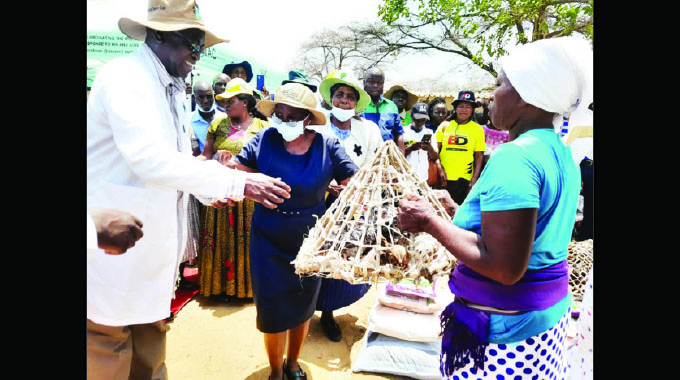
Precious Manomano-Herald Reporter
THE Presidential Rural Poultry Scheme has brought a new lease of life to beneficiaries in both rural and urban areas, with some of them saying the nutrition of their families has improved while also generating income for them.
Since the scheme was launched in Masvingo in August last year, over 800 000 birds have been distributed.
This season, the Government is targeting 450 000 households under the scheme, with over 80 000 households having benefited so far.
Each household will get 10 indigenous poultry birds and a 200g vitamin stress pack.
The poultry scheme is set to increase incomes and alleviate poverty through commercialising free range poultry production.
Rural households used to keep their road runners for subsistence in terms of meat and eggs to supplement their diet occasionally, and rarely for sale.
But they now have to do it as a business to ensure financial stability while also increasing small livestock in Zimbabwe.
While the scheme is largely aimed at rural communities, those in urban areas will not be left behind. The Presidential Rural Poultry Scheme falls under the Livestock Growth Plan (2021-2025).
Statistics from Zimbabwe Free Range Poultry Association (ZFRPA) indicate that Bulawayo province has so far received 45 348 birds, Harare 54 591, Manicaland 63 950, Mashonaland Central 39 003, Mashonaland East 298 134, Mashonaland West 103 660, Masvingo 54 210, Matabeleland North 71 624, Matabeleland South 25 550 and Midlands province 33 479.
Beneficiaries have so far received stress mix packets and 367 tonnes of feed.
In separate interviews, some of the beneficiaries praised the scheme, saying it has transformed their lives.

Villagers receive chicks under the Presidential Rural Poultry Scheme.
Mrs Farai Mashazhu of Greencroft in Harare said the programme was good as it has created a ready market for her.
“I used to struggle a lot in search of markets but l am glad now that the market is ready,” said Mrs Mashazhu.
“I am guaranteed a market and plan knowing that I will get my money without hassles. I am supplying chicks.”
Mrs Mashazhu makes more profit from selling road runners, for which she has a great passion.
“It’s not easy to be in poultry production, but passion pushes me to do that. To me, road runners are the real meat.
“From four road runners that l kept at home, they have now multiplied to 150 within a year. Neighbours and visitors are also interested in this production,” she said.
A youthful beneficiary, Mr Kudzanai Mungwariri, said the scheme has provided a ready market for him, adding that he is targeting to increase capacity to over 1 000 chicks per week.
Mr Mungwariri holds a degree in journalism.
“I specialise in chicks, so l buy eggs from farmers and supply them to the Zimbabwe Free Range Poultry Association (ZFRPA) and other markets. We are grateful for the scheme because it offers the opportunity to open markets to different people. This will promote sustainable growth and create competition in local and international markets.
“I benefited immensely from the production and the project has transformed my life,” he said.
Suppliers are paid on a monthly basis for the day-old chicks and eggs supplied through the ZFRPA. Most of the suppliers have increased production while others are employing more staff to boost their operations.
Another poultry farmer, Mr Francis Mapuranga of Chegutu said he supplies an average of 60 crates of fertilised eggs per week towards the Presidential Rural Poultry Scheme.
He has now started a cattle ranching project.
“Most farmers started supplying the eggs and I supply an average of 1 800 fertilised eggs weekly for hatching and have since bought seven heifers using proceeds from poultry.
“Supplying fertilised eggs has helped me grow into a commercial entity,” he said.
An 82-year-old farmer, Gogo Enina Mavuta, of Siyapambi Growth Point in Masvingo, thanked the Second Republic for introducing the poultry scheme.
She thanked President Mnangagwa for being a hands-on leader who attends to people’s challenges.
“We want to thank President Mnangagwa for implementing the Rural Poultry Scheme because besides boosting our nutrition, the programme will also earn us income through the sale of chickens,” said Gogo Mavuta.
Mrs Blessing Mhone of Tapfumaneyi Village in Goromonzi said she was grateful to see the Government intervention uplifting people’s living standards through such programmes.
“This is a wonderful project which the majority take part in to improve their standards of living. I am happy that this programme is benefiting people across the country.
“We are grateful and this will go a long way in alleviating poverty. I have a larger family but l can sustain my family through this project. This project will continue to sustain my large family and l have no doubt about this because already l have created a good market,” said Mrs Mhone.
Mr Moses Zinyama of Chinyika Village in Goromonzi also said all beneficiaries should take full advantage of the scheme to sustain their families.
He said the programme has trained them to be self-sufficient, independent and to improve people’s lives.
“I learnt a lot about poultry and now I am experienced. I can manage time to balance work and other activities. My kids have eggs for breakfast, and we don’t struggle for relish.
“The programme has opened our eyes that there are business opportunities in free range chickens. I am planning to buy an incubator and produce chicks for other beneficiaries,” he said.
In line with development that leaves no one and no place behind, the scheme, though primarily focusing on rural areas, will also benefit urbanites.
Mrs Loice Mureza of Chitungwiza said she used to struggle to get buyers for her indigenous chickens, but she has since taken advantage of the Presidential Rural Poultry Scheme to supply day-old chicks.
“I deliver day-old chicks to the Zimbabwe Free Range Poultry Association at the Exhibition Park in Harare. I have been supplying chicks since November and the business has proved to be viable,” she said.
Mr Tinashe Madondo of Murape Village in Goromonzi said the commitment shown so far by the Government to empower youths was greatly appreciated.
“This is a wonderful project, which the majority take part in to improve their lives. We are grateful to our Government because this will go a long way in alleviating poverty. Everything is now moving well and I hope this project will continue to improve the way we live,” said Mr Madondo.
Mrs Violet Dzamanga of Chiundura said poultry was a cash generating business that does not require a lot of effort.

Villagers receive training in poultry production.
“If taken seriously, this is a business which brings more money with little effort put in. We are grateful. I live in remote areas but I can tell you that I am now living a luxurious life through this scheme.
“I sell eggs and meat as well; so I am grateful for this initiative. We are proud of our Government,” she said.
The breeds of the chickens include Boschveld, Sasso, Kuroiler and indigenous chickens.
ZFRPA secretary general, Ms Beauty Jiji, said distribution of birds will continue in all provinces.
Farmers’ unions have hailed the scheme, saying it had already positively improved the livelihoods of many people in rural areas.
Former Zimbabwe National Farmers Union vice president Mr Edward Dune said the initiative was greatly appreciated, adding that it had boosted food security and nutrition especially in rural communities.
“This is a positive step towards alleviating poverty, especially among vulnerable groups and widows who are struggling to make ends meet. We really appreciate its scope, as it will help to increase exports and incomes for rural households,” he said.
Zimbabwe Indigenous Women Farmers Trust president, Mrs Depinah Nkomo, said the scheme was very helpful, adding that many people were now earning a living through the initiative. Prostitution and robbery cases will be reduced because of this empowerment project, she said.
The project is part of the Government’s broader vision of creating a US$8,5 billion agriculture industry by 2025, which dovetails with the Second Republic’s signature vision of having an upper-middle income economy by 2030.
The interventions are meant to help increase the country’s food self-sufficiency from 45 percent to 100 percent, thereby reducing reliance on imports, as the Government seeks to make Zimbabwe the breadbasket of Africa again.


 Online Reporter