

 Chronicle Editor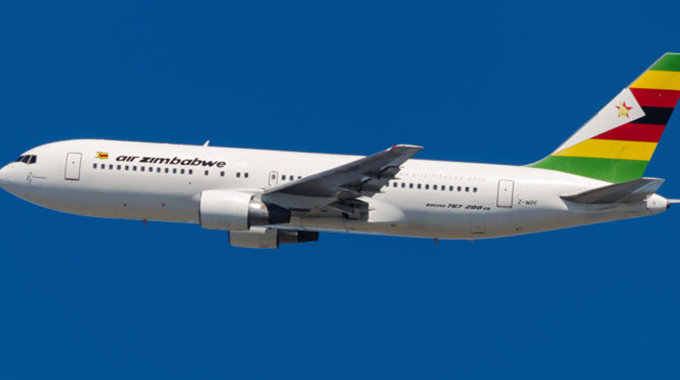
The national flag carrier, Air Zimbabwe, in turbulence for a prolonged period, is hopefully beginning to fly out of it.
Largely due to mismanagement and corruption, the airline is saddled with a debt of about US$334 million. One of the company’s aircraft, a Boeing 767-200, was impounded by American General Supplies at Gatwick International Airport in London in December 2011 over a debt amounting to US$1, 2 million. Fearful of more seizures of its aircraft, the national airline has not been on the lucrative London-Harare route since then.
It used to fly around 18 planes but, after many were grounded over the years, Air Zimbabwe now has just one, a Boeing 767-200ER, which is restricted to plying domestic and regional routes. In January the company was forced to suspend flights for some two weeks due to maintenance works that were being carried out on the only functioning plane.
In another highlight of the challenges that have bedeviled the company, in August 2015, scores of its passengers were stranded at the Joshua Mqabuko Nkomo and the Robert Gabriel Mugabe international airports in Bulawayo and Harare respectively after the national airline reportedly ran out of jet fuel. The passengers had to wait for more than eight hours as one of its aircraft flew to Zambia to purchase fuel for the trips.
In April 2015, two former Air Zimbabwe Holdings (Pvt) Ltd bosses, Grace Pfumbidzayi, who once served as its secretary and former group chief executive Peter Chikumba were jailed for defrauding the airline of €5 175 593 and US$502 748 in an insurance scam.
It has been truly difficult for Air Zimbabwe for so long but we foresee it emerging out of the challenges soon.
Air Zimbabwe, being the national airline, is our pride collectively as Zimbabweans, just like the national soccer team, the Warriors or the national netball team, the Gems. It represents us wherever it flies, flying the national flag on our behalf. As a result of this it is our wish that ongoing efforts to revive the company will bear fruit.
Its placement under reconstruction on October 4 last year in terms of the Reconstruction of State-Indebted Insolvent Companies Act (Chapter 24:27) is one big step forward. During the reconstruction process, all payments towards debts accrued by the company prior to October 4 last year, would be temporarily suspended and settled in terms of this process.
Acquisition of more planes has been identified as one of the ways through which Air Zimbabwe can be put back into shape. Pursuant to that, on Tuesday, Air Zimbabwe took delivery of an Embraer ERJ145 that was bought from the US.
“Government has delivered on its commitment and promise to resuscitate Air Zimbabwe after the national airline took delivery today of the first additional aircraft, an Embraer ERJ145 purchased from the United States of America. The 50-seater jet is expected to go through the local registration process as well as all mandatory checks, tests and certification before it enters into service within the next 21 days,” Air Zimbabwe corporate affairs manager, Mr Tafadzwa Mazonde said this week.
Two additional Boeing 777-200 ERs are expected in the country soon. This will take to four the number of the Air Zimbabwe’s serviceable planes. Four aircraft is a small number if one looks back to the size of what the company used to fly but we are encouraged in that modesty. We look forward to a few more acquisitions in the next few months.
A larger fleet will enable Air Zimbabwe to expand its services to more routes domestically and abroad. It will give the airline more flexibility in case, for example, one of its planes is grounded for some reason. It will be able to juggle around its planes for replacements instead of the new normal of flights on some routes being cancelled altogether. Air Zimbabwe’s viability would be enhanced as well if more planes are acquired and are in service. A viable Air Zimbabwe would be able to employ more people and be able to begin to repay its debt. A return to the London-Harare route can then be possible if debts are cleared or a payment plan is negotiated.
However, acquisition of new aircraft, on its own, will not take Air Zimbabwe to the heights it must be. It is important for the new managers at the company to avoid the pitfalls that grounded the company. They must be better managers who run the company as a business that Air Zimbabwe is. They must shun corruption at all costs.
With a bigger fleet and top-notch management the company will definitely soar because there is no shortage of business. We know that planes flying into and out of Harare, Victoria Falls and Bulawayo are almost always full of passengers. Air Zimbabwe, in our view, stands to benefit the most from this business; far much better than any among its competition, if the recovery efforts underway stabilise the company.



 Online Reporter