Online Reporter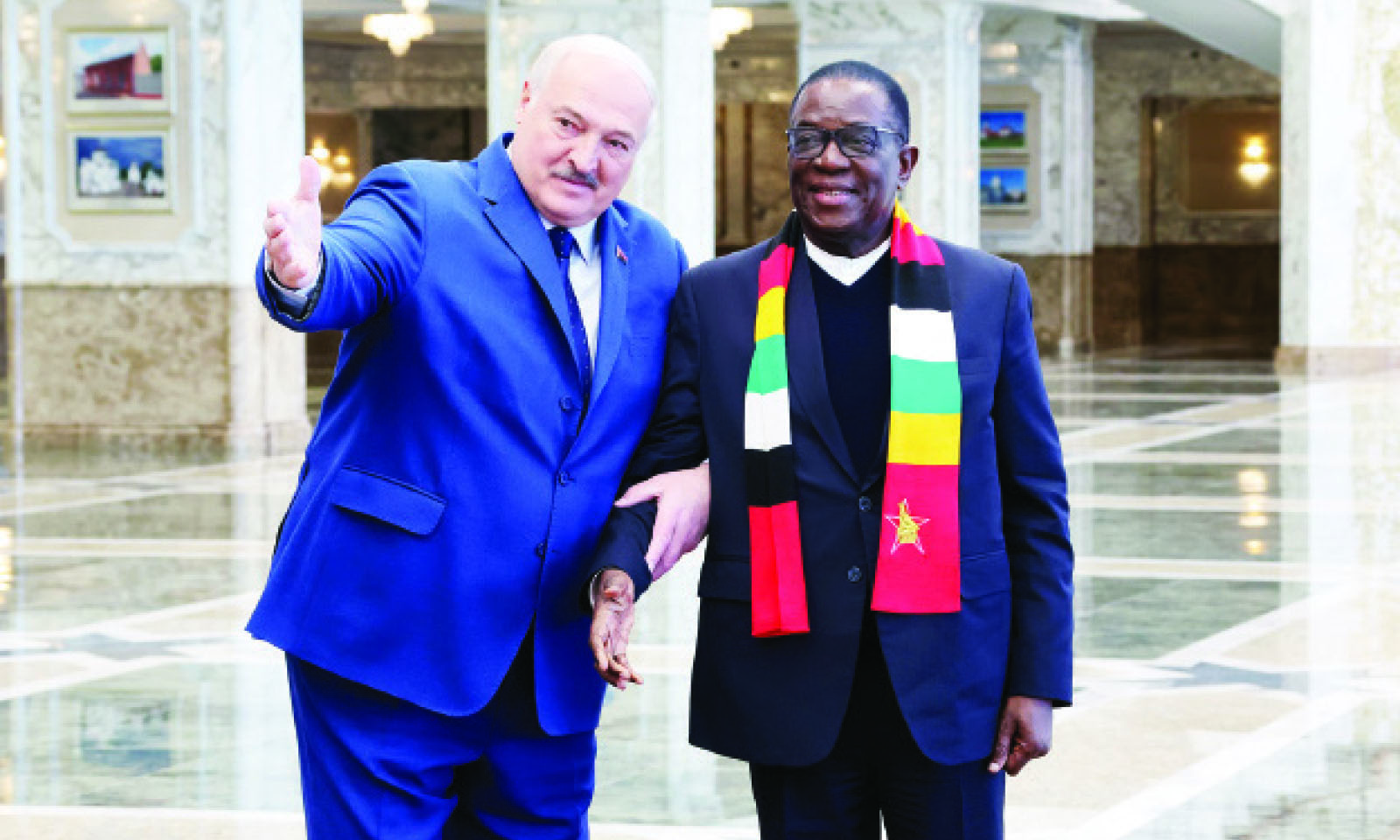
WITH Zimbabwe’s foreign policy pillar of economic diplomacy, encapsulated by the mantra — “friend to all and enemy of none” — the crucial point is that doing business needs to go beyond talk and become practical on-the-ground cooperation, trade and investment.
In his State visit to Belarus this week, President Mnangagwa, accompanied by a team of Cabinet ministers with particular interest in the proposals being considered at the official level, was exceptionally keen on this practical side of closer economic ties.
There was already a good successful example of the desired practical trade ties with the farm mechanisation programme run by a major Belarus manufacturer of tractors and other advanced agricultural equipment.
This allows credit sales of very robust machinery, solving the dual needs of desirable technology and financing from a single source.
This is why that Belarus company is now the largest single supplier of such equipment in Zimbabwe, reaping the advantages of having the right product at the right price as well as showing a high level of trust in Zimbabwe and Zimbabwean farmers that most of its competitors have been reluctant to show.
Government to Government contacts and guarantees help, of course, but in the end the trade rests on product, price and innovative financing.
Belarus has certain advantages in being a source of goods for Zimbabwe.
It was a major industrial centre in the west of the old Soviet Union, and on independence, built on the experience of being able to manufacture advanced machinery and equipment, plus other products, that while at the technological cutting edge could still cope with what amounted to a rough physical environment.
This is an advantage when dealing with a country like Zimbabwe, where there can quite often be tough and rough environments and where we do not want to see decent modern equipment break-down easily, and at the same time is fairly easy to service and maintain by local technical people.
During his visit, President Mnangagwa wanted to see a dual emphasis on increasing trade, rather than just an expansion in areas of trade and cooperation.
Besides this widening of economic relations, he was also keen on a deepening of ties, for example suggesting the tractor exporter looked at Zimbabwean assembly and perhaps some local manufacturing input.
This would not only cement the price advantages, since it must cost a bit to ship assembled products between a landlocked country in Eastern Europe to a landlocked country in Southern Africa.
It would also allow that same manufacturer to use Zimbabwe as a base to expand sales in Africa, where the growing free trade on the continent makes it important to be inside the fence. It also makes it easier to show off the equipment in an African environment, important for a non-traditional supplier.
The expansion of trade and cooperation was seen in the signing and initialling of eight agreements, again full of practical measures rather than declarations of intent, and going into a fair amount of detail.
High on the list were the two agreements on health. The Second Republic has made major advances in building up the public health sector and ensuring that hospitals and clinics have the proper equipment, consumables and medicines.
There is still some way to go and progress now requires some major re-equipping, rather than just maintenance and repair of older equipment that has reached the end of its natural life.
So one agreement is for the major infrastructural upgrade of the Parirenyatwa Group of Hospitals, the largest health facility in Zimbabwe.
This will require a lot of detailed work, but so long as the right equipment at the right price can be supplied, and preferably with some innovative financing as with the tractor deals, it should result in a major advance and thus open the doors to more business in the health sector.
The second health deal was over the supply of pharmaceuticals and associated consumables.
Here Zimbabwe is not looking at a single source, but will be looking hard at Belarus suppliers, again where the quality and price are right. This is sound commercial sense, and means that the trade will be based on a proper basis, rather than goodwill.
There is competition in this area, and a small country like Zimbabwe cannot rarely make special deals, so we need a competitive environment to make our health tax dollars go the furthest.
On the information front, Zimbabwe is still in the process of switching over from the obsolete analogue broadcasting technologies to the modern digital technologies, that offer opportunities for making far better use of our assigned broadcasting frequency ranges and improving quality of services quite dramatically.
A lot has already been done, but there is still some way to go to have an ultramodern broadcasting and television network for all desired services that reaches into every corner of the country.
Again Belarus has suitable suppliers and the deal here should mean that they can be involved.
In all these deals and agreements, both countries have been emphasising the practical aspects rather than the more general memorandums of understanding that marked the advent of tighter Belarus-Zimbabwean relations.
Some of those more general expressions of goodwill have not really been implemented, a point that came up in discussions.
We assume the more detailed and specific agreements made during this State visit by President Mnangagwa will be implemented because they are based on practical trade and economics, which are the basis of any growth in closer ties.