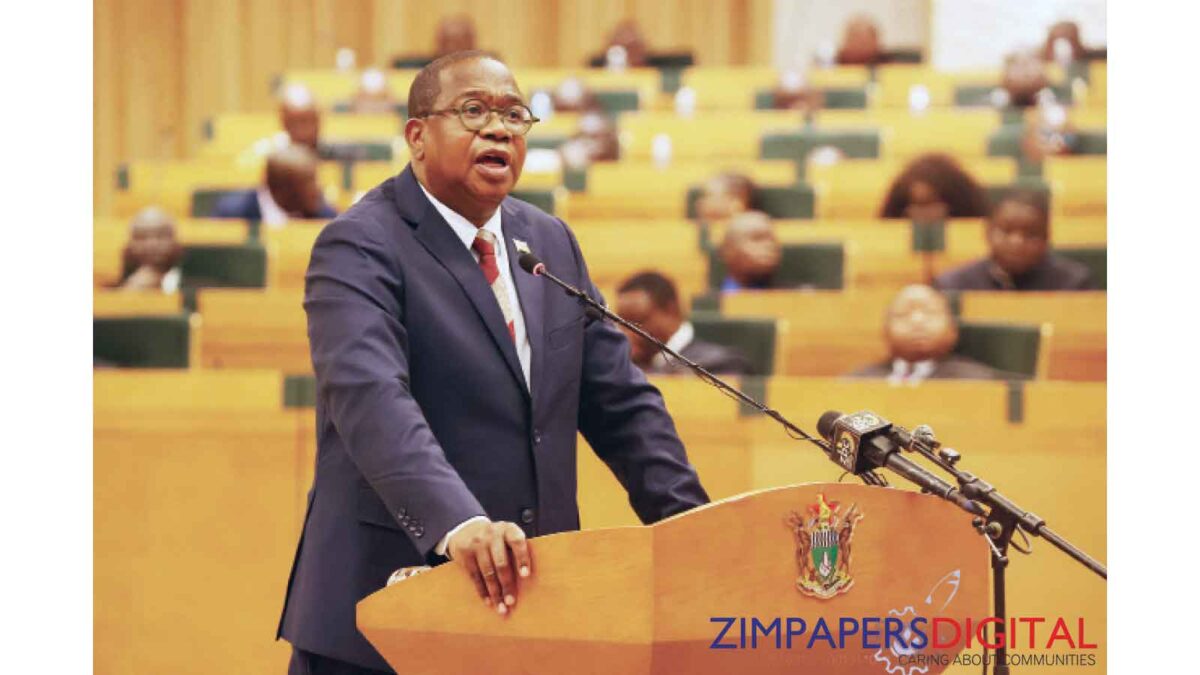
THE 2027 National Budget presented by Finance Minister Mthuli Ncube to Parliament on Thursday maintains the prudence with accelerated Government spending on developing the country, maintains hard-won low inflation and economic stability and is generally people-oriented as we now expect with the Second Republic under President Mnangagwa’s efficient administration.
But at the same time, there are some breaks for taxpayers, possible because more people who should pay tax are now forthcoming, giving a bit of leeway to reward the honest.
Planned spending is increasing significantly with economic growth producing more revenue from taxes and more taxpayers complying.
So next year the Government plans to spend almost ZiG388 billion, a big real jump under low inflation from this year’s ZiG290 billion, but almost entirely covered by taxes and other income, so we win the benefits of the economic reforms.
Minister Ncube’s conservatism over keeping expenditure within income is perhaps shown by the results of last year’s budget where he budgeted for a tiny deficit.
More efficient tax collection meant that while his tightly controlled expenditure this year remains at ZiG290 billion, he will have revenue of ZiG305 billion, the surplus being used to clear payment arrears.
He intends to not only keep his spending controls, but to tighten them, with one major innovation requiring contractors for Government work to guarantee this for five years to ensure all Zimbabwean firms building our infrastructure meet the standards of the best performers.
There is determination to get value from every dollar spent.
The bulk of the revenue goes on providing services to the people.
The two education ministries and the Ministry of Health and Child Care account for 26 percent of the budget.
That includes not only the large payroll for all those teachers, lecturers, doctors and nurses, but also the capital spending on new schools while upgrading schools, colleges and universities, and new hospitals and clinics while reworking those we already have.
The next line ministry on the list is Agriculture, Mechanisation and Water Resources Development, again with a substantial staff spread across the country, plus heavy capital spending on dams, boreholes and mechanisation to ensure we can move vast numbers of people up the ladder from poverty into prosperity through backing their hard work and at the same time feed ourselves and provide a lot of the raw materials our rapidly growing industries need, so boosting urban prosperity as well through job creation.
While the Finance Minister will continue upgrading conditions of service, he is determined to keep the total employment costs at under half the budget, so he has the cash to build our infrastructure and support those who do need help, a larger item next year with the expected El Nino drought.
On taxation, Minister Ncube stressed the main thrust is making sure that those who should pay tax do pay tax and while simplifying procedures for the honest, he is ensuring more of the others join in.
He does not believe in a small minority being compliant.
His success with VAT, the largest contributor to revenue, exemplifies this approach with even fairly modest businesses now using systems that make collection easy and certain.
Because of these successes, he has been able to ease income tax a bit on individuals and families.
He wants Parliament to approve new tax brackets that raise the tax-free window from the equivalent of US$100 a month to US$150 a month and reserves the 40 percent bracket for that section of income over US$3 000 a month.
With low inflation, this is a boost to real incomes for the honest tax payers. These reforms will allow taxpayers to spend an extra US$81 million next year, so benefiting a wide range of businesses from builders to retailers.
The money transfer tax will be further cut to 1,25 percent for ZiG transactions and 1,75 percent for US dollar transactions.
Mobile phones will be imported tax free, but the Minister expects far more of those imports in the formal sector, and so will claw back some of the concession from rising VAT and tax on rising profits in that sector.
Other tax regimes are simplified, a boost to the honest, as well as being opened to tougher enforcement. Miners have even more incentives to beneficiate their minerals before export. Fertiliser manufacturers get decent concessions, but he wants to see lower prices in return.
The only tax rise is on cigarettes. Every time a smoker lights up they will chip in with 1,5 US cents with this simplified “sin tax”.
Most of the rest of the taxation proposals make it a lot easier to track down cheating, and stop it. There are incentives for honesty, such as the new rules on taxing rents where the compliant can claim back their expenses.
To keep track on probable smuggling, there is now a list of 19 imported items, ranging from cement and tyres to diapers and drinks, where matches will be made between what is sold and what is declared on import, so investigators can target actual smuggling more accurately and precisely.
All in all, we see the same building on success, making Government more efficient and responsive to people’s needs, and continuing our path of high growth with high fairness.