Online Reporter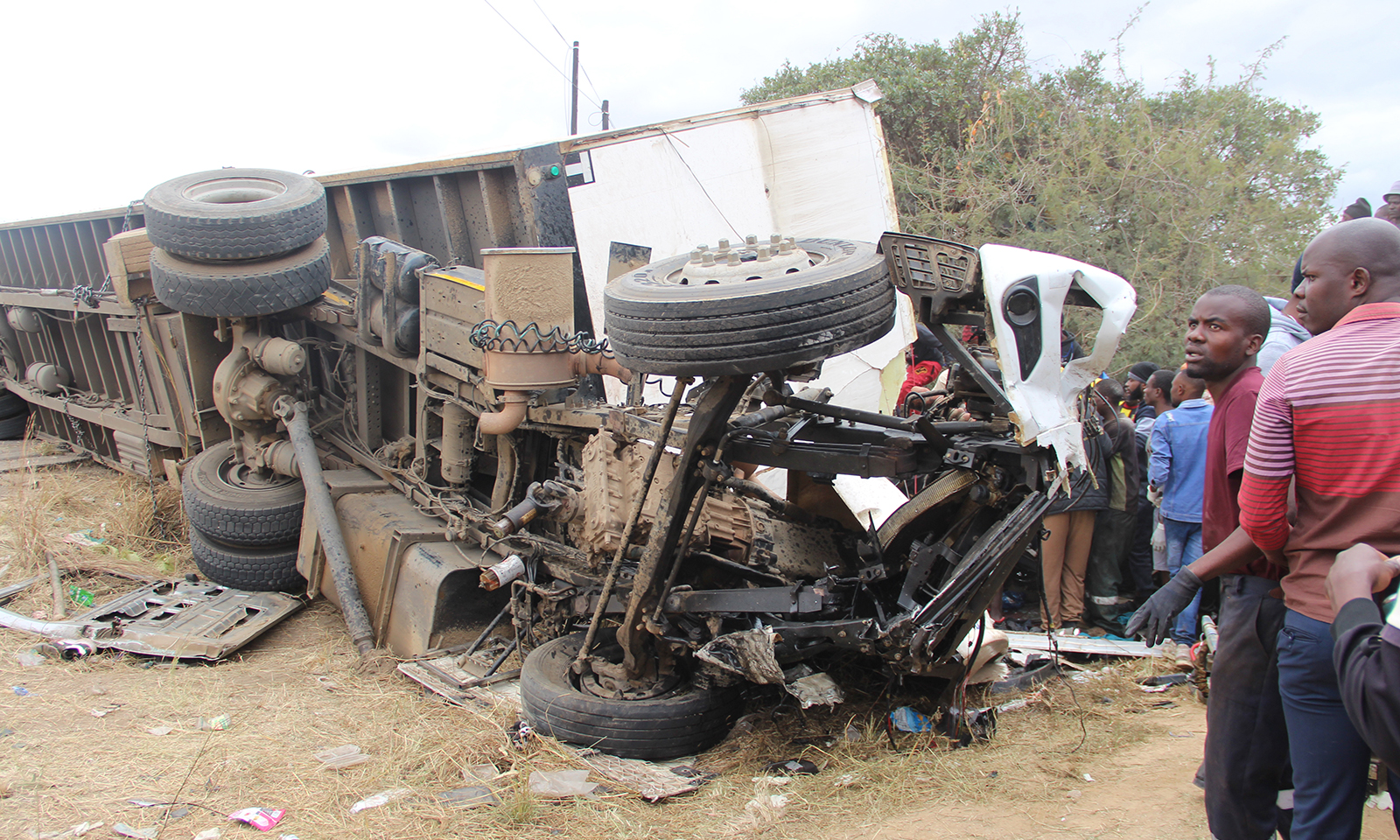
THE heart-breaking accident in Chitungwiza yesterday when 15 people aboard a commuter omnibus and two pedestrians were killed, when the kombi was hit by a truck, shows up the fact that almost all accidents are caused by human error, not lack of infrastructure.
The section of Seke Road where the accident occurred, just south of Manyame Bridge, is a dual motorway with the two carriageways separated by a low paved island.
This is a well-built highway that keeps the traffic in each direction separate, and in theory should mean that the worst accident is a rear shunt, which is rarelyfatal.
But what happened yesterday showed up the human error. A Honda Fit, which eyewitnesses are sure was a mushikashika, suddenly appeared in front of the truck that was in its correct carriageway on the way to Harare.
The light car apparently entered the highway from a side road just before the bridge that leads to the waterworks.
The truck driver swerved to avoid the probable crash, but since his vehicle was both big and powerful, it was able to cross the paved barrier between the two carriageways and crash into the kombi coming from Harare.
The degree of blame contributed by the three drivers will eventually be sorted out by the police investigation.
The police, who investigate all fatal and most serious accidents, and the Traffic Safety Council of Zimbabwe, which analyses the reasons for accidents and road deaths as part of its relentless struggle against death and destruction on the roads, both find that almost all accidents are caused by a human being, a driver who made a mistake, who did not follow the best practice laid down by the Highway Code and the rules set down in the road law.
Sometimes, and this could be the case yesterday, more than one driver involved in the accidents makes a mistake, or was at the very least not following best practice even if they were not in definite breach of the law.
Those who teach defensive driving, and they all come from or are licenced by the Traffic Safety Council of Zimbabwe, go further than just teaching that drivers must follow the law, for they also note when traffic conditions mean you should be taking further action, and what to do when other drivers are not careful and not following the law so you can avoid an accident or at least minimise the damage.
After every fatal crash involving a kombi driver there are calls to ban kombis.
And the involvement of what is assumed by many to have been a mushikashika driver will bring pressure to bear there as well. But regardless of who is to blame, kombis do not cause accidents, trucks do not cause accidents, even mushikashika do not cause accidents. It is the drivers who cause accidents.
Sometimes drivers deliberately break the law, and kombi drivers do more than their share of bullying and relying on other drivers to miss them when they breach common sense safety let alone the law. Sometimes drivers are quite legal, but are not paying attention properly and not thinking about what could happen next.
Our road accident statistics are appalling. More than 2 000 people a year are killed on our roads, and while the deaths of 17 in a single accident concentrate concern and sympathy, the fact remains that every day someone dies, in fact an average of around six people a day.
And yet almost all these accidents and deaths are preventable. If every driver followed the Highway Code our accident rate would plummet and the only deaths each year would be those caused by mechanical faults, and that would mean a tiny fraction of the more than 2 000 caused by bad driving.
Kombi crashes tend to raise calls for banning kombis, which are essential for public transport. The correct response is to ensure kombi drivers follow the law and best practice as laid down in the Highway Code. Enforcement can be made more complete, perhaps by involving those associations that have been forming.
If every kombi driver had to belong to a recognised association to be employed, and would be expelled if found in breach of the law so losing their possibility of employment, then there might be changes.
Mushikashika are far worse, since they are totally illegal with no public transport regulations at all, and people need to be taught not to use them. The crimes committed against passengers, up to robbery and rape, should have deterred people from taking the risk.
But no driver can just blame others without examining their own driving. How many drivers have bought, read and studied the latest edition of the Highway Code, or even read it since they passed their provisional licence test decades ago. We have the means to slash our accident rates but these all mean that all drivers use those means.
Yesterday’s Chitungwiza tragedy was almost certainly avoidable. It was the fault of bad driving, since the road was good and there was a dual carriageway which is supposed to keep traffic lanes separate. But, however well we build and upgrade our roads, we still have to upgrade our drivers, and that means more than just enforcement, useful as that is, but rather every driver becoming committed to driving as safely and as carefully as possible.