Online Reporter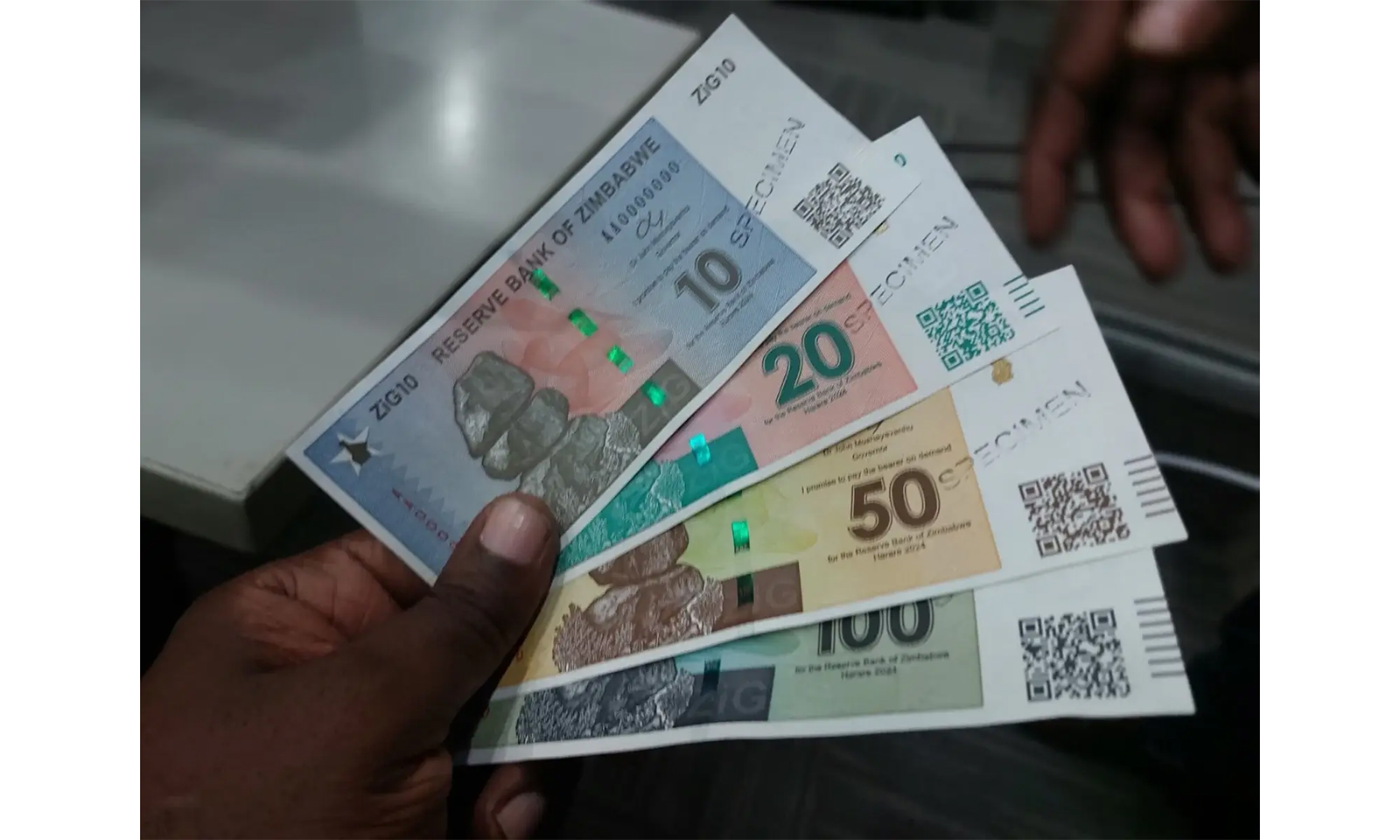
At long last, the pressures on Zimbabwe’s local currency are moving in the right direction, thanks to the Reserve Bank of Zimbabwe’s firm monetary policy backing the Government’s strict fiscal policy, and the strong alignment of the two policies in the major goal of maintaining a respectable and desirable local currency.
When the ZiG was introduced a little under a year ago, about 80 percent of local transactions were in foreign currency, predominantly US dollars, and just 20 percent in the ZiG.
The build up of last year has seen the ZiG now accounting for 30 percent of local transactions, and would be more but for the drought severely cramping incomes of farmers and thus most other rural inhabitants.
At the same time, since the exchange rate was adjusted to realistic levels a few months after the ZiG was introduced, the interbank exchange rate has been largely steady, oscillating within a fairly narrow band as banks adjust their daily rates after looking at supply and demand.
The interbank rate is a weighted average. Each bank sets its own exchange rates for buying and selling foreign currency, and although the 5 percent margin has been liberalised, most banks are sticking to very tight margins between the two rates.
The interbank rate calculated by the Reserve Bank each day takes the data for each bank’s exchange rates and the amount of business it does, and then calculates the weighted averages for the buy and sell rates, and finally the mid-exchange rate that acts as the official exchange rate outside the banking system.
Outside this bank-driven exchange rate, there is what is called politely the “parallel market” although in fact it is an illegal black market. The average premiums, and each dealer has their own premiums, there used to be high, with very large margins between what a black market dealer would pay for US dollars and the far higher price demanded for selling these.
That high-margin sale rate is what is usually quoted as the “parallel rate”, and the price has been falling in recent months as black market dealers scramble for a share of a decreasing market as ever more dealings are done through the banks or through direct purchases by those with US dollars. Direct purchases have become the norm since the “supermarket rate” and what a black-market dealer pays for a US dollar are almost the same.
In all countries the non-bank rate, legal or illegal, is always a bit higher than what bankers pay when they buy and sell foreign currency.
Some of this is because a tourist perhaps wants to change money at midnight, and sometimes because people want to buy illegal drugs or launder money or indulge in other criminal activity, where banks will refuse to deal. But it need not be high when almost all proper business is done through banks.
One pressure now acting to maintain, and even raise, the value of the ZiG is the decision by Government that at least half of corporate taxes must be paid in ZiG, so even enterprises with exceptionally high levels of dollar transactions need ZiG to pay their tax, and have to buy that via banks from those with holdings in ZiG. Those doing most of their business in ZiG have the ZiG for their large shares in local currency taxes.
This pressure by exporters and petroleum dealers wanting ZiG was seen in December last year and will be even more prominent this month for the first quarter tax payments. Banks, which tend to be among the more profitable businesses, are already complaining that they will need to buy ZiG for their own account as well as buy for exporter customers.
This was part of their arguments when in discussion with the Reserve Bank and the Ministry of Finance, Economic Development and Investment Promotion when complaining about what they described as tight liquidity.
The joint and aligned measures by the Reserve Bank and Finance Ministry to prevent any random creation of new money, no “printing” in colloquial terms although the printing these days would be electronic rather than on a press, is one major reason for why the ZiG is maintaining its strength.
But Reserve Bank Governor Dr John Mushayavanhu has also noted that liquidity is not tight.
The problem is that banks are not dealing with each other and instead just want to deposit their surplus ZiG in their zero-interest Reserve Bank accounts.
As he points out, we need a flourishing interbank market, which is quite different from the interbank calculation of the exchange rate.
On any given day after the daily transactions are complete one would expect about half the banks to have surpluses and half deficits, although the actual proportions would vary as banks vary in size.
In a normal system those with surpluses would then lend to those in deficit. The Reserve Bank itself is not going to create money to lend to those in deficit; they need to borrow from the surplus holders.
In other words, the pool of liquidity is reasonable, and if anything needs to be watched closely so that it does not expand more than economic growth and the extent of the gold and foreign reserves could cover with a decent margin.
The problem is that it is being inefficiently used because bankers are not using markets efficiently, and making money while they do so by lending out surpluses.
Zimbabwe has been moving towards being a normal country operating in a normal environment, with this process starting with the tight fiscal policy of the Second Republic, where the Government borrowing is very small and only for instant income-producing capital development.
The Government and the Reserve Bank have managed to track down all the taps creating money, and some of them were far from obvious and more obscure than first assumed, and has turned them off. So we are now in the position of a normal country following the rules and expected to be using markets to sort out exchange rates and liquidity management.