Online Reporter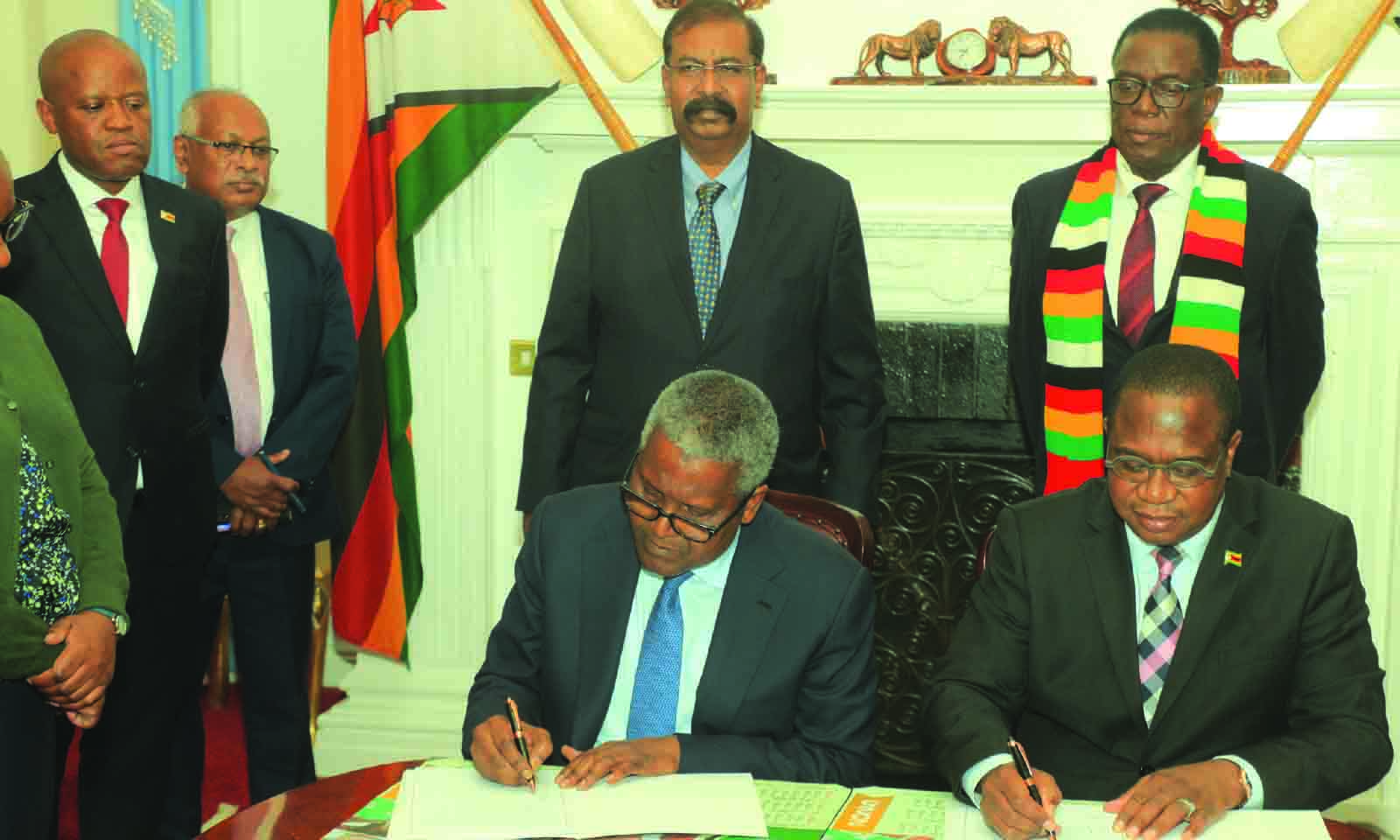
PROPOSED investments by Africa’s wealthiest man, Mr Aliko Dangote, in Zimbabwe have moved from possible proposals to something a lot firmer with the signing of a global cooperation agreement on Wednesday.
That agreement basically lists major investments the Dangote Group wishes to make in Zimbabwe and makes it clear this country will welcome such investments.
It is a preliminary agreement, but will ensure that when more detailed proposals are made, they will not be held up.
The agreement opens the doors on the more detailed work that will be needed on the planning side as Dangote Group works through the highly slimmed down licencing criteria in modern Zimbabwe’s pro-investment environment, and then the actual opening of mines, a cement factory, a fertiliser factory, an oil refinery and a pipeline.
It is already a significant step forward on earlier investigations by Mr Dangote in 2015 and then at the start of the Second Republic in 2018.
He was worried on both visits that Zimbabwe was not really ready for major investment, and that even in 2018 the promises being made by then new President Mnangagwa needed to be converted to effective action before he was ready to start committing his money.
Other investors were in the same boat but the way the Second Republic implemented the transitional economic programme and then implemented the first phase of the national development strategy has reassured investors that we are serious. Mr Dangote is the latest to praise the country for converting the rhetoric to action, and the first new major investor from Africa to climb aboard as a result.
He has made it clear that he now sees the results of the major efforts made by President Mnangagwa and his Government in restoring investor confidence through the bold economic measures already implemented, rather than just talked about. This exercise in practical applications of reforms fits in with Mr Dangote’s businessperson’s agenda of doing rather than talking, so the good match is possible.
The global agreement was signed before President Mnangagwa by Mr Dangote and Minister of Finance, Economic Development and Investment Promotion Mthuli Ncube within hours of Mr Dangote’s arrival in Zimbabwe.
Clearly, especially considering Mr Dangote’s distaste of empty rhetoric by himself or anyone else, the agreement is the result of detailed negotiations over some time and the public ceremony was designed to make sure everyone understood that both the investor and the Government were on board.
Mr Dangote’s planned investments are an integrated industrial complex centred on the heavy industries that his group already invests in in its Nigerian home and several other African states. The bits fit together to maximise production from each dollar invested.
The initial investment is in coal and limestone mining to feed a cement works and a power station that will ensure that the Dangote Group in Zimbabwe has its own power. He is then keen on fertiliser manufacturing, which can use some of the same raw materials.
But it takes off with access to petroleum refining, which plugs into the proposals for using Zimbabwe as the distribution and refining centre for the Dangote Group petroleum business in Southern Africa. This will require a new pipeline in the south and west of Zimbabwe, and the petroleum business will be feeding Namibia, Zambia and Botswana as well as Zimbabwe with Nigerian petroleum products.
Looking at Mr Dangote’s full range of proposals, it is clear why he has been so successful in African production.
Each bit of the investment proposals seems to perform several functions and the whole lot across several sectors still combines many aspects. This is an example to us all as well as the way Mr Dangote likes to do business.
Zimbabwe has, before the Second Republic, built up an economy reliant on farming and mining but with industrial manufacturing, largely food processing, in a few larger factories and a spread of consumer products in smaller concerns.
Second Republic advances have seen more and better farming, large expansion in mining and the introduction of heavy industry in manufacturing. Mr Dangote’s plans see the continued expansion of this heavy industry sector, adding to the major gains already made by other investors.
This is allowing him to use Zimbabwe as a central pivot of the expansion of his industrial empire into Southern Africa, although he is not neglecting South Africa and Zambia.
Zimbabwe’s industrial investment strategy of converting our own raw materials into the building blocks of a modern industrial economy obviously has struck a chord with investors, now including Mr Dangote, with the Government policies under President Mnangagwa, coupled with the natural and human resources of Zimbabwe, creating the right conditions for serious investment. And a US$1 billion plus investment is definitely a serious investment.
Our economic growth has been high by global and African standards, but has largely been built around mining and farming.
As we are now adding the industrial side in a very big way, we can translate large chunks of that mining and farming growth into ever greater value addition and speed up our economic growth even further.
As Mr Dangote noted when explaining why he is now so hot about Zimbabwean potential, we are passing the necessary tests of serious and practical investment promotion, rather than just talking about what is needed, and each new investor adds not only to the economic output of Zimbabwe, but makes it clear to others that we have a great deal to offer.